Foreign-Affairs

Pakistan seeks early resumption of direct flights with Bangladesh
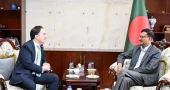
High Commissioner of Pakistan to Bangladesh Syed Ahmed Maroof on Tuesday requested Bangladesh for easing visas for Pakistani nationals to Bangladesh for further advancing the trade and economic relations between the two countries and enhancing people-to-people contact.
He also underscored the need for early resumption of direct flights between Bangladesh and Pakistan by either Bangladeshi or Pakistani airlines.
The envoy paid a courtesy call on the Adviser for Foreign Affairs of the interim government Md Touhid Hossain today at the Ministry of Foreign Affairs and discussed the issues.
Referring to his meeting with Chief Adviser Prof Muhammad Yunus, High Commissioner Maroof assured the full support of the Government of Pakistan in any initiative to reinvigorate the SAARC and expressed hope that Bangladesh and Pakistan will continue to work closely at other multilateral fora.
The High Commissioner expressed hope that the Prime Minister of Pakistan and Chief Adviser would be meeting on the sidelines of the upcoming UNGA in New York, according to the Ministry of Foreign Affairs.
The envoy congratulated the Adviser for Foreign Affairs on his appointment as the Foreign Affairs Adviser.
He referred to the congratulatory messages of the Prime Minister of Pakistan to the Chief Adviser and reaffirmed the commitment of the Government of Pakistan to work with the interim government of Bangladesh for the benefit of the peoples of both countries.
The High Commissioner of Pakistan emphasized the need to strengthen relations between the two countries.
He emphasized the necessity of resuming the activities of the existing bilateral mechanisms like Foreign Secretary-level Consultations and Joint Economic Commission.
The Foreign Affairs Adviser also underscored the significance of strengthening bilateral relations and assured to extend necessary cooperation for further advancing the ties.
He also emphasized the importance of revitalizing SAARC to foster strong regional cooperation for the benefits of the peoples of the region.
1 year ago

Bangladesh eyes people-centric relationship with India: FS
Newly appointed Foreign Secretary Md Jashim Uddin on Tuesday said India is the closest neighbor of Bangladesh and Bangladesh looks forward to taking forward the relationship to a people-centric approach.
The Foreign Secretary underscored the significance of addressing key issues that could act as catalyst for a forward looking relationship, particularly stopping border killings and concluding the Teesta water-sharing agreement.
He also discussed the flood situation in Bangladesh when Indian High Commissioner Pranay Verma met him at the Ministry of Foreign Affairs.
The Indian High Commissioner congratulated the Foreign Secretary on assuming his new responsibilities.
He expressed the willingness of the government of India to work with the interim government of Bangladesh in the coming days.
During the meeting, the Foreign Secretary mentioned that Bangladesh witnessed a second liberation recently through a mass uprising spearheaded by valiant students, joined by the mass people.
He thanked the government of India and the Prime Minister of India for his good wishes extended to Chief Adviser Prof Muhammad Yunus.
He also thanked the External Affairs Minister of India Dr S Jaishankar for his message of felicitation to the Adviser of Foreign Affairs on his assumption of new responsibilities.
On regional cooperation, Foreign Secretary stressed meaningful regional cooperation under SAARC and BIMSTEC.
The Foreign Secretary mentioned that Bangladesh expects cooperation from India on the issue of early repatriation of Rohingyas to their homeland, Myanmar.
1 year ago
Wage board reforms for journalists under consideration: Adviser Nahid
Md. Nahid Islam, Adviser to the Ministry of Posts, Telecommunications, and Information Technology and the Ministry of Information and Broadcasting, has acknowledged dissatisfaction with the current wage board and noted that the low salary structure is causing young people to lose interest in journalism. He said that there are ongoing considerations for reforming the wage board.
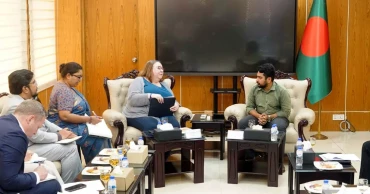
The adviser made these comments during a meeting with the U.S. Embassy Charge d'Affaires Helen LaFave at the Secretariat's Post and Telecommunications Division office today.
He added that if journalists take the initiative for reforms, the government would work towards resolving the issue.
Addressing inquiries from Helen LaFave regarding media freedom, particularly in relation to the Cyber Security Act, Nahid Islam affirmed the government's commitment to ensuring media freedom.
He criticized past governments for undermining media freedom through certain laws, including the Cyber Security Act, and assured that his administration is working on this issue, saying that no law conflicting with international human rights standards would be retained.
He also mentioned plans to collaborate with the Press Institute of Bangladesh (PIB), university journalism departments, and citizen journalists on training programs.
The meeting was attended by Secretary of the Post and Telecommunications Division Dr. Md. Mushfiqur Rahman, Secretary of the Information and Communication Technology Division Md. Shamsul Arefin, U.S. Embassy Political-Economic Counselor Eric Zillan, Economic Officer James Gardiner, Commercial Counselor John Fay, and Public Affairs Officer Stephen Ebeli.
1 year ago
DCAB greets Foreign Affairs Adviser, FS
Members of Diplomatic Correspondents Association, Bangladesh (DCAB) on Tuesday congratulated Foreign Affairs Adviser Md Touhid Hossain and newly appointed Foreign Secretary Md Jashim Uddin on their respective appointments in August and earlier this month.
DCAB President Nurul Islam Hasib and General Secretary Ashiqur Rahman Apu greeted them separately with flower bouquets.
The DCAB President placed a number of proposals on professional grounds including smooth flow of information.
The Foreign Adviser and Foreign Secretary took note of the proposals and assured of looking into those proposals for the better understanding of diplomatic reporters on critical issues.
Former DCAB President Masud Karim, senior members Salam Jubair, Shahidul Islam Chowdhury and Israt Jahan Urmi also spoke on various issues.
Director General (Public Diplomacy) Seheli Sabrin, former DCAB President Raheed Ejaz, Vice President Tanzim Anwar, former General Secretaries and executive committee members were present.
1 year ago
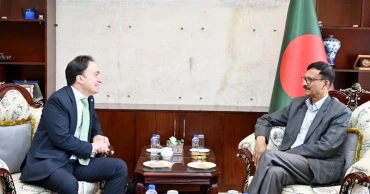
Argentina lauds Dhaka’s singing of int’l convention paving way for more accountable govt
Ambassador of Argentina to Bangladesh Marcelo Cesa on Tuesday applauded Bangladesh for being a signatory of the ‘Instrument of Accession to the International Convention for Protection of All Persons from Enforced Disappearance (ICPPED)’, paving the way for a more accountable government and preventing such inhuman acts by any future regime.
The Ambassador paid a courtesy call on Foreign Affairs Adviser Md Touhid Hossain at his office in the Ministry of Foreign Affairs and discussed issues of mutual interest.
The Adviser recalled Bangladesh's diplomatic presence in Buenos Aires in the 70’s and his own pleasant experience of exploring Argentina.
He conveyed his appreciation for the Argentine Government for opening an Embassy in Dhaka.
Acknowledging the soaring potential of engagement and probable challenges, they both discussed solutions and way forward for cooperation in a gamut of areas including trade, agriculture and agro-processing, industries, capacity building and knowledge sharing, direct shipping, connectivity, energy, sports (football in particular), education, among others.
They also looked into formulating and establishing the policy and regulatory infrastructure that could facilitate the engagement in those areas.
The Ambassador specifically mentioned the collaborative research on prevention of rice plant’s pests between Bangladesh Rice Research Institute (BRRI) with the counterpart Agency in Argentina.
In addition, he mentioned an ongoing framework of cooperation between Bangladesh Cotton Development Board and the Argentine National Institute of Agricultural Technology (INTA).
The Ambassador appraised the recent exploration of energy deposits in Argentina and scope of future cooperation, said the Ministry of Foreign Affairs.
Regarding the recent signing on the Football cooperation between Bangladesh and Argentina, the Adviser opined that Argentina may contribute in skill development of players and coaches of Bangladesh and arranging the visit of Argentine football clubs to Bangladesh.
The Adviser appreciated Argentina’s contribution towards the Rohingya issue in the international forum and requested continuous support in favour of Bangladesh’s position in rehabilitating the Rohingyas to their homeland in Myanmar.
Both sides agreed that bilateral political consultation should be set in motion and initiated at an early date.
1 year ago
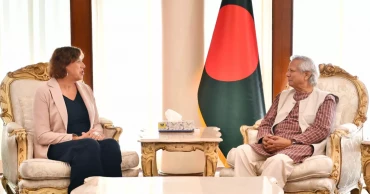
Reform Agenda: Prof Yunus seeks Dutch support
Chief Adviser Prof Muhammad Yunus on Tuesday sought Dutch support for the ambitious reform agenda of the interim government, noting that every institution of the country was destroyed by Sheikh Hasina's autocratic regime.
"We have to reinvent the institutions," he conveyed to Ambassador of the Netherlands to Bangladesh Irma van Dueren when she paid a courtesy call on Bangladesh Chief Adviser at the State Guest House Jamuna in Dhaka.
Prof Yunus said his government is committed to carrying out vital reforms in education, finance, labour sector, election commission, judiciary, civil administration and business environment.
1 year ago
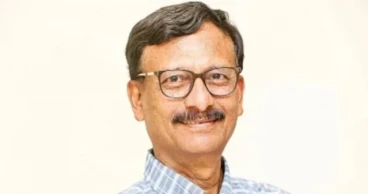
Bangladesh makes its language of protest "stronger" over border killings: Adviser
Foreign Affairs Adviser Md Touhid Hossain on Tuesday said Bangladesh made its language of protests "stronger" regarding recent border killings and clearly condemned such actions.
“We have made our protest language stronger. It is a very sensitive issue what we are telling every moment. We expect India will take it into cognizance,” he told reporters while responding to a question on recent border killings.
Talking to reporters at the Ministry of Foreign Affairs, Adviser Hossain reiterated Bangladesh’s call for stopping border killings and said they need to come out from this in the two countries' interest as it brings no benefit but the relations are impacted very negatively.
“We told them clearly that we condemn this act. This is playing a very negative role in Bangladesh-India relations. I have never heard anyone saying it brings benefit to India,” he said.
Meanwhile, the Ministry of Foreign Affairs registered a protest to the government of India on the killing of a 16-year-old Bangladeshi boy named Jayanta Jambu of Baliadangi upazila of Thakurgaon district, who was shot and killed by Border Security Force (BSF) of India on September 9.
In the protest note sent to the Indian High Commission in Dhaka on Tuesday, Bangladesh expressed grave concern that despite repeated commitments from the Indian authorities to pursue non-lethal strategy and stop killings, such incidents of killing have been continuing.
While the government of Bangladesh denounces these ruthless acts, maintains that any national of either country entering each other’s territory without valid documents may be dealt with in accordance with the laws of the respective country and under no circumstances should they be subjected to torture and death.
The government of Bangladesh called upon the government of India to prevent the recurrence of such ruthless acts, investigate all border-related killings, identify those responsible and bring them to justice.
The government of Bangladesh, earlier, called upon the government of India to stop repetition of such "heinous acts" and conduct enquiries into all border killings, identify the responsible persons and bring them to justice.
The Ministry of Foreign Affairs of Bangladesh lodged a formal protest to the government of India on the killing of a 13-year-old Bangladeshi girl, Shwarna Das of Juri upazila of Moulvibazar district, who was shot and killed by Border Security Force (BSF) of India on September 1.
In the protest note sent to the Indian High Commission in Dhaka today, Bangladesh strongly protested and condemned such ruthless acts and expressed deep concern over the incidents.
The government of Bangladesh reminded that such incidents of border killing are undesirable and unwarranted and such actions are in violation of the provisions of the Joint Indo-Bangladesh Guidelines for Border Authorities, 1975.
Indian High Commissioner to Bangladesh Pranay Verma met newly appointed Foreign Secretary Jashim Uddin at his office on Tuesday and discussed issues of mutual interest.
On Monday, Foreign Affairs Adviser Hossain said border killing is certainly a barrier to building good relations between Bangladesh and India.
He said there is a repercussion across the country when an individual is killed along the border.
“That is a negative repercussion which we do not want," said the Adviser.
Indian Border Security Force (BSF) personnel gunned down another Bangladeshi teen and injured two others including the teen’s father along Baliadangi border in Thakurgaon early Monday, said police.
The victim was identified as Joyanta Kumar Singha, 15, while the injured were Joyanta’s father Mahadev Kumar Singha, and Bangdu Mohammad, of Fakir Bhita village in the upazila.
The injured are undergoing treatment at Rangpur Medical College Hospital, he said, adding that the BSF troops took away the body.
Describing border killings unacceptable, Hossain said border killing took place when it was said the two countries are going through a golden chapter and there has been no change in this trend.
1 year ago
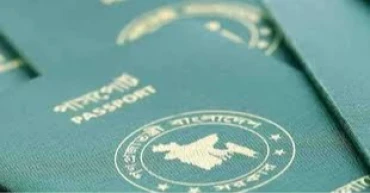
Bangladeshis can now apply for student visa at Romanian embassies in Hanoi and Bangkok
Bangladeshi students selected to study in various universities in Romania can now apply for student visas at the Embassy of Romania in New Delhi, India, as well as the Embassy of Romania in Hanoi, Vietnam and the Embassy of Romania in Bangkok, Thailand.
The relevant wing at the Ministry of Foreign Affairs, Dhaka, confirmed this on Tuesday.
Romania was one of the first European states to recognise newly independent Bangladesh in 1971.
In 2022, the Romanian side organised a three-month temporary consulate in Dhaka in order to facilitate the granting of working visas for the Bangladeshi citizens.
1 year ago
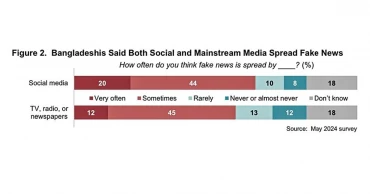
INR survey: Bangladesh faces media credibility crisis amid disinformation surge and digital literacy gaps
An INR survey conducted in May has highlighted a crisis of trust in Bangladesh's media landscape. Following the ouster of former Prime Minister Sheikh Hasina’s government, public confidence in both social and mainstream media has plummeted, exacerbated by rampant disinformation and a complex media environment.
The Bureau of Intelligence and Research (INR) delivers and coordinates timely, objective intelligence that advances US diplomacy. INR is a bureau of the US Department of State.
Widespread Disinformation on Social Media
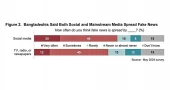
The survey reveals that 64% of Bangladeshis are acutely aware of the proliferation of fake news on social media platforms and messaging apps. The political turbulence following Hasina’s departure on August 5 has provided fertile ground for misinformation.
Some disinformation campaigns, reportedly fueled by sources from neighboring India, risk inflaming religious tensions within Bangladesh, it says. Despite the prevalent domestic disinformation, 46% of respondents suspect foreign influence in spreading fake news, with India frequently cited.
WhatsApp is regarded as somewhat more trustworthy compared to platforms like Facebook and YouTube, as messages often come from known contacts. Conversely, TikTok faces significant skepticism, with 25% of users doubting its reliability.
Mainstream Media Under Scrutiny
The distrust is not confined to social media; mainstream media is also under scrutiny. The survey indicates that 57% of Bangladeshis believe traditional outlets like television, radio, and newspapers disseminate fake news. Although 53% of respondents find their preferred TV channels reliable, 45% remain doubtful, reflecting a broad-based skepticism towards all news sources. This distrust is further fueled by perceptions of intentional misinformation by journalists, with over half of respondents believing that reporters sometimes spread false information.
Struggles with Fake News Verification
The challenge of distinguishing between real and fake news is palpable. Many emerging internet users, including a 37-year-old Dhaka resident who expressed frustration with the difficulty of discerning credible information, have been misled by false reports, such as rumors about factory fires or spikes in commodity prices. This has led to unnecessary panic and financial strain for some consumers. In response, some individuals have scaled back their media consumption, particularly regarding political news, and developed personal strategies like cross-referencing reports or relying on trusted media logos for verification.
Digital Literacy Amidst Growing Internet Use
The rapid growth in internet usage, accelerated by the COVID-19 pandemic, has introduced many Bangladeshis to the online world. According to the survey, 53% of adults now use the internet, with half of them having adopted it in the past five years. However, many new users, particularly women, face challenges with digital literacy. Approximately 40% of internet users are unfamiliar with basic tasks such as using search engines, and few are aware of fact-checking websites, complicating their ability to verify the accuracy of the news.
The combination of growing disinformation, skepticism towards media, and digital literacy challenges presents a formidable obstacle to the interim government’s efforts to stabilize the country and restore public trust in the media.
1 year ago
Majority Whip Durbin expresses support for Dr. Yunus at US Senate
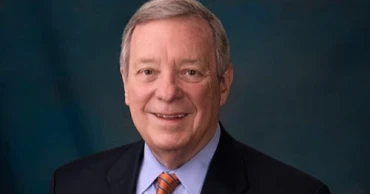
US Senate Majority Whip Dick Durbin (D-IL) on September 9 took to the Senate floor to express his support for Nobel Peace Prize Laureate Dr. Muhammad Yunus, who was recently appointed to lead the Bangladesh interim government following the resignation of former “authoritarian” Prime Minister Sheikh Hasina.
In his remarks, Durbin detailed Dr. Yunus’ life-long work of developing microloan programs that allow low-income families in developing countries make a living.
Durbin began his remarks by recalling his first trip to Bangladesh, when he met Dr. Yunus for the first time.
“During the course of that trip, I was introduced to an economics professor [Dr. Yunus] at the university. He was an interesting character. He had come up with a theory that he thought would help the poorest people on Earth. It was known as microcredit, and he created something called the ‘Grameen Bank,’ the people’s bank,” Durbin began his remarks.
“Basically, what he set out to do was to prove that you could loan a small amount of money to the poorest people on Earth and dramatically change their lives. They would pay it back and start to be more constructive and more profitable in what they were doing... we kept in touch after that visit.”
“I thought that he was extraordinary and that he should be recognized here as well. I led the effort with the late Senator Mike Enzi and Congressman Rush Holt to award the Congressional Gold Medal to this remarkable economics professor, Dr. Muhammad Yunus. He was sometimes known as the ‘Banker to the Poor’ after he received the Nobel Prize. He pioneered microlending as a groundbreaking method of helping some of the world’s poorest people. He recognized that with just a little bit of money in hand, many people could lift themselves out of poverty,” Durbin said.
“Through his Grameen Bank, he [Dr. Yunus] proved that microlending could be done – collateral-free – and that investing in poor women actually paid off. In fact, most of Grameen Bank’s loans have gone to poor women who rise from terrible poverty to become small businesspeople,” Durbin continued.
Durbin then shared a story of meeting a woman in Uganda who received a microloan from Grameen Bank, according to his office.
“I’ve seen the results of that innovative approach all over the world now, including a visit to a ramshackle hut in Uganda where I met three mothers who were working in the local market. I asked them, through an interpreter, how microcredit had changed their lives,” Durbin said. “One woman said, ‘My knees have gone soft.’ I didn’t understand what she meant. I asked her to explain.”
“She said, ‘Before I got my microcredit loan, which gave me a chance to go to the market and make a little money, I used to have to crawl on my knees to beg my husband for money to feed the children. I don’t have to crawl anymore. My knees have gone soft,’” Durbin shared.
Because of the success of many microcredit programs, which have allowed more than 140 million people on five continents to receive microloans, Dr. Yunus was awarded the Nobel Peace Prize in 2006. Yet, Dr. Yunus has endured baseless harassment by the then Bangladeshi government for years, including being saddled with more than 100 unsubstantiated legal charges and threats of six months to life in prison on these faulty claims.
“Quite simply, Dr. Yunus’ ideas changed the world and helped earn him that Nobel Peace Prize. Tragically, his ideas also earned him the wrath of the Bangladeshi Prime Minister, Sheikh Hasina, whose government harassed Dr. Yunus for years with questionable legal charges and threatened jail time,” Durbin said.
In August, Prime Minister Hasina stepped down amid increased political unrest. Days after her resignation, Dr. Yunus was sworn in to lead the interim government until new elections can be held.
“Imagine my surprise last month… Hasina finally resigned as Prime Minister of Bangladesh amid massive public protests, and the students who were leading the protest demanded that the leader of their country be none other than Dr. Muhammad Yunus, the same economics professor I met more than 20 years ago,” Durbin said.
“I called him on the phone when I heard his good fortune. He was upbeat and believes that the people of that country are prepared now to rise to this historic opportunity.”
“I’m going to offer my full support to him today. I believe in him. I did 20 years ago, and I do today. I urge President Biden to support him as well. I know Dr. Yunus has the best interests of the Bangladeshi people at heart and will do his utmost in this challenging time,” Durbin concluded his remarks.
In July, Durbin led three colleagues in releasing a statement denouncing the harassment against Dr. Yunus, calling on the Bangladeshi government to end the mistreatment of Dr. Yunus, and pull down the dubious charges he is facing.
The statement followed a letter sent by Durbin and his colleagues calling on Bangladeshi Prime Minister Sheikh Hasina to end the harassment against Dr. Yunus. Earlier this summer, Durbin further expressed his support for Dr. Yunus is a speech on the Senate floor.
The harassment campaign against Dr. Yunus was denounced by more than 100 Nobel Prize winners, including former US President Obama. Durbin led the effort in the United States Congress to award Dr. Yunus the Congressional Gold Medal in 2010, recognizing his pioneering contributions in the fight against global poverty. The Medal was later presented to Yunus in 2013.
1 year ago