foreign-affairs
French ambassador encourages Bangladeshi students to consider France as higher education destination
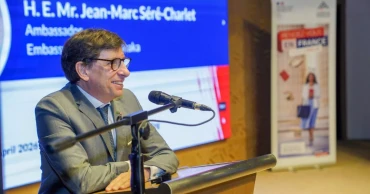
French Ambassador to Bangladesh Jean-Marc Séré-Charlet on Tuesday underscored France’s commitment to strengthening international academic collaboration and encouraged students to consider France as a destination for higher education due to its rich academic environment, cultural diversity, and high-quality education at affordable costs.
He visited the American International University-Bangladesh (AIUB), accompanied by the Embassy’s Cultural Attaché, Baptiste Lebret, and representatives from Campus France Bangladesh.
During the visit, the Ambassador met with the university’s management team, engaged in interactive discussions with students, and toured the university’s scenic campus.
Gandharbpur project expected to transform Dhaka’s water supply: France
1 month ago
FM Khalilur set to meet 3 key Indian Ministers in Delhi Wednesday
Bangladesh on Tuesday expressed optimism that Foreign Minister Dr Khalilur Rahman’s “goodwill visit” to India will lay an important foundation for elevating cooperation between the two countries to a more fruitful and sustainable level in the future.
The Indian Ministry of External Affairs, however, described Dr Khalilur’s trip as an “official” visit and outlined his engagements in New Delhi in detail.
“It is hoped that this visit will lay an important foundation for elevating cooperation between Bangladesh and India to a more fruitful and sustainable level in the future,” Spokesperson of the Ministry of Foreign Affairs SM Mahbubul Alam told reporters at the ministry.
FM’s India Visit: Dhaka to push key bilateral concerns in talks with Delhi
Describing it as a “goodwill visit” to India, he said the Foreign Minister left for New Delhi in the afternoon en route to Mauritius to participate in the Indian Ocean Conference, scheduled to be held from April 10 to 12.
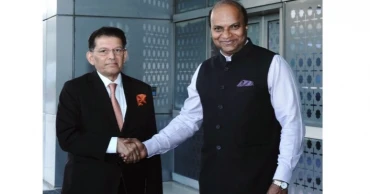
The Foreign Minister arrived in New Delhi on Tuesday is scheduled to hold meetings with Indian External Affairs Minister (EAM) Dr S Jaishankar, National Security Adviser Ajit Doval, and Petroleum, Natural Gas Minister Hardeep Singh Puri and Commerce & Industry Minister Piyush Goyal during the “stopover” in New Delhi.
In these meetings, the MoFA spokesperson said Bangladesh will emphasise stability and the continued development of bilateral relations based on dignity, mutual trust and respect, and shared interests.
India warmly welcomed Foreign Minister Dr Khalilur on his arrival in New Delhi.
"India and Bangladesh share warm and historic ties anchored in strong people to people relations. The visit will further bolster India Bangladesh partnership," said Indian External Affairs Ministry Spokesperson Randhir Jaiswal.
From New Delhi, Foreign Minister Khalilur is likely to fly to Mauritius on the same flight on Thursday morning as his Indian counterpart, Jaishankar, to attend the 9th Indian Ocean Conference.
1 month ago
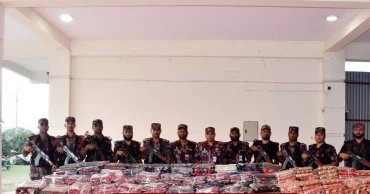
Indian sarees worth over Tk 1.69 crore seized in B'baria
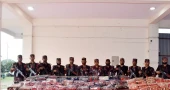
Border Guard Bangladesh (BGB) has seized a pickup truck carrying 1,161 high-quality Indian sarees worth over Tk 1.69 crore during a special anti-smuggling operation in Bijoynagar Upazila, Brahmanbaria.
The operation was conducted on Monday by a patrol team from the Brahmanbaria Transit Camp under the Sarail Battalion (25 BGB) in the Mukundapur area.
Smugglers attempted to flee upon detecting the BGB presence, but the team successfully chased and intercepted them in the Laxmi Bazar area.
The estimated market value of the seized sarees is Tk 1,69,32,000. The items are currently being deposited at the Akhaura Customs Office.
Sarail Battalion Commander Lt. Col. Jabbar Ahmed said BGB will continue to be a symbol of border security and trust.
He said BGB has strengthened intelligence, surveillance, and operational activities to secure the border under Akhaura and Bijoynagar upazilas of Brahmanbaria and Madhabpur upazila of Habiganj and to prevent smuggling.
"We are confident this trend will continue in the future.”
1 month ago
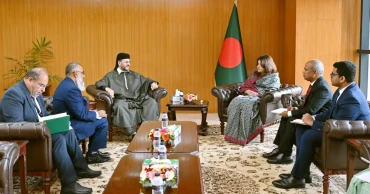
Libyan ambassador reaffirms support for Bangladeshi expatriates in Libya
Ambassador of Libya to Bangladesh Abdulmutalib S. M. Suliman on Monday reaffirmed Libya’s continued support for Bangladesh and its expatriates in Libya, expressing strong commitment to further strengthening the brotherly relations between the two countries.
He paid a courtesy call on State Minister for Foreign Affairs Shama Obaed Islam at the Ministry of Foreign Affairs and discussed issues of mutual interest.
The meeting reaffirmed the longstanding friendship and growing bilateral relations between Bangladesh and Libya.
The State Minister appreciated the Government of Libya for hosting a significant number of Bangladeshi workers and professionals and welcomed its recent initiative to recruit medical personnel from Bangladesh.
She also thanked the Libyan authorities for ensuring the safety and security of Bangladeshi expatriates and for their support in repatriating stranded nationals.
Both sides discussed ways to enhance cooperation in trade and investment, particularly in the energy, infrastructure, pharmaceutical, and manpower sectors.
The State Minister proposed the formation of a Bangladesh–Libya Joint Business Forum to further boost bilateral trade and economic engagement.
Ambassador Suliman reiterated Libya’s commitment to strengthening cooperation in all sectors, including the recruitment of skilled and semi-skilled manpower and collaboration in the energy sector.
He assured continued support for Bangladesh and its expatriates in Libya.
The State Minister emphasized the importance of increasing people-to-people contact, including cultural and sports exchanges, and underscored the need for regular bilateral engagements and high-level visits to further deepen the partnership.
1 month ago
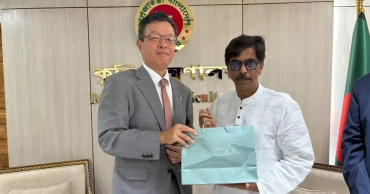
Bangladesh, Japan agree to boost cooperation in agriculture, fisheries, livestock
Bangladesh and Japan on Monday expressed interest in promoting cooperation in agriculture, fisheries and livestock sectors, and concurred to work together to further strengthen the bilateral relations.
Japanese Ambassador to Bangladesh Saida Shinichi paid a courtesy call on Mohammad Amin Ur Rashid, Minister for Agriculture, Fisheries and Livestock and discussed the issues.
The Ambassador explained Japan’s ongoing cooperation in the field of agriculture, fisheries and livestock, and both sides engaged in discussions on a wide range of issues including recent efforts by the Japanese private sector as well as the ongoing ODA projects.
1 month ago
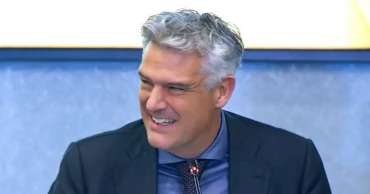
Dutch Ambassador to visit Chattogram today to advance water, urban resilience partnerships
Ambassador of the Kingdom of the Netherlands to Bangladesh Joris van Bommel will visit Chattogram on Tuesday as part of ongoing efforts to strengthen bilateral cooperation in circular water and waste management solutions for sustainable economic development.
The Netherlands, globally recognised for its expertise in water management and climate adaptation, remains committed to working closely with Bangladesh to co-create practical, scalable solutions tailored to local needs.
This visit underscores the Netherlands’ commitment to support Bangladesh in addressing critical urban challenges, particularly in waterlogging, drainage, solid waste and waste water management, which continue to affect the livability and economic vitality of Chattogram, said the Dutch Embassy in Dhaka.
During the visit, Ambassador van Bommel will engage with key government stakeholders, including representatives from the Chattogram City Corporation (CCC), Chattogram Water Supply and Sewerage Authority (CWASA), and the Chattogram Development Authority (CDA), as well as senior officials, development partners, and private sector leaders.
The Ambassador’s programme will include site visits to important urban infrastructure locations such as the Halishahar landfill, existing sewage treatment facilities, and selected drainage and canal systems.
These visits aim to gain firsthand insights into the challenges and opportunities for integrated water and waste management solutions.
The visit builds on the Embassy’s support for the Pre-Feasibility Studies on Chattogram Solid Waste and Drainage Management and Circular approaches in Waste Water Management, implemented by Dutch-Bangladeshi consortia.
It underscores the Embassy’s ambition to attract Foreign Direct Investments to Bangladesh through Public-Private Partnership (PPP) projects that can contribute to long-term, sustainable urban transformation.
In the evening, a high-level networking dinner will be hosted in honour of the Ambassador, bringing together distinguished representatives from government, business, civil society, and development organizations.
The event will serve as a platform to deepen dialogue, foster collaboration, and explore innovative Bangladeshi-Dutch partnerships in urban infrastructure and circular economy solutions.
1 month ago
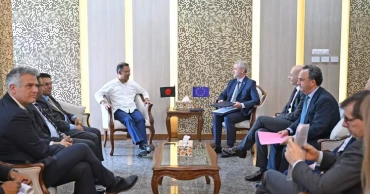
PCA to be ‘initialled’ during FM’s visit to Brussels April 20
The European Union (EU) on Monday said they look forward to the new Bangladesh-EU Partnership and Cooperation Agreement (PCA) which will be ‘initialed’ during the visit of Foreign Minister Dr Khalilur Rahman to Brussels on April 20, enhancing cooperation across the board.
The EU expressed support for priority reforms, economic modernisation and managed migration, stressing the importance of a level playing field to promote investment.
“Shared values underpin the EU’s partnerships around the world,” said the EU Embassy in Dhaka after Ambassador of the EU Delegation to Bangladesh Michael Miller with Ambassadors of EU Member States resident in Dhaka (France, Germany, Italy, the Netherlands, Spain, along with the Chargés d’Affaires of Denmark and Sweden) paid a courtesy call on Prime Minister Tarique Rahman at his office.
US envoy meets PM Tarique Rahman
During the meeting, the Heads of Mission of Denmark, France, Germany, Italy, the Netherlands, Spain, Sweden and the EU passed a ‘message of readiness’ to intensify relations with the new government.
They congratulated the Prime Minister on his landslide victory in the recent general election and expressed strong support to the government.
Both sides reaffirmed their strong commitment to further strengthening the longstanding and mutually beneficial Bangladesh-EU partnership, said the Ministry of Foreign Affairs.
They expressed satisfaction with the steady progress of bilateral relations, noting that the partnership has evolved into a comprehensive and multifaceted engagement encompassing all sectors of mutual interest.
The PCA aims to provide a “comprehensive and robust framework” for Bangladesh-EU relations with a view to enhancing cooperation in multifarious sectors while guiding the future interactions in the face of new global realities and emerging challenges.
The PCA will give Bangladesh-EU relations a new legal foundation, which is more comprehensive and up-to-date and will respond better to current and evolving challenges, according to the EU.
Secretary at the Ministry of Foreign Affairs Dr Md Nazrul Islam will accompany the Foreign Minister during visit to Brussels, the capital of Belgium.
1 month ago
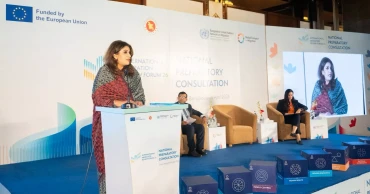
Migration must be governed upholding dignity, rights: Shama Obaed
State Minister for Foreign Affairs Shama Obaed Islam on Monday said their shared objective remains clear to ensure that migration is governed in a manner that upholds the dignity, protection, and rights of people on the move, while maximizing mutual benefits for countries of origin, transit, and destination alike.
Speaking at a national preparatory consultation ahead of the International Migration Review Forum (IMRF) 2026, she said the consultation provides a valuable opportunity to reflect collectively on the progress achieved and the challenges that remain in implementing the Global Compact in Bangladesh.
Shama Obaed credits govt for stable fuel prices amid global hike
The International Migration Review Forum (IMRF) 2026 will be held at the United Nations Headquarters in New York from May 4 to 8.
“I hope that our discussions today will offer thoughtful insights and practical recommendations to further strengthen our policies and institutional frameworks,” said the State Minister.
Speakers at the national consultation emphasised on the importance of inclusive dialogues in shaping effective migration policies and the need for continued collaboration and innovation in addressing migration challenges.
They reaffirmed Bangladesh’s commitment to advancing safe, orderly, and regular migration through strengthened partnerships and policy coherence.
The government of Bangladesh, in collaboration with International Organization for Migration (IOM) as the Coordinator and Secretariat of the Bangladesh United Nations Network on Migration (BDUNNM) and with the support from the European Union (EU), convened the national preparatory consultation.
The event brought together representatives from government ministries and departments, United Nations agencies, civil society, development partners, academia, and the private sector.
The event, co-chaired by the Bangladesh Migration Compact Taskforce, aimed to assess Bangladesh’s progress in implementing the Global Compact for Safe, Orderly and Regular Migration (GCM) and to identify key priorities for the years ahead.
Adopted in 2018, the GCM provides a comprehensive framework for international cooperation on migration. The IMRF serves as the global platform to review its implementation.
Bangladesh has demonstrated strong commitment to the GCM through sustained policy engagement and multi-stakeholder collaboration.
The recent soft adaptation of the National Action Plan for GCM (2026–2030) marks a significant milestone in aligning national migration governance with global commitments, IOM said.
Progress has been notable in areas such as labour migration, migrant protection, reintegration and addressing the diverse drivers of migration.
State Minister of the Ministry of Expatriates’ Welfare and Overseas Employment Md Nurul Hoque said the consultation brings together government institutions, civil society, and development partners to take stock of our progress and identify priorities moving forward.
“Through inclusive dialogue and coordinated action, we aim to ensure that migration continues to contribute to the well-being of our migrant workers and the sustainable development of our nation,” he said.
Asad Alam Siam, Secretary of the Ministry of Foreign Affairs; Md Mokhtar Ahmed, Secretary of the Ministry of Expatriates’ Welfare and Overseas Employment; Giuseppe Loprete, Chief of Mission a.i. of IOM Bangladesh and Coordinator of BDUNNM; Jurate Smalskyte Merville, Counsellor, Team Leader of the Human Capital Development Team of EU; Giuseppe Di Giovanni, Migration Expert of the Embassy of Italy in Bangladesh; and Syed Saiful Haque, Chairman of WARBE DF; spoke among others.
The consultation featured thematic breakout sessions focusing on ensuring safe and regular migration pathways; strengthening rights-based border governance; enhancing migrant protection and integration; and promoting evidence-based policymaking and public discourse.
These sessions provided a platform for participants to share good practices, lessons learned, and emerging priorities.
Key recommendations from the discussions will inform Bangladesh’s national position and contributions at IMRF 2026.
1 month ago
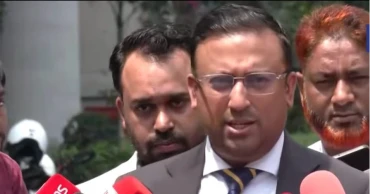
Dhaka wants to develop new relationship with India: Humaiun Kobir
Emphasising the need to strengthen people-to-people ties with India beyond one-person driven engagement, Bangladesh Prime Minister’s Foreign Affairs Adviser Humaiun Kobir on Monday said Bangladesh wants to develop a new relationship with India, ending Hasina-era type relations with the neighboring country.
“It’s a new relationship between Bangladesh and India. There is nothing like Hasina’s Awami League in Bangladesh now. Hasina is non-existent. She died politically long days ago,” he told reporters after a meeting between Prime Minister Tarique Rahman and Indian High Commissioner to Bangladesh Pranay Verma.
The meeting comes ahead of Foreign Minister Dr. Khalilur Rahman’s scheduled visit to New Delhi starting Tuesday.
During the trip, he is expected to meet Indian External Affairs Minister Dr. S. Jaishankar, and hold talks with National Security Adviser Ajit Doval and Petroleum and Natural Gas Minister Hardeep Singh Puri.
Adviser Kobir said that sustained openness and candid dialogue between the two sides could help address several longstanding challenges.
At the meeting with PM Tarique, Indian High Commissioner Pranay Verma reaffirmed India’s intent to work together with the Government and the people of Bangladesh in a ‘positive, constructive and forward-looking manner’ based on mutual interest and mutual benefit.
They discussed bilateral engagement with focus on people-centric cooperation in multiple domains aligned with the national development priorities of the two countries, said the High Commission after the meeting.
The discussions focused on enhancing cooperation in a wide range of areas including public health, financial inclusion, women‘s empowerment, rural development, bilateral trade and investment, ease of doing business, technology partnerships, and power and energy cooperation.
The High Commissioner underlined that India-Bangladesh cooperation should transform their geographical proximity into new opportunities by strengthening economic and connectivity linkages, and by enhancing cultural and people-to-people exchanges.
The Foreign Minister is scheduled to depart for New Delhi on Tuesday afternoon, before continuing on to Mauritius. Prime Minister’s Foreign Affairs Adviser Humaiun Kabir will accompany him during the New Delhi leg of the visit.
1 month ago
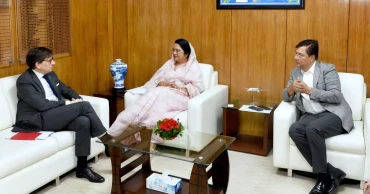
French envoy stresses fair business climate to attract EU firms to Bangladesh
French Ambassador to Bangladesh Jean-Marc Séré-Charlet on Monday highlighted the importance of ensuring a fair and level playing field to encourage greater engagement of European companies in Bangladesh.
France looks forward to working closely with the new government to deepen cooperation and advance new opportunities in trade, investment, and aviation.
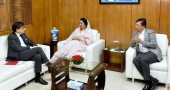
The French Ambassador paid a courtesy call on Civil Aviation and Tourism Minister Afroza Khanam Rita at Secretariat and discussed the issues of mutual interest.
State Minister for Civil Aviation and Tourism M. Rashiduzzaman Millat was also present at the meeting.
The meeting focused on the strong bilateral relations in the civil aviation sector and on exploring opportunities to develop existing links.
Noting France’s role as a key development partner and export destination for Bangladesh, the Ambassador highlighted the strong collaboration between Thales and CAAB, especially at Hazrat Shahjalal International Airport in Dhaka.
He underlined the successful operational transition of the nationwide Air Traffic Management System, said the French Embassy after the meeting.
He also emphasised the commitment of the European company Airbus to supporting the development of Bangladesh’s aviation industry.
Bangladesh’s strategic location between South Asia and Southeast Asia offers significant potential for the country to emerge as a regional aviation hub, the French envoy said.
The Ambassador said the partnership with Airbus would not only strengthen fleet capacity but also enhance the overall aviation ecosystem of Bangladesh.
It would also demonstrate concretely the desire of Bangladesh to engage in a long-term partnership with the EU in the field of civil aviation.
1 month ago