foreign-affairs
Bangladesh intensifies energy diplomacy with US, Russia amid diversification push
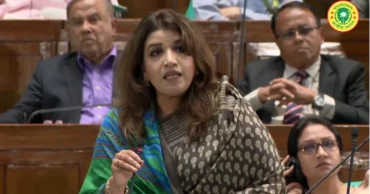
Reaffirming the government’s commitment to diversifying energy sources, State Minister for Foreign Affairs Shama Obaed Islam on Tuesday said the Energy Ministry is currently in discussions with both the United States and Russia to address the country’s energy challenges.
She said the existing sanctions on Russia require procedural handling, including engagement with the United States.
Relevant ministries are actively working to resolve these complexities through diplomatic channels.
“Every effort is being made under the leadership of the Prime Minister, Tarique Rahman, with a focus on safeguarding the economy and public interest,” she told reporters at the Ministry of Foreign Affairs.
Responding to queries, the State Minister acknowledged that US approval becomes a natural consideration due to sanctions on Russia.
Highlighting broader diversification efforts, she said Bangladesh is exploring energy sourcing options from multiple countries, including the United States, Russia, India, Indonesia, and Malaysia, to strengthen reserves.
She emphasised that there is currently no energy crisis, though some groups are attempting to create an artificial sense of shortage.
She said new energy supplies may arrive in April from countries such as Saudi Arabia, India, Malaysia, and Indonesia.
“To diversify energy sources, we will take all necessary steps,” she added.
Meanwhile, Power, Energy and Mineral Resources Minister Iqbal Hasan Mahmud Tuku informed parliament on Monday that fuel hoarding, not supply shortages, has emerged as the primary concern.
“Let me state clearly—there is no fuel shortage in Bangladesh at this moment. In fact, supply has increased compared to last year,” he said, noting that fuel supply in March 2026 was maintained at 10–25 percent higher than in March 2025.
Delivering a statement under Rule 300, he added that diesel stocks rose from 206,000 tonnes on February 17 to 218,000 tonnes by March 30, despite sales of approximately 482,000 tonnes over the past 41 days.
On a separate issue, Shama Obaed stressed the need for coordinated international action against human trafficking, urging all concerned countries to take a united stance.
“People will continue going to countries like Libya, but the real issue is that dishonest individuals are exploiting lives for financial gain. We must bring them to justice first,” she said.
Earlier, she also called for strict measures to eliminate human trafficking, stating that those involved must face exemplary punishment under both domestic and international laws.
“The long-term solution lies in preventing human trafficking altogether. It cannot be tolerated under any standard of civilisation,” she added.
2 months ago
Govt accords highest priority to repatriation of Rohingyas to Myanmar: Shama Obaed
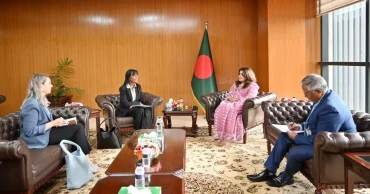
Recalling the visit of the UN Secretary General in 2025, State Minister for Foreign Affairs Shama Obaed Islam on Tuesday reiterated that the new government accords the highest priority to the repatriation of forcibly displaced Rohingyas to Myanmar.
She emphasised keeping spotlight on this issue through a multi-stakeholder approach and sought continued cooperation in securing funding to sustain essential humanitarian assistance.
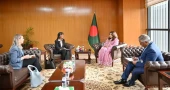
The issues came up for discussion when newly appointed UN Resident Coordinator (UNRC) ad interim in Bangladesh Carol Flore-Smereczniak met the State Minister at the Ministry of Foreign Affairs.
The State Minister expressed her appreciation for the work of the UN Country Office and various UN agencies in Bangladesh, including the democratic process in Bangladesh.
Shama Obaed shared her own experience working with the UN entities.
She recalled the letter from the UN Secretary General to Prime Minister Tarique Rahman, MP, following the election victory.
The State Minister also underscored the importance of continued UN support in advancing the vision of the new government.
Flore-Smereczniak reaffirmed the UN’s steadfast commitment to Bangladesh and its readiness to further deepen its partnership with the Government.
She underlined that the UN will continue to advance its efforts in key areas such as women’s empowerment, gender equality and inclusive development.
The State Minister assured her of extending full support and working closely with the UN to achieve these shared priorities.
Earlier in the day, the UNRC ad interim held a meeting with Foreign Secretary Asad Alam Siam at the latter’s office.
2 months ago
IGP seeks Ireland's support in strengthening capacity of police
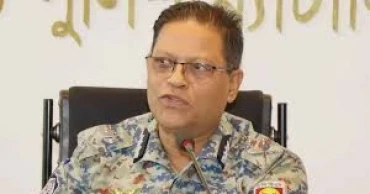
Inspector General of Police (IGP) Md Ali Hossain Fakir on Tuesday sought support from Ireland in strengthening the capacity of the police force.
The IGP said this during a meeting with Irish Ambassador to Bangladesh Kevin Kelly at Police Headquarters on Tuesday.
The Irish Ambassador expressed interest in enhancing cooperation between the police forces of the two countries. He also exchanged views with the IGP on police reform in Bangladesh and other issues of mutual interest.
Justice will follow for all pre- and post-August 5 police fatalities: IGP
The IGP said the Irish Ambassador on the reform programmes and various activities of Bangladesh Police.
Senior police officials were present at the meeting.
2 months ago
UNGA Presidency: Bangladesh seeks Ireland’s support
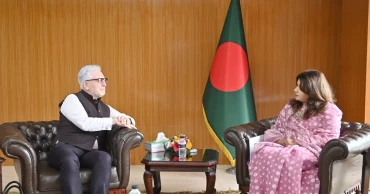
State Minister for Foreign Affairs Shama Obaed Islam on Tuesday sought Ireland’s support for Bangladesh’s candidacy for the Presidency of the 81st United Nations General Assembly (2026–27).
The two sides also exchanged views on regional and global issues, underscoring the importance of peace, stability, and enhanced international cooperation.
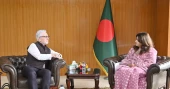
The issues were discussed when Ambassador of Ireland to Bangladesh (resident in New Delhi) Kevin Kelly paid a courtesy call on the State Minister at the Ministry of Foreign Affairs.
He warmly congratulated the State Minister on her assumption of office and expressed confidence in further strengthening Bangladesh-Ireland relations under the present government.
Both sides reaffirmed their commitment to advancing the mutually beneficial partnership, exploring avenues for cooperation in trade and commerce, development partnership, education, sports and culture, as well as consular and migration matters.
They also discussed strengthening collaboration in both bilateral and multilateral settings, said the Ministry of Foreign Affairs.
2 months ago
Bangladesh, Russia discuss military, technical cooperation
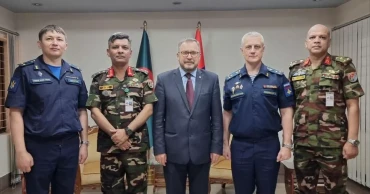
Russian Ambassador Alexander Khozin and Military, Air and Naval Attaché Colonel Pavel Ivashinnikov on Tuesday held talks with Lieutenant General Mir Mushfiqur Rahman, Principal Staff Officer of Bangladesh’s Armed Forces Division, on enhancing military and technical cooperation.
The discussions covered current and potential areas of collaboration and explored ways to expand the legal framework governing bilateral military cooperation, said the Russian Embassy in Dhaka.
2 months ago
US announces $235,000 grant to restore historic Musa Khan Mosque at DU
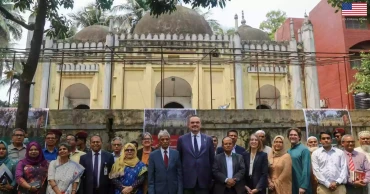
The United States has announced a $235,000 grant to support the restoration of Mughal-era Musa Khan Mosque at Dhaka University.
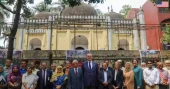
U.S. Ambassador Brent T. Christensen announced the grant under the Ambassadors Fund for Cultural Preservation (AFCP) at a programme at Dhaka University on Tuesday, according to the U.S. Embassy in Dhaka.
With this latest funding, the United States has contributed over $1 million to 13 cultural preservation projects in Bangladesh over the past 25 years, reflecting a longstanding partnership between the two countries.
Obaidul Islam appointed Dhaka University VC, Mamun Ahmed named UGC chairman
In partnership with Bangladesh’s Department of Archaeology, the US will restore the mosque’s Islamic architectural features, establish a permanent digital archive, and train young architects to preserve Bangladesh’s cultural heritage.
2 months ago

Japan lauds govt’s ‘well-conceived’ plan, says it will ‘positively affect’ investors' minds
Japanese Ambassador to Bangladesh Saida Shinichi on Monday appreciated the new government’s ‘well-conceived plan’ which, in his interpretation, consists of a reconciliation to break the old time cycle, restoration of law and order, and economic growth through enhanced investment.
“All these will positively affect investors' minds and the prerequisite of accelerating economic growth through more FDIs,” he said, reiterating Japan’s ‘true appreciation’ for the peaceful elections which Bangladesh has achieved February this year and new administration's well-conceived plan.
The Ambassador made the remarks while speaking at a commemorative event for Economic Partnership Agreement (EPA) with Bangladesh.
Prime Minister’s Adviser Rashed Al Mahmud Titumir, Head of the Economic Section at the Embassy of Japan in Bangladesh Yutaro Mochida, Deputy Director-General (Ambassador), the Ministry of Foreign Affairs of Japan Izuru Kobayashi (online message) also spoke at the opening session of the event.
Executive Chairman of the Bangladesh Investment Development Authority (BIDA) Ashik Chowdhury, among others, spoke at the second session of the event.
The event was hosted by the Embassy of Japan in Bangladesh and Japan External Trade Organization Dhaka Office (JETRO Dhaka) while it was supported by Japanese Commerce and Industry Association in Dhaka (JCIAD/Shoo-Koo-Kai) and Japan Bangladesh Chamber of Commerce & Industry (JBCCI).
The Ambassador said Bangladesh and Japan have shared a long-standing friendship (0:25) since your independence. “As your faithful and dedicated development partner, Japan has consistently supported Bangladesh as a nation irrespective of its ruling party.”
He said this cooperation has evolved into today's strategic partnership founded on trust and shared values.
The Ambassador recalled that before signing the EPA, some critics were seen in the Bangladesh press. “I thought in my mind at the time that they might be looking at as long as three years, maybe a little bit short cycle.”
As was the case in our EPAs with leading ASEAN countries, he said EPAs should be concluded with a decade-long perspective - 30, 50, 70 years. “You see, most of our partners of ASEAN have jumped into a robust economic growth trajectory.”
The envoy said Bangladesh is now standing at the doorstep of the safe path. Other criticism at the time was that Japanese commitments were not concessional enough.
“As a previous negotiator with India, I can assure you this is by far the most concessionary EPA Japan has ever signed,” he claimed.
More importantly, the envoy said, it is not only about each timeframe and it is about legal assurance for businessmen, traders, farmers, manufacturers, and most significantly, investors, given that it perfectly matches new administration and BNP's manifesto focusing on enhanced growth through more ideas.
“Another significant point I should raise - I want to raise here - is that we could send a clear message to the world that we both uphold free trade,” he said.
Considering the international trade circumstances, the EPA signing at this time does mean a lot, said the Japanese envoy.
Looking back at their negotiation history, he said they faced boosted, powerful, and tough Bangladeshi negotiators in front of them.
Japanese Ambassador Saida Shinichi meets Foreign Adviser Touhid
“We are even sometimes pushed into a corner. Bangladeshi tough negotiators got even confident enough to name the European Union as the next target. I just crossed my fingers to them,” the envoy said.
The Ambassador said there is a key for Asia's development path and hoped that together they will inspire new ideas, foster new collaborations, and create new success stories between the two nations.
2 months ago
PM Tarique writes to Qatari Amir expressing solidarity
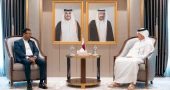
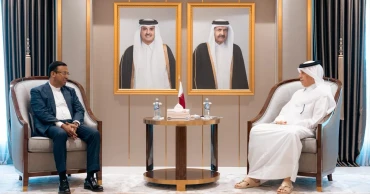
Prime Minister Tarique Rahman, in a letter addressed to Amir of the State of Qatar Sheikh Tamim bin Hamad Al Thani, has conveyed Bangladesh’s solidarity with the leadership, government and brotherly people of Qatar in the context of the current regional situation.
Foreign Affairs Adviser to the Prime Minister Humaiun Kobir met Minister of State for Foreign Affairs Sultan bin Saad Al Muraikhi and handed over the personal letter from the Prime Minister of Bangladesh.
The Foreign Adviser arrived in Qatar’s capital Doha on Sunday as the Special Envoy of Prime Minister and is expected to visit few other Gulf countries after Qatar, said the Ministry of Foreign Affairs on Monday.
President, PM pay last respect to Speaker’s wife Dilara Hafiz
In the letter, the Prime Minister expressed appreciation for Qatar’s continued hosting of approximately 450,000 Bangladeshi expatriates and for the measures taken by the Qatari authorities to ensure their safety and well-being.
2 months ago
Japanese FM shows strong interest in boosting cooperation with Bangladesh
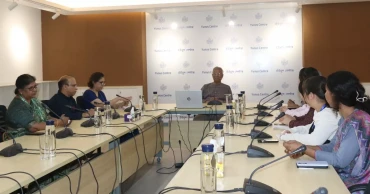
Former Chief Adviser to the interim government and Nobel Peace Laureate Prof Muhammad Yunus has returned to Dhaka after a six-day visit to Japan.
He returned to his office at the Yunus Centre in Mirpur on Monday.
During the visit, Japanese Finance Minister Satsuki Katayama joined Prof Yunus for dinner and expressed ‘strong interest’ in strengthening cooperation between the two countries.
He participated as a “Sage” at the Harmony by Design: Asia Dialogue in Tokyo, organised by the Sasakawa Peace Foundation, alongside regional leaders including former Thai Prime Minister Chuan Leekpai.
Prof Yunus also met former First Lady Akie Abe and engaged with senior members of the Foundation, said the Yunus Center on Monday.
He delivered a keynote at the Next-Generation Asia Peacebuilding Forum, encouraging youth to link economic opportunity with peace through social business. He also joined discussions with Japanese recruiters on expanding opportunities for Bangladeshi workers under a zero-cost migration model.
On March 26, Professor Yunus met leaders from Japan’s creative industries to explore collaboration in animation, digital education, and skills development.
He also attended a roundtable on ethical migration under the GEMS-Net initiative, focusing on building a transparent and responsible migration system.
At the United Nations University, he interacted with young children in a lively session on social business and participated in the Yunus Global Forum 2026, where he delivered a keynote on building a “Three Zero World”—zero poverty, zero unemployment, and zero net carbon emissions.
On March 27, Prof Yunus visited Sakai, Ibaraki Prefecture—an innovation-driven city near Tokyo. Prof Yunus was welcomed by Mayor Masahiro Hashimoto, who is leading efforts to transform the city into a model “3ZERO Smart City” inspired by the vision of zero poverty, zero unemployment, and zero net carbon emissions.
Prof Yunus interacted with students at a local elementary school, where he planted a cherry tree symbolizing future generations.
He also discussed initiatives such as social business funds and “3ZERO Clubs” to promote community innovation.
The visit included a stop at Bando Taro Co., Ltd., where he observed a business model integrating social impact and planted peach trees as a symbol of sustainability and long-term vision.
Prof Yunus also joined a seminar on “Investment in the Future of Bangladesh” at the Embassy of Bangladesh in Tokyo on March 27, organized by the Japan External Trade Organization (JETRO) and co-hosted by Ambassador Md. Daud Ali.
The event brought together around 100 participants, including business leaders and members of the Japan-Bangladesh Committee for Commercial and Economic Cooperation.
In his keynote, Prof Yunus highlighted the potential of Bangladesh’s young workforce, encouraged Japanese investment, and underscored the significance of the Economic Partnership Agreement as a milestone for expanding trade and establishing production hubs for both domestic and global markets.
The delegation also included Md. Ashraful Hassan, Managing Director and CEO of Grameen Telecom Trust; Lamiya Morshed, Executive Director of the Yunus Centre and Shazeeb M Khairul Islam, founder of YY Ventures.
2 months ago

Govt focuses on economic diplomacy to boost investors' confidence
State Minister for Foreign Affairs Shama Obaed Islam on Monday claimed the government has undertaken a series of coordinated initiatives to restore the confidence of international investors and expand Bangladesh’s export markets through strengthened economic diplomacy and investment-friendly reforms.
“The government remains committed to accelerating economic growth through sustainable and diversified development, alongside enhanced engagement with global partners,” she said, in absence of the Foreign Minister, while replying to a question from ruling party lawmaker AE Sultan Mahmud Babu in the Parliament.
The state minister said the Ministry of Foreign Affairs Bangladesh is working in line with the government’s electoral commitments to expand export markets, attract foreign investment and strengthen diplomatic relations while safeguarding national interests.
She noted that, in addition to traditional markets in Europe and North America, Bangladesh is actively exploring new opportunities in the Middle East, Africa, South America, Southeast Asia and Eastern Europe.
Shama Obaed said discussions are underway with several countries to sign bilateral trade agreements, Preferential Trade Agreements (PTAs) and Free Trade Agreements (FTAs), which are expected to boost exports and strengthen bilateral ties. She emphasised that such agreements are being pursued under the “Bangladesh First” principle.
Highlighting export diversification, she said the government is working to reduce dependence on the ready-made garments sector by promoting a wider range of products in global markets. Diplomatic missions abroad are organising trade exhibitions and participating in international fairs in coordination with the Ministry of Commerce and the Export Promotion Bureau.
She also mentioned initiatives to promote local products through international online marketplaces and said a national single-window system has been introduced to streamline import-export procedures.
To improve the investment climate, the government has launched the BanglaBIZ portal, offering one-stop digital services for investors, alongside tax incentives, enhanced facilities for capital and profit repatriation, and identification of priority sectors.
Six key investment agencies, including Bangladesh Investment Development Authority, Bangladesh Economic Zones Authority and Bangladesh Export Processing Zones Authority, have been brought under a coordinated platform, while 32 reform initiatives are being implemented to address investor concerns.
The BIDA website has also been redesigned with sector-specific information, incentives, focal contacts and research-based reports to improve investor communication, she added.
Bangladeshi missions abroad are working to simplify visa procedures, facilitate business delegations, improve consular services and enhance coordination on port and customs-related matters.
The state minister expressed hope that these measures would help rebuild investor confidence and attract greater foreign direct investment.
She said the government plans to organise country-specific investment roadshows, sourcing meetings, B2B matchmaking programmes and Bangladesh Investment Seminars in coordination with relevant agencies.
Shama Obaed also highlighted increased diaspora engagement programmes to encourage expatriate Bangladeshis to contribute to economic development through investment, remittances and technology transfer.
She added that export expansion and economic diplomacy are ongoing efforts, with the government continuing to work closely with relevant stakeholders to strengthen Bangladesh’s position as a reliable investment destination.
2 months ago