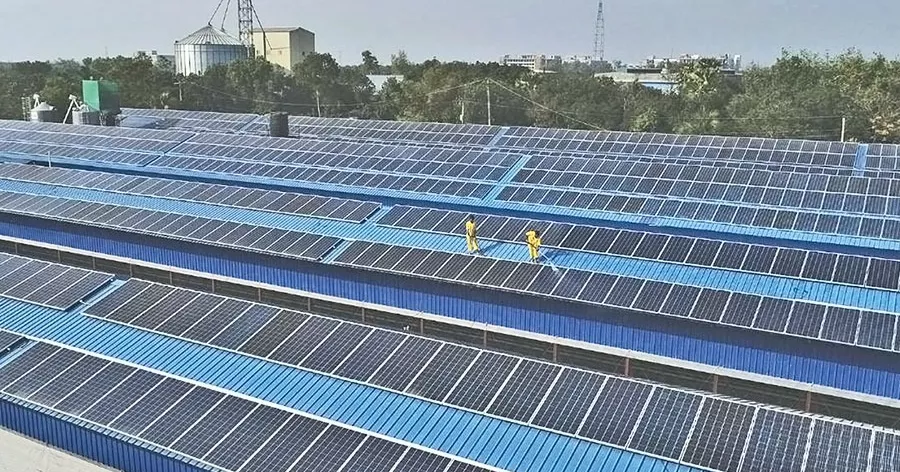
In a major push toward clean energy, the government has taken up a plan to ramp up renewable power generation and reduce reliance on coal and fuel-based electricity that contributes to environmental degradation.
The project titled “Construction of Sonagazi 220 MW Solar Power Plant,” will be implemented by the Electricity Generation Company of Bangladesh Ltd (EGCB) under the Power Division.
Once completed, it will stand as one of the largest utility-scale solar installations in the country.
A Major Step Toward a Greener Power Mix
The proposed plant will be set up in Sonagazi upazila of Feni district, marking a substantial stride in Bangladesh’s efforts to diversify energy sources and align with long-term climate and clean energy commitments.
According to the project proposal, the solar plant will require an estimated investment of Tk 1,888.10 crore.
Read more: BRAC Bank, IDCOL fund 64.55 MW solar project
Of this, Tk 147.56 crore will come from the government, Tk 1,623.63 crore from foreign financing, and Tk 116.91 crore from EGCB’s own resources.
The project is expected to run from July 2025 to June 2028.
Officials said the move corresponds with national plans to boost renewable energy’s share in the power mix and reduce dependence on fossil fuels.
It is also designed to help achieve the target of generating 20 percent of Bangladesh’s electricity from renewable sources as highlighted in the Integrated Energy and Power Master Plan (IEPMP) 2023.
Under the plan, the government aims to raise renewable capacity to 38 gigawatts by 2050.
Key Infrastructure and Technical Features
The plant’s construction will involve installing 469,560 solar PV modules and 26 grid-connected inverters, supported by a 240MVA electrical substation.
It will also include four 230/33kV transformers, auxiliary transformers and a 13.3km second circuit of a 230kV transmission line.
Read more: BSTI opens state-of-the-art solar panel testing lab
A new GIS bay at the BEZA substation and an AIS bay at EGCB’s existing 75MW substation will also be developed to facilitate uninterrupted transmission.
Beyond its electrical infrastructure, the project includes building 6.9km of embankments, laying CC blocks along 2.67km of the southern dyke, excavating and renovating two canals spanning 3km, constructing 10.98km of internal roads, and developing a control room and a five-storey dormitory.
A Vision Rooted in Earlier Planning
EGCB’s journey in developing renewable energy in Sonagazi dates back to 2017, when it acquired 999.65 acres in Purba Bardhali mouza.
Of this, 285 acres were used for a 75MW solar plant already in operation. The new 220MW facility will be built on 634 acres of the remaining land.
Once operational, the electricity generated will be fed into the national grid via PGCB’s Mirsarai substation, ensuring distribution across the country.
Read more: Solar power projects face delays amid challenges: Adviser Fouzul Kabir
The Planning Commission officials said the project would add 220MW of clean energy to the grid, reduce carbon emissions, and support improved service reliability.
It also said the initiative would help develop skilled manpower in advanced solar technologies.
Solar Expansion Gains Momentum Nationwide
Bangladesh’s renewable energy landscape has been expanding in recent years, with several high-capacity plants already operational.
These include 275MW Beximco Gaibandha Solar PV Park, Rangpur (commissioned 2021 134.30MW Mongla Solar PV Park, Khulna (2021),134.30MW Orion Khulna Solar PV Park, Khulna (2021), 73MW Mymensingh Solar PV Park (2021), 20MW Teknaf Solartech Energy Limited Plant, Cox’s Bazar (2018)
Large-scale initiatives under development include 1,000MW Swarna Dwip Solar Plant, Noakhali — a Bangladesh Army Welfare Trust project, 300MW Rampal Solar Power Plant, a Saudi-Bangladesh joint venture.
Other projects in the pipeline involve capacities of 300MW in Sreemangal and 200MW each in Mongla and Thakurgaon, reflecting a strategic nationwide shift toward solar-driven power generation.
As Bangladesh positions itself for a renewable-focused future, the massive Sonagazi solar plant is expected to play a transformative role—cutting emissions, easing pressure on fossil fuel imports, and ensuring cleaner, more reliable energy for millions.
Read more: Walton installs country’s largest floating solar power plant