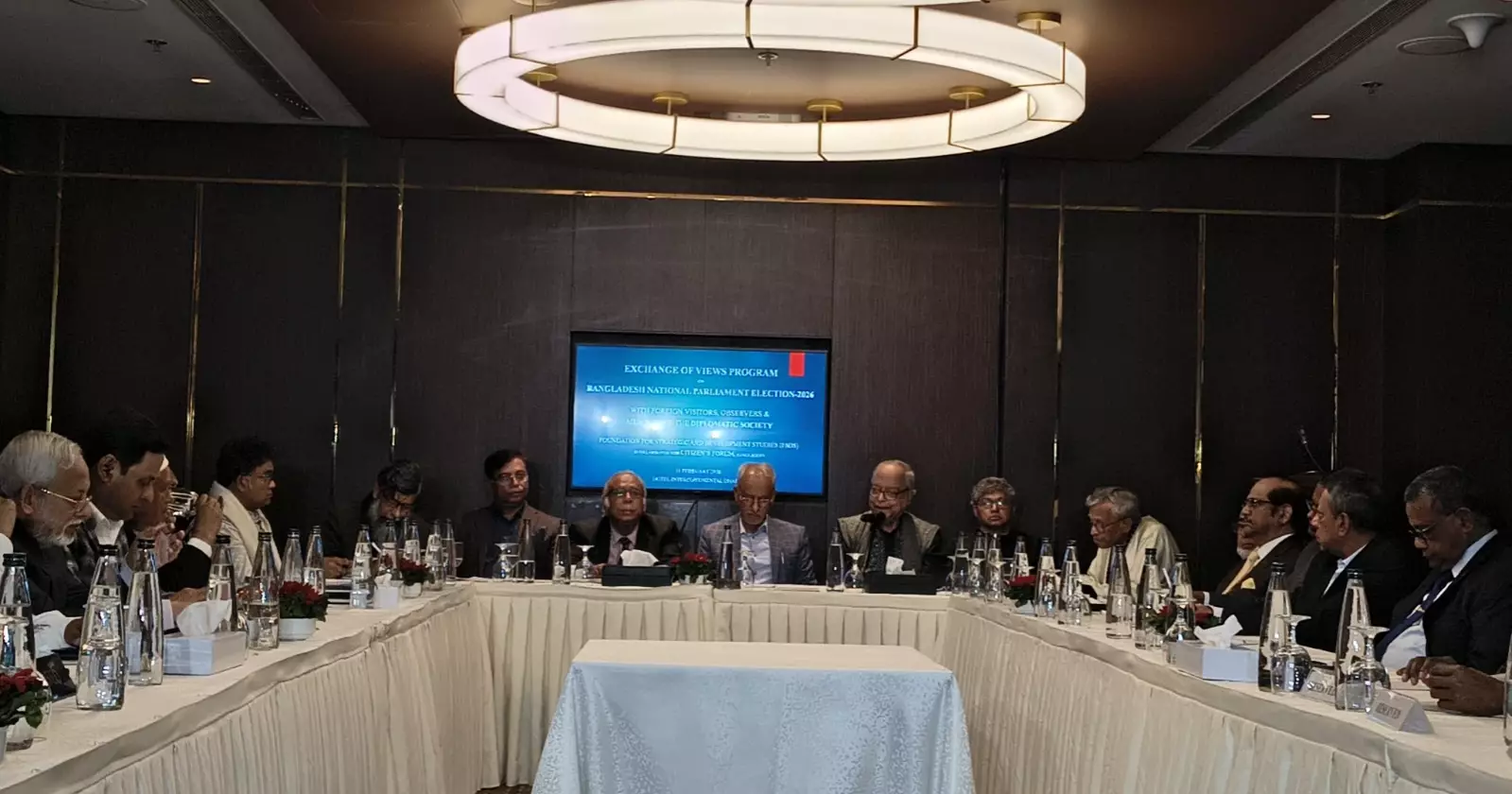
Economist Mahbub Ullah on Wednesday expressed optimism that Bangladesh’s will be participatory and credible ones, saying there is no reason for voter turnout to fall below 60 percent if the overall situation remains stable.
“I think the voter turnout in this election will not be less than 60 percent; it may even be higher. Although it is often said that the 87 percent turnout in 2008 was the highest in Bangladesh’s history, that election was controversial. I hope there will be no such criticism about the upcoming election,” he said.
Mahbub Ullah was speaking at a discussion on the national election held at city a hotel, organised by the Foundation for Strategic and Development Studies (FSDS).
He said there is concern in some quarters that the absence of the Awami League from the electoral contest could reduce turnout. However, the large number of people leaving Dhaka to cast their votes suggests that the party’s absence is unlikely to have a negative impact on voter participation, he added.
Noting that people across the country are eagerly awaiting a fair election, he said political parties will bear a major responsibility to accept the results once announced.
“There are high expectations among the people regarding this election. The next government must ensure that it does not fail to meet those expectations in any way,” he said.
Referring to what he described as institutional deterioration during the Awami League’s over one-and-a-half-decade rule, the former Dhaka University economics professor said reviving weakened state institutions, including the economy, judiciary and administration, will be the biggest challenge for the incoming government.
He also urged the new government to safeguard Bangladesh’s independence and sovereignty while pursuing a positive new beginning.
Speakers at the programme expressed multifaceted concerns over the country’s economic outlook, saying the next government will face immediate and significant challenges.
They stressed the need for prioritising a clear economic action plan.
Grameen Bank Chairman Abdul Hannan Chowdhury said prolonged economic mismanagement over the past 17 years has left the economy fragile and distressed. “All parties have announced ambitious pledges in their manifestos. But the first priority should be economic restraint.”
Investment Corporation of Bangladesh Chairman Abu Ahmed, however, said that despite mounting economic challenges, the economy could rebound quickly if the new government adopts sound policies.
Bangladesh Polls: Electioneering ends as parties leave voters with promises
Security analysts at the event underscored the importance of ensuring robust security measures both on election day and in the post-election period. They stressed the need to assess preparedness to address any untoward incidents nationwide, beyond just securing polling centres.
Former Additional Inspector General of Police Mazharul Haque said adequate preparation is essential to maintain law and order after the announcement of results. “Even if the situation remains manageable on polling day, a lack of preparation could lead to disorder once results are declared.”
Emphasising security in rural areas as well as urban centres, former ambassador M Shahedul Haque said that a form of ‘mafia-style control’ has emerged in villages following the fall of the Awami League government on August 5, 2024.
He said the rising incidents of violence and extortion in rural areas must be addressed to ensure a credible election.
Expressing concern over possible post-election reprisals against minorities, Prof Sukomal Barua of the Department of Pali and Buddhist Studies at Dhaka University said minority communities fear potential attacks after the results.
He urged the government and law enforcement agencies to prevent any such incidents at all costs.
Former Dhaka University Pro-Vice Chancellor Prof Anwarullah Chowdhury and FSDS Chairman Major General (retd) Fazle Elahi Akbar also voiced hope for a free, competitive and inclusive election.