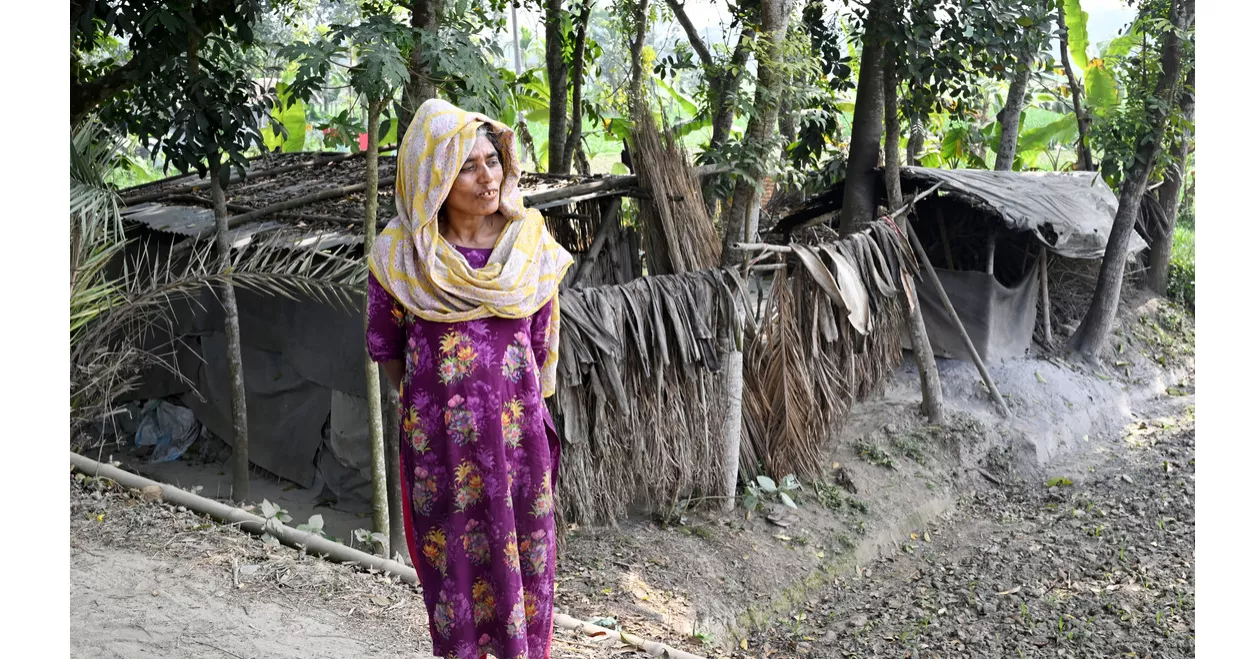
By a roadside in Jagalba village of Kushtia, an elderly couple live in a fragile tin-and-polythene shelter that barely protects them from rain or winter cold, but they see elections after a time gap.
For Babu Sheikh and his wife Kajol Rekha, the upcoming national election will pass like many before it without their participation.
Their exclusion is not due to a lack of interest. Instead, it hinges on Tk 650, the amount they were told they must pay as house tax to complete voter registration.
Unable to arrange the money, the couple say they have once again been deprived of their right to vote in Bangladesh’s 13th national election.
“We live hand to mouth,” said Kajol Rekha, sitting inside the makeshift hut that has been her home for more than a decade. “We simply could not manage the money.”
A Life Uprooted by Politics
The couple were repatriated from Jhenaidah around 15 to 16 years ago after fleeing what they describe as political persecution.
They originally lived in Chhota Moukuri village in Shailkupar upazila, where they owned homestead land and kept livestock.
Their lives changed after they voted for the 'Sheaf of Paddy' in a national election. Following the Awami League’s victory at the time, they allege they were harassed and tortured, forcing them to abandon their village.
Seeking safety, they moved to Jagalba village under Betbaria Union in Kushtia’s Khoksa upazila, where they have lived ever since.
Living without documents, or security
Today, Babu Sheikh and Kajol Rekha, along with their children, live beside a road on land temporarily provided by Kajol Rekha’s maternal uncle.
They own no land in the area.
Their shelter has no proper fence, doors or windows. Torn jute sacks, polythene sheets and pieces of special cloth used for river erosion prevention are used to cover the structure.
“It is extremely inhuman,” said Abdul Matin, a member of Ward No. 2 of Betbaria Union. “They have been living like this for 15–16 years.”
According to Matin, the lack of basic documents has become a major obstacle to voter registration.
“To become voters or transfer voter registration, documents such as electricity bills, tax receipts, land papers, and even a mobile phone number are required. They have none of these,” he said.
‘Promises that Never Materialise’
Kajol Rekha, who is mentally challenged, said that before every election, people come to her home with assurances that they will help her and her husband become registered voters.
“But nothing happens,” she said.
Ahead of the 12th national election, the couple had approached local Awami League leader Helal Uddin, hoping he would assist them with registration.
They were later told they needed to deposit Tk 650 at the Union Parishad as house tax.
“As we could not manage the money, our dream of becoming voters remained unfulfilled,” Kajol Rekha said.
Kushtia Jamaat Ameer dies while addressing protest rally
Helal Uddin confirmed that Kajol Rekha is known to him and acknowledged that she had moved to the area after facing political persecution.
“I tried to transfer her voter registration, but it could not be completed,” he said.
Fear Still Lingers
Beyond financial hardship, fear continues to shape the couple’s decisions.
Having once been forced to flee their home after voting, Kajol Rekha said she worries that participating in another election could again put her family at risk.
“We are afraid. What if voting means we have to leave this place too?” she said.
As Bangladesh prepares for another national election, Babu Sheikh and Kajol Rekha remain on the margins — citizens in name, but unable to exercise one of the most basic rights of democracy.