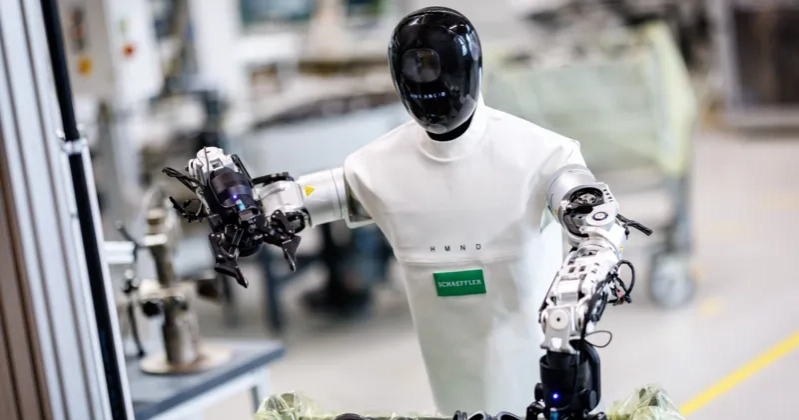
From clumsy machines to fluid, human-like movers, the future of robotics may depend less on artificial intelligence and more on the hidden hardware that powers motion, researchers and engineers say.
British YouTuber and engineer James Bruton recently drew attention online after building a giant, rideable walking robot inspired by the At-At vehicles from the Star Wars films. His aim, he said, was not only to attract viewers but also to create a walking machine that moved in a controlled and stable way rather than wobbling awkwardly.
To achieve this, Bruton designed complex systems of motors and gears that act like advanced servos, allowing precise control and feedback. He later demonstrated the machine by riding it around slowly, dressed as a Stormtrooper. He is now working on an even more challenging two-legged version, which will require far greater balance and responsiveness.
Bruton explained that some of his components behave like “variable springs”, capable of absorbing impact from the ground and even reversing motion when needed. Such features, he said, help the robot dynamically manage changing loads while walking.
At the heart of these developments are actuators – the motors that drive movement in machines. Actuators allow robotic arms, humanoids and animal-like robots to move by rotating or extending parts of their bodies. However, experts say current actuator technology still falls far short of the efficiency, precision and adaptability seen in biological muscles.
“If robots are to become more capable, their actuators need to improve dramatically,” said Mike Tolley of the University of California, San Diego. He noted that traditional direct current motors, long used in robotics, work well for high-speed tasks such as spinning fans but are poorly suited for movements that require high force and fine control, like lifting or pushing.
Tolley added that safety is another concern. For robots to work alongside humans, their actuators must be easily back-driveable, meaning they can be instantly stopped or pushed back without causing injury. Many existing systems lack this capability.
Energy efficiency is also a major limitation. Jenny Read, programme director for robot dexterity at technology funding agency Aria, said electric motors drain batteries quickly and can overheat at smaller scales, restricting how long robots can operate.
Several companies are now trying to overcome these challenges. Germany-based engineering firm Schaeffler is developing advanced actuators for British robotics company Humanoid, focusing on energy-efficient and tightly controlled movement essential for bipedal robots.
Schaeffler president David Kehr said the company is experimenting with designs that balance friction, power and back-driveability while also generating detailed data that allows computers to adjust movement in real time. The firm hopes to eventually deploy such robots in its own factories to address labour shortages, with existing workers retrained for other tasks.
Meanwhile, US robotics leader Boston Dynamics has partnered with South Korea’s Hyundai Mobis to develop a new generation of actuators similar to electric power steering systems used in vehicles. Hyundai Mobis vice president Se Uk Oh said reliability and safety are critical, especially as these components will be used in humanoid robots operating near people.
Beyond metal and electric motors, researchers are also exploring softer alternatives. Tolley’s team in California has developed air-powered soft robots that can move on land and in water without electronics. In one experiment, a six-legged robot walked purely through air pressure, while other designs proved resilient enough to withstand being driven over by a car.
Aria is funding research into actuators made from elastomers, rubber-like materials that expand or contract when voltage is applied, mimicking biological muscles. While such technologies have yet to transform robotics, Read said persistent experimentation could eventually lead to breakthroughs.
The long-term goal, experts agree, is to create robots that move with far greater elegance and adaptability. “Today’s robots still feel heavy and clunky,” Read said. “That’s completely different from how humans and animals move. True grace in robotics is still a work in progress.”
With inputs from BBC