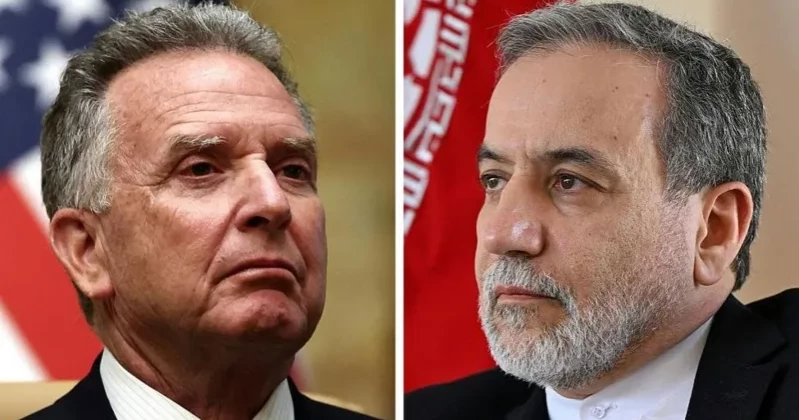
Senior officials from the United States and Iran met in Oman on Friday for talks aimed at easing tensions that have raised fears of a direct military confrontation between the two countries.
The discussions follow a US military build-up in the Middle East, prompted by Iran’s violent crackdown on nationwide anti-government protests last month, which human rights groups say left thousands dead. The exact scope of the talks, believed to be indirect, remained unclear, with both sides far apart in their positions amid mutual distrust.
US negotiators were led by special envoy Steve Witkoff, while Iran’s delegation was headed by Foreign Minister Abbas Araghchi. Oman’s foreign minister held separate meetings with Witkoff, Araghchi, and US envoy Jared Kushner, focusing on creating conditions to resume diplomatic and technical negotiations.
The US has demanded that Iran freeze its nuclear programme, surrender its stockpile of enriched uranium, address its ballistic missile programme, halt support for regional armed groups, and improve its treatment of citizens. Iran, however, has insisted that discussions will be limited to its nuclear programme, and it remains unclear if the two sides have resolved these differences.
The last round of talks on Iran’s nuclear programme, scheduled for June 2025, collapsed after a surprise Israeli attack. In recent weeks, US President Donald Trump has threatened military action if a deal is not reached, sending thousands of troops and an “armada” of warships, fighter jets, and an aircraft carrier to the region. Iran has warned it would respond to any attack by targeting US military assets in the Middle East and Israel.
For Iran’s leadership, analysts say the talks may be a last chance to avert US military action that could further destabilize the regime, which is under significant pressure following the brutal suppression of nationwide protests triggered by an economic crisis. The Human Rights Activists News Agency in Washington reported at least 6,883 deaths and more than 50,000 arrests during the demonstrations.
The current crisis has revived concerns over Iran’s nuclear programme, a long-standing point of contention with the West. Iran maintains its programme is for peaceful purposes, while the US and Israel accuse it of pursuing nuclear weapons. Iran also insists on its right to enrich uranium domestically and has rejected demands to transfer its 400kg stockpile of highly enriched uranium abroad.
Officials indicated that Iran could consider concessions, such as establishing a regional uranium enrichment consortium, similar to proposals in previous negotiations that collapsed after the Israeli attack. Tehran, however, has rejected US demands to limit its ballistic missile programme or stop supporting regional allies it calls the “Axis of Resistance,” including Hamas in Gaza, militias in Iraq, Hezbollah in Lebanon, and the Houthis in Yemen, calling such demands a breach of its sovereignty.
Iranian President Masoud Pezeshkian said on Tuesday he instructed Araghchi to pursue “fair and equitable negotiations” with the US, provided a suitable environment exists. Iran is also expected to push for the lifting of sanctions that have severely impacted its economy.
For the US, the Oman talks could provide a potential diplomatic alternative to military action. Regional countries have warned that a US strike could trigger a wider conflict and long-term instability in Iran, noting that air power alone would not topple the Iranian leadership.
Trump, when asked if Iran’s Supreme Leader Ayatollah Ali Khamenei should be worried, told NBC News, “I would say he should be very worried. Yeah, he should be.” US Secretary of State Marco Rubio emphasized that discussions must go beyond the nuclear issue to achieve meaningful results.
The meeting, initially planned in Istanbul, was moved to Oman at Iran’s request. Oman also hosted similar discussions last year. The talks are being led by Egypt, Turkey, and Qatar as part of efforts to de-escalate tensions in the region.
With inputs from BBC