irrigation crisis
Drought deepens irrigation crisis in Sunamganj’s haor belt
A prolonged dry spell has created a severe water crisis in the haor areas of Sunamganj, leaving Boro farmers worried about their crops and livelihoods.
With almost no rainfall in the region for nearly five months, croplands across several haors are facing an acute shortage of water, severely affecting Boro paddy cultivation this season.
Farmers said the lack of irrigation water has already begun to damage many paddy fields.
In some areas, plants are drying up due to drought while in others they are being attacked by insects and diseases.
Funding delays stall haor embankments, putting Sunamganj’s Boro harvest at risk
If the situation continues, farmers fear that overall production may drop significantly, they said.
Most haor areas in the district depend heavily on natural water reservoirs and rainfall for irrigation.
But this year’s prolonged dry weather has left many fields without sufficient water.
Local farmers also alleged that some water bodies have been drained prematurely by unscrupulous people.
They said the absence of effective government initiatives to address the water shortage has added to their anxiety, with many fearing financial losses if the drought continues.
During a visit to Khushdar haor in Sunamganj Sadar upazila, UNB correspondent found large stretches of farmland suffering from severe water scarcity.
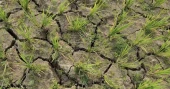
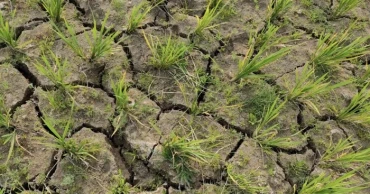
In some upstream areas of the haor, the soil has cracked due to drought. With no alternative irrigation system in place, farmers are anxiously looking to the sky hoping for rain.
Nazir Ali, a farmer from the Baraghat area, said he cultivated Boro rice on six khanis of land this season but the lack of water has put his crop at risk.
“The soil has cracked and the rice plants are turning reddish and drying up,” said the 50-year-old farmer. “I thought it would rain, but there has been no rainfall for a long time. If rain does not come soon, we will face heavy losses. Many farmers like me in the haor areas are in the same situation.”
Race Against Water: Delayed funds put Sunamganj’s Boro crop in danger
7 months ago
Large tract of Boro farmland in Sunamganj under threat as water dries up
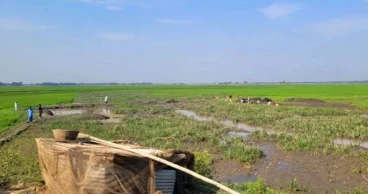
An irrigation crisis has emerged across hundreds of hectares of Boro farmland lying to the south of Jibdara Bazar, Shimulbak Union, in Sunamganj’s Shantiganj Upazila due to a lack of water.
The farmlands are cracking due to water scarcity, and the drying up of water bodies in the Haor has caused severe distress for farming families, putting the crops at risk.
Locals say the filling up of the water bodies in the Haor has caused the irrigation crisis. Farmers fear that if these water bodies are not dredged soon, the farmlands in the Haor will remain uncultivated in the future.
According to the Upazila Nirbahi Officer’s office, the Suraiya Beel water body in Ukargaon, Shimulbak Union, has 13.30 acres, but it is devoid of water.
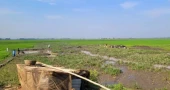
On a visit Monday morning, it was observed that hundreds of hectares of Boro farmland were spread across the Haor south of Jibdara Bazar. Farmers had planted Boro rice across the vast Haor, but there is a severe irrigation crisis. The Suraiya Beel water body in the middle of the Haor has no water, making it difficult to identify land and water bodies.
The land has become filled with silt, and the water body is now indistinguishable from the land. There is no water left, and the little that was available has been used up by farmers in the past few days.
Unregulated fishing devastates Jamalganj haors endangering biodiversity
Haor farmer Md Enamul Haque said, "I have a lot of land in this Haor, and I have spent a lot of money cultivating it. Now, there is a severe irrigation crisis. The filling up of the Suraiya Bill water body has caused this hardship."
Farmer Sohel Mia from Jibdara village said, "If there is no rain this year, harvesting the planted crops will be uncertain. If this water body is dredged, we will be able to grow rice, otherwise, all the land in this Haor will remain uncultivated next year."
The villagers, who have leased the water body, have also been affected by its filling. They believe that dredging the water body would benefit both the government and the farmers. The government’s revenue would increase, and farmers would be able to grow crops. They have urged the government to expedite the dredging process.
Sajirul Islam, president of the Jibdara Adarsha Fishers' Cooperative Society, the lessee of the Suraiya Beel water body, said, "At the start of the Boro season, farmers use the water from the water body for cultivation. However, the water body has completely filled up. Every year, we dredge some parts of the water body with our own funds to create ponds, but it is not sufficient. The water body needs to be dredged on a larger scale. We too have been affected as the lessees of the water body."
Inoperative water regulators in Sunamganj haors threaten Boro crops
Ahsan Habib, Upazila Agriculture Officer, said, "I will inform the Upazila Water Management Committee, and also notify the Bangladesh Agricultural Development Corporation (BADC) to address the irrigation crisis. To achieve the target, uninterrupted Boro cultivation must continue."
Sukanto Saha, Shantiganj Upazila Nirbahi Officer and Water Management Committee President, said, "The filling up of the water body has caused this problem. However, no one has submitted a written request to me regarding this matter."
He added, "Every water body needs to be dredged. If the locals apply for the dredging of the water body, we will verify it and grant permission for the dredging or arrange for it through a project."
1 year ago