powerful earthquake
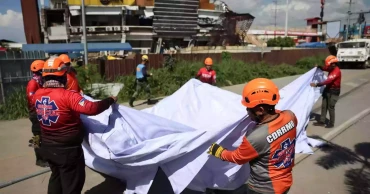
Powerful earthquake in Philippines kills 37, displaces over 20,000
Rescue teams continued searching damaged buildings in the southern Philippines on Tuesday to ensure no one remained trapped, a day after one of the country's strongest earthquakes in the last 50 years killed at least 37 people and forced more than 20,000 residents from their homes.
Authorities said only four people were officially listed as missing in the provinces near the epicentre of Monday’s 7.8-magnitude earthquake. However, the Office of Civil Defense said several collapsed and severely damaged structures still needed to be thoroughly checked for possible survivors and additional casualties.
The earthquake struck off the coast of Mindanao, the Philippines' second-most populous island. Nearly 500 people were injured, while thousands sought refuge in emergency shelters.
Many residents fled their homes fearing a tsunami. Although waves reaching up to 1.4 metres above normal tide levels were recorded in parts of the Philippines, damage was limited. Officials reported that six stilt houses in a coastal village were damaged by tsunami waves. Smaller waves were also observed in Indonesia, Palau and southern Japan.
The disaster caused widespread destruction across several provinces. In General Santos, a coastal city known as the country's tuna industry hub, at least 13 people died due to collapsed buildings and falling debris.
Another 18 people were killed in Sarangani province, most of them in a landslide that buried homes in the mountainous town of Glan, according to disaster officials. Additional deaths were reported in South Cotabato, Davao Occidental and Balut Island.
Initial government assessments showed that around 2,000 houses and 117 government buildings and facilities were damaged. General Santos International Airport remained closed, leading to the cancellation of 63 domestic flights, except those carrying humanitarian aid.
Authorities said nearly 6,000 public school buildings in affected provinces must be inspected before classes can resume. The earthquake struck on the first day of the new school term following a two-month summer break, and many of those injured were students attending morning flag-raising ceremonies.
Officials have warned that damaged buildings remain at risk of collapse due to strong aftershocks.
"We cannot force the immediate reopening of schools because we have to ensure the integrity of the buildings," said Rafaelito Alejandro of the Office of Civil Defense.
According to the Philippine Institute of Volcanology and Seismology, the earthquake originated at a depth of 33 kilometres beneath the sea, about 32 kilometres southwest of Maasim town in Sarangani province.
The quake was triggered by movement along the Cotabato Trench and was the strongest to hit the country since a devastating 8.1-magnitude earthquake and tsunami in 1976 that killed about 8,000 people.
The Philippines also experienced a 7.8-magnitude earthquake in 1990 that killed more than 1,000 people and caused major destruction in the country's north.
President Ferdinand Marcos Jr. deployed senior government officials to oversee rescue operations, aid distribution and damage assessments of roads, bridges and other infrastructure.
The United States said it was coordinating with Philippine authorities and stood ready to assist response efforts. France, Japan and New Zealand also expressed support.
The Philippines frequently experiences earthquakes and volcanic eruptions because it lies along the Pacific "Ring of Fire," a zone known for intense seismic activity. The country is also hit by around 20 typhoons and tropical storms each year, making it one of the world's most disaster-prone nations.
4 months ago

Death toll of powerful earthquake in Haiti soars to 1,297
The death toll from a 7.2-magnitude earthquake in Haiti climbed to 1,297 on Sunday, a day after the powerful temblor turned thousands of structures into rubble and set off franctic rescue efforts ahead of a potential deluge from an approaching storm.
Saturday’s earthquake also left at least 5,700 people injured in the Caribbean nation, with thousands more displaced from their destroyed or damaged homes. Survivors in some areas were forced to wait out in the open amid oppressive heat for help from overloaded hospitals.
Read: At least 304 dead, 1,800 hurt as powerful quake slams Haiti
The devastation could soon worsen with the coming of Tropical Depression Grace, which is predicted to reach Haiti on Monday night. The U.S. National Hurricane Center warned that although Grace had weakened from tropical storm strength Sunday, it still posed a threat to bring heavy rain, flooding and landslides.
The earthquake struck the southwestern part of the hemisphere’s poorest nation, almost razing some towns and triggering landslides that hampered rescue efforts in a country already struggling with the coronavirus pandemic, a presidential assassination and a wave of gang violence.
The epicenter was about 125 kilometers (78 miles) west of the capital of Port-au-Prince, the U.S. Geological Survey said, and aftershocks continued to jolt the area Sunday.
In the badly damaged coastal town of Les Cayes, Jennie Auguste lay on a flimsy foam mattress on the tarmac of the community’s tiny airport waiting for anything — space at a hospital or a small plane like the ones ferrying the wounded to the capital. She suffered injuries in the chest, abdomen and arm when the roof collapsed at the store where she worked.
“There has been nothing. No help, nothing from the government,” Auguste’s sister, Bertrande, said.
Read: Rescuers racing in Haiti as storm threatens to follow quake
In scenes widespread across the region hit by the quake, families salvaged their few belongings and spent the night at an open-air football pitch. On Sunday, people lined up to buy what little was available: bananas, avocados and water at a local street market.
Some in the town praised God for surviving the earthquake, and many went to the cathedral, which appeared outwardly undamaged even if the priests’ residence was destroyed.
“We only have Jesus now,” said Johanne Dorcely, whose house was destroyed. “If it wasn’t for Jesus, I wouldn’t be able to be here today.”
5 years ago