Asia
Japan to host South Korea summit as ties with China worsen
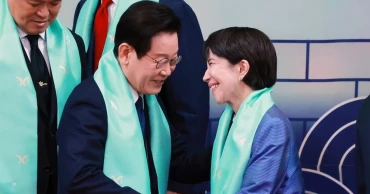
Japanese Prime Minister Sanae Takaichi will host South Korean President Lee Jae Myung in her hometown of Nara on Tuesday, aiming to strengthen ties between the two neighbours as Japan’s relations with China continue to deteriorate.
The meeting comes amid heightened regional tensions. Lee’s visit follows his trip to China last week, where President Xi Jinping sought closer ties with Seoul amid strained Japan-China relations after Takaichi warned in November that a possible Chinese military move against Taiwan could justify Japanese intervention.
The Nara meeting will mark the leaders’ first full summit and their third encounter in less than three months since Takaichi took office, according to Japan’s Foreign Ministry. Talks are expected to focus on trade, China’s growing influence and North Korea’s security threat, as well as how both countries should navigate US President Donald Trump’s unpredictable diplomacy and Washington’s pressure to increase defence spending.
Foreign Minister Toshimitsu Motegi said strengthening Japan–South Korea ties and trilateral cooperation with the United States was more important than ever given the current strategic environment.
Takaichi and Lee are also scheduled to visit Horyu Temple, one of the world’s oldest surviving wooden structures, highlighting Japan’s early cultural links with the Korean Peninsula. Lee will later meet South Korean residents in Japan.
Although Japan and South Korea share ancient cultural and political ties, relations have long been strained by disputes rooted in Japan’s colonial rule of Korea from 1910 to 1945. Issues such as forced labour and wartime sexual slavery have repeatedly disrupted ties, despite a 1965 treaty meant to settle compensation claims.
Relations have improved in recent years, driven largely by shared concerns over China’s assertiveness. While historical disputes are expected to be avoided at the summit, media reports say the leaders may discuss humanitarian cooperation to recover remains of Korean forced labourers killed in a 1942 mining accident in western Japan.
1 month ago
New US ambassador to India pushes deeper trade ties despite Russian oil tensions
The United States and India remain actively engaged in talks on a bilateral trade agreement aimed at strengthening their economic and strategic partnership, despite tensions over New Delhi’s continued purchases of Russian oil, the US ambassador-designate to India said Monday.
Since Russia’s invasion of Ukraine in 2022, India has become the world’s second-largest buyer of Russian crude after China, drawing sharp criticism from the Trump administration. In August, US President Donald Trump imposed an additional 25% tariff on Indian goods over the oil purchases, raising total US tariffs on India to 50%.
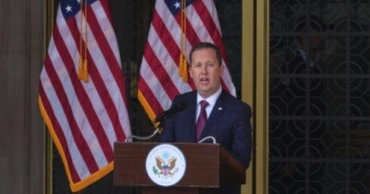
Speaking on his first day at the US Embassy in New Delhi, ambassador-designate Sergio Gor said the next round of trade-related talks was scheduled for Tuesday. “Real friends can disagree, but always resolve their differences in the end,” Gor said, adding that Washington remains determined to finalize an agreement despite the complexities involved with the world’s most populous country.
Gor, who also serves as US special envoy to South and Central Asia, announced that India will be formally invited next month to join Pax Silica, a US-led strategic initiative focused on building a secure silicon supply chain covering critical minerals, energy, semiconductors, advanced manufacturing and artificial intelligence.
India and the US have been negotiating a trade agreement since early 2025, but talks stalled over Russian oil imports and Indian concerns about protecting small farmers and domestic industries.
Gor said trade is central to bilateral ties, alongside cooperation on security, counterterrorism, energy, technology, education and health.
Amid rising US tariffs, India has accelerated efforts to finalize other free trade agreements, including a deal with Oman last month and completed negotiations with New Zealand.
1 month ago
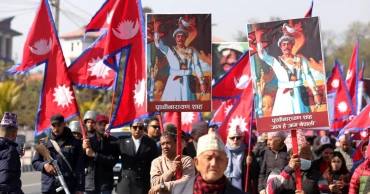
Nepal royal family supporters rally in Kathmandu seeking restoration of monarchy
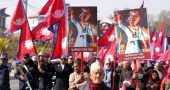
Supporters of Nepal’s former royal family rallied in the capital on Sunday, calling for the restoration of the monarchy ahead of parliamentary elections scheduled for March.
It was the first major demonstration by backers of deposed King Gyanendra since an interim government was formed following violent youth-led protests in September that toppled the previous administration.
“We love our king. Bring back the king,” demonstrators chanted as they gathered near the statue of King Prithvi Narayan Shah, founder of the Shah dynasty in the 18th century.
The monarchy was abolished in 2008, forcing King Gyanendra, the last Shah ruler, to step down and turning Nepal into a republic.
“The last and only alternative for this country is king and monarchy,” said protester Samrat Thapa. “After the Gen Z movement and the path the country has taken, the monarchy needs to be restored to manage the situation.”
Sunday marked the birth anniversary of Prithvi Narayan Shah. Previous rallies on the day have turned violent, with clashes between protesters and police. Two people were killed during a pro-monarchy rally last March. This year’s gathering remained peaceful under heavy police presence.
Despite the end of royal rule nearly two decades ago, Nepal’s former royal family still commands notable public support.
The current interim government, led by retired Supreme Court judge Sushila Karki, Nepal’s first female prime minister, took office after Gen Z-led protests over corruption, unemployment, lack of opportunities and poor governance. The unrest was sparked by a brief ban on social media imposed by the previous government.
Karki has faced criticism for delays in launching corruption cases.
1 month ago
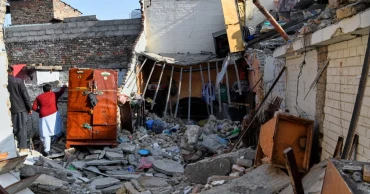
Gas cylinder explosion after wedding kills eight in Islamabad
At least eight people, including the bride and groom, were killed early Sunday when a gas cylinder exploded at a house in Pakistan’s capital shortly after a wedding reception, police and officials said.
The explosion occurred while guests who had gathered to celebrate the newlyweds were sleeping at the house, causing part of the building to collapse, according to Islamabad police. Seven others were injured in the blast.
Police said the incident took place in a residential area in the heart of the city. Government administrator Sahibzada Yousaf said authorities were alerted early Sunday and investigations were underway. He added that several nearby homes were also damaged.
Prime Minister Shehbaz Sharif expressed deep grief over the loss of lives and conveyed condolences to the victims’ families. In a statement from his office, he directed health authorities to ensure the injured receive proper treatment and ordered a full investigation into the incident.
Many households in Pakistan rely on liquefied petroleum gas cylinders due to low natural gas pressure, and such cylinders have often been linked to fatal accidents caused by gas leaks. Police said investigations were continuing.
1 month ago
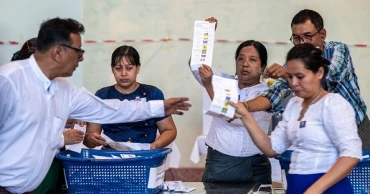
Myanmar presses ahead with second phase of elections amid ongoing conflict
Myanmar on resumed voting Sunday in the second round of its first general election in five years, expanding polling to additional townships, including some areas affected by the civil war between the military government and its armed opponents.
Polling stations opened at 6am in about 100 townships, including parts of Sagaing, Magway, Mandalay, Bago and Tanintharyi regions, as well as Mon, Shan, Kachin, Kayah and Kayin states. Several of these areas have recently seen clashes or remain under tight security, highlighting the risks surrounding the vote.
The election is being conducted in three phases because of ongoing fighting. The first round was held on Dec 28 in 102 townships, while the final phase is scheduled for Jan 25. Voting will not take place in 65 townships due to security concerns.
Myanmar’s bicameral parliament has 664 seats, with the military guaranteed 25% under the constitution. A parliamentary majority allows a party to choose the president and form a government.
Although more than 4,800 candidates from 57 parties are contesting seats, only six parties are competing nationwide. Results from the first phase showed the military-backed Union Solidarity and Development Party (USDP) winning nearly 90% of contested lower-house seats, as well as majorities in regional legislatures. Authorities claimed a turnout of about 52% in the first round.
Critics, including the United Nations, argue the polls lack credibility, citing the detention of more than 22,000 political prisoners, the exclusion of opposition parties and the imprisonment of former leader Aung San Suu Kyi. Rights groups warn that harsh new election laws and ongoing violence undermine any claim of a free or fair vote.
1 month ago
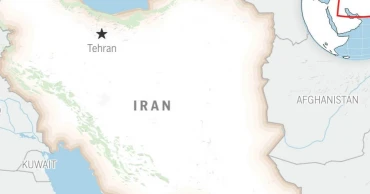
Iran says it is ready to respond if attacked again
Iran does not want a war with Israel or the United States, but it is fully prepared to defend itself if it comes under attack again, Foreign Minister Abbas Araghchi said on Thursday.
Speaking to reporters upon his arrival in Beirut, Araghchi said Tehran is also willing to resume negotiations with Washington over its nuclear program, provided the talks are based on mutual respect and not pressure or “dictation” from the US.
His remarks come amid growing fears that Israel, a close US ally, could again target Iran following the 12-day war in June, when Israel struck Iran and killed several senior military commanders and nuclear scientists. During that conflict, the United States also bombed key Iranian nuclear enrichment facilities.
“America and Israel have tested their attack on Iran and this attack and strategy faced extreme failure,” Araghchi said at the start of his two-day visit to Lebanon. “If they repeat it, they will face the same results.”
“We are ready for any choice. We don’t desire a war but we are ready for it,” he added.
In February, US President Donald Trump reinstated his “maximum pressure” campaign against Iran in an effort to block Tehran from developing nuclear weapons. The policy included US-led airstrikes on three major Iranian enrichment sites in June.
Araghchi said Iran is prepared for negotiations, but stressed that any dialogue must be built on respect and shared interests.
“We believe that once the Americans reach the outcome that constructive and positive negotiations rather than ordering dictation are the framework, then at that time the results of these negotiations become fruitful,” he said.
Iran began enriching uranium up to 60% purity after Trump withdrew the US from the 2015 nuclear agreement with world powers in 2018. While Tehran insists its nuclear program is for peaceful purposes, Western governments and the UN’s nuclear watchdog say Iran had an organized weapons program until 2003.
In late December, Trump warned that the US could launch further military strikes if Iran attempts to rebuild its nuclear program, following talks with Israeli Prime Minister Benjamin Netanyahu in Florida.
END/UNB/FH/1719 Hrs
1 month ago
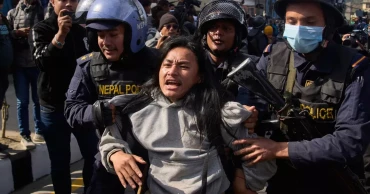
Gen Z activists in Nepal turn against interim government they helped install
Young protesters who spearheaded last year’s mass uprising in Nepal are increasingly disillusioned with the interim government that came to power after weeks of violent demonstrations, accusing it of failing to deliver on promises to end corruption and ensure accountability.
Mukesh Awasti, 22, had planned to leave for Australia in September to study civil engineering. Instead, he joined protests in Kathmandu demanding an end to corruption and better governance. He was shot by security forces during the unrest and later lost a leg. From his hospital bed at the National Trauma Center in the capital, Awasti said he now regrets taking part in the movement.
“I gave up everything, but nothing has changed,” he said. “Corruption has not ended, and those who fired on protesters have not been arrested.”
The protests erupted on Sept. 8 and quickly turned violent, leaving at least 76 people dead and more than 2,300 injured. The movement, driven largely by so-called Gen Z activists, forced political leaders into negotiations that resulted in the appointment on Sept. 12 of Sushila Karki, a retired Supreme Court judge, as Nepal’s first female prime minister. She was tasked with leading an interim government and holding parliamentary elections in March.
Months later, many of the same protesters say the government has failed them. The country’s anti-corruption agency has filed only one major case, which does not involve prominent political figures. Politicians accused by demonstrators are preparing to contest the upcoming elections, while no cases have been brought against leaders who were in power when protesters were killed or injured.
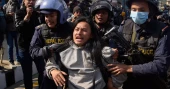
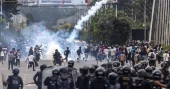
Frustration has pushed injured demonstrators and families of victims back onto the streets. In recent weeks, dozens have staged protests outside the prime minister’s office, some of which were dispersed by police.
“We are here again because the government did nothing,” said Suman Bohara, who walks with crutches after his right foot was badly injured during the protests. “Families lost loved ones, many were wounded, but there has been no justice.”
The original demonstrations drew tens of thousands of mostly young people angered by widespread corruption, unemployment, lack of opportunity and poor governance. The unrest was initially triggered by a government ban on social media platforms. Protesters broke through police barricades and tried to storm Parliament, prompting security forces to open fire.
Within days, protests spread nationwide. Mobs torched the offices of the prime minister and president, attacked police stations and burned the homes of senior politicians, many of whom were evacuated by army helicopters. The military eventually restored order, and talks led to the formation of the interim government with the sole mandate of conducting elections.
Prime Minister Karki has repeatedly said her government is focused on that task. She has pledged that parliamentary polls will be held on March 5, saying preparations are nearly complete and the security situation has improved.
“As the world looks toward a smooth transition through elections, I want to assure everyone that we will deliver,” Karki said recently.
However, divisions within the Gen Z movement have complicated the political landscape. Different groups are now pushing competing demands, including direct elections for prime minister, scrapping the current constitution and imprisoning all former political leaders. There is no unified leadership, with multiple individuals claiming to represent the movement’s voice.
Analysts say this lack of clarity has become a major obstacle.
“The confusion we see today is largely because there was no clear agreement on what the protesters wanted or how the new government should function,” said Abeeral Thapa, principal of Polygon College of Journalism and Mass Communications in Kathmandu.
Some activists have begun opposing the March elections, arguing that their movement was not meant simply to replace one parliament with another. They insist that corruption must be tackled immediately and those responsible for abuses must be punished before any vote is held.
Others believe elections are necessary to bring in new lawmakers who can pursue those goals through democratic means.
Legal uncertainty has further complicated matters. Nepal’s constitution does not clearly outline provisions for forming an interim government. When appointing Karki’s administration, the president stated that its primary responsibility was to hold elections, raising questions about how much authority it has to meet broader demands.
Thapa said the protests were initially narrow in focus but quickly spiraled beyond their original aims.
“They started with demands to control corruption and lift the social media ban,” he said. “But events took an unexpected turn, and the collapse of the government was not something they fully planned for.”
Whether the promised elections can be held in March remains uncertain, but analysts say there are few alternatives. For now, many young Nepalis who once celebrated the fall of the previous government are left feeling betrayed by a system they hoped to change, unsure whether the movement that cost so much can still deliver the reforms they demanded.
1 month ago
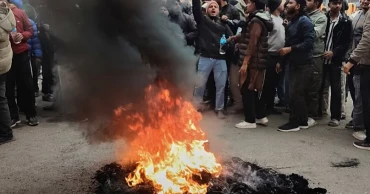
Southern Nepal border city under curfew following Mosque vandalism
Authorities in southern Nepal imposed a strict curfew in the border city of Birgunj after tensions flared between Hindu and Muslim communities following the vandalism of a mosque over the weekend, officials said Tuesday.
The Parsa District Administration ordered residents to stay off the streets, banning all public movement, demonstrations and gatherings. Security forces were authorized to take strong action against anyone violating the curfew, including the use of firearms if necessary, according to the official notice.
Police and army units armed with automatic weapons were deployed across Birgunj, a major commercial hub located about 130 kilometers (80 miles) south of Kathmandu. The city serves as Nepal’s most important land border crossing with India and is a critical gateway for fuel, food and other essential imports entering the country.
Nepal’s Gen Z Protesters disillusioned with government they helped install
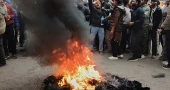
The unrest began Sunday when Muslim groups organized protests after a mosque in a nearby town was vandalized. Later the same day, Hindu groups held their own demonstrations, raising fears that the situation could escalate. Protest activity has continued intermittently since then, prompting authorities to impose the curfew to prevent violence.
Officials said there have been no serious injuries or large-scale clashes between the two communities so far. Some minor scuffles were reported between protesters and riot police as officers worked to keep the groups apart and restore calm.
Interreligious violence is uncommon in Nepal, a predominantly Hindu country where Muslims make up a small minority of the population. Most Muslim communities are concentrated in southern districts near the Indian border, including areas such as Birgunj, where close cultural and economic ties exist across the frontier.
Local officials said the curfew would remain in place until tensions ease and warned residents to comply with security directives as authorities continue monitoring the situation closely.
1 month ago
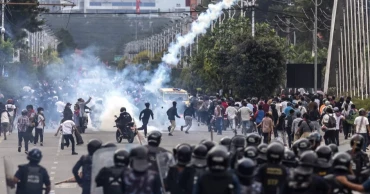
Nepal’s Gen Z Protesters disillusioned with government they helped install
Mukesh Awasti, a 22-year-old protester who lost a leg after being shot by security forces during Nepal’s September protests, says he regrets sacrificing so much for limited change.
The demonstrations, sparked by corruption, lack of opportunities, and social media restrictions, killed 76 people and injured over 2,300, eventually leading to the appointment of Nepal’s first female prime minister, Sushila Karki, who promised elections in March.
However, protesters are disappointed with the interim government’s performance. Only one significant corruption case has been filed, excluding major political figures, and those responsible for violence against demonstrators remain unpunished. Injured protesters have returned to the streets, demanding accountability and systemic reform.
Analysts say the movement’s lack of unified leadership and unclear demands has complicated Nepal’s political landscape. Some groups now oppose the March elections, arguing their goals go beyond parliamentary polls and include ending corruption and jailing corrupt leaders.
Prime Minister Karki maintains the government is focused on preparing for elections and improving security, but the ability to meet protesters’ broader demands remains uncertain, as the constitution provides no clear framework for interim governments beyond overseeing polls.
The Gen Z-led movement highlights both the challenges of youth-driven activism and the gap between revolutionary expectations and political realities in Nepal.
2 months ago
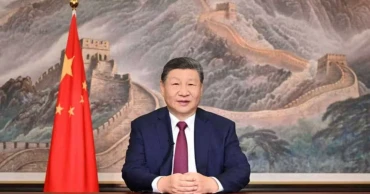
China bans exports of dual-use goods to Japan amid Taiwan tensions
China on Tuesday banned exports of dual-use goods that can serve military purposes to Japan, a move that comes at time of heightened tensions between the two countries over Taiwan, a self-ruled island Beijing claims as its sovereign territory.
The Chinese commerce ministry warned that individuals or organizations violating the ban would face legal action, regardless of nationality. The ministry did not specify the items affected, but technology products such as drones and navigation systems could be included.
Japan’s Foreign Ministry strongly protested, calling the measure targeted and “unacceptable,” and demanded its withdrawal. The announcement follows months of escalating friction, including Japan’s plans to double military spending and incidents of Chinese aircraft locking radar on Japanese jets.
China recently conducted large-scale military drills around Taiwan, with Foreign Minister Wang Yi condemning both Taiwan and Japan’s “pro-independence” stance.
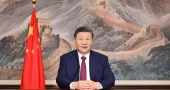
Chinese leader Xi Jinping also met South Korean President Lee Jae Myung, urging regional cooperation to defend the outcomes of World War II and maintain stability in Northeast Asia.
2 months ago