Middle-East
Missiles strike Israel as Iran retaliates over attacks on nuclear, military targets
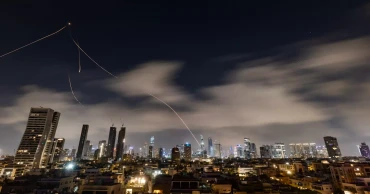
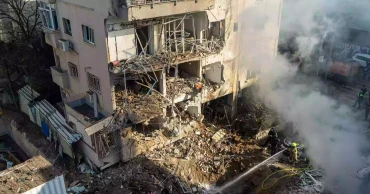
Missiles rained down on Israel Friday as Iran launched a retaliatory attack in response to Israeli strikes on its nuclear facilities and military leaders.
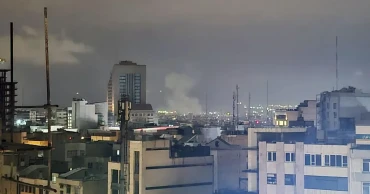
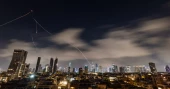
Air raid sirens echoed throughout the country, with explosions heard in Jerusalem and smoke seen over Tel Aviv.
Although dozens of missiles were reported by the military, no immediate casualties were confirmed, and residents were ordered to take shelter.
Israel's earlier airstrikes hit key nuclear enrichment sites and military installations in Iran, killing at least three senior military officials and significantly escalating tensions between the longtime regional enemies.
These attacks are considered the most serious Iran has faced since the Iran-Iraq war in the 1980s.
The confrontation follows rising hostilities surrounding Iran’s advancing nuclear program. Israel has long warned of such a military strike, while U.S. administrations have worked to avoid it, fearing broader instability in the region and questioning the effectiveness of any strike on Iran’s deeply fortified nuclear infrastructure.
Key Developments:
Targeted strikes in Iran: Israeli attacks destroyed parts of Iran’s nuclear infrastructure and missile systems, killing several high-ranking military figures, including nuclear scientists.Mounting regional tension: The incident follows Iran's announcement to activate another uranium enrichment site, shortly after being rebuked by a U.N. nuclear watchdog. Meanwhile, Israeli PM Netanyahu narrowly survived a political challenge at home.Global reactions: Iran’s Supreme Leader Ayatollah Ali Khamenei vowed retribution, declaring Israel would not go unpunished. Netanyahu defended the strikes as necessary to counter Iran’s existential threat. Former U.S. President Donald Trump called on Iran to negotiate urgently.
6 months ago
Who was Hossein Salami, the IRGC chief killed in Israeli strike?
Hossein Salami, the chief of Iran’s elite Islamic Revolutionary Guard Corps (IRGC), has been killed in an Israeli strike on Tehran’s nuclear facility, according to Iran’s state media. The report said that several other senior Iranian officials were also killed in the early Friday morning attack.
Israeli forces launched coordinated strikes on multiple locations, including the Iranian capital Tehran, on Friday at dawn. Their state television reported that the IRGC’s headquarters in Tehran was among the sites targeted.
Over the past 20 months, Tehran has found itself entangled in multiple crises amid mounting instability in the Middle East. Salami’s death, analysts suggest, is a major blow to Iran’s leadership, as he was one of the country’s most powerful figures.
Hossein Salami was born in 1960 in the Iranian city of Golpayegan. He joined the IRGC during the Iran-Iraq war in 1980 while still a college student. Rising through the ranks, he went on to lead the IRGC’s air forces and later served as its deputy commander.
Trump urges Iran to make nuclear deal as conflict with Israel escalates
Salami gained notoriety both inside Iran and internationally for his hardline stance against the United States and its allies. In a 2016 speech, he declared, “A fertile ground has been prepared to deactivate, collapse, and destroy the Zionist regime.”
During the same speech, he also issued threats against the United States.
On April 21, 2019, Iran’s Supreme Leader Ayatollah Ali Khamenei appointed Salami as the commander-in-chief of the IRGC, replacing Maj Gen Mohammad Ali Jafari.
His appointment came during a critical time when President Trump, during his first term at office, had withdrawn the nuclear deal and imposed severe sanctions on Iran. The Trump administration had also designated the IRGC as a “terrorist organisation.”
In 2020, following a US drone strike that killed IRGC Quds Force commander Qassem Soleimani near Baghdad Airport, Salami warned that American and Israeli commanders would become retaliatory targets. “If our commanders are threatened, no enemy commander will be safe,” he declared.
6 months ago
Trump urges Iran to make nuclear deal as conflict with Israel escalates
US President Donald Trump on Friday urged Iran to reach a nuclear agreement “before it is too late,” warning of further violence as tensions in the Middle East reach a boiling point following Israel’s devastating strikes on Iranian territory.
Trump made the appeal in a post on his social media platform, Truth Social, where he blamed Iran for missing repeated chances to finalise a nuclear deal and warned of “more brutal” attacks in the future if diplomacy fails, reports BBC.
"I told them, in the strongest of words, to ‘just do it,’ but no matter how hard they tried, but no matter how close they got, they just couldn’t get it done," he wrote.
"There has already been great death and destruction, but there is still time to make this slaughter, with the next already planned attacks being even more brutal, come to an end."
"Iran must make a deal, before there is nothing left, and save what was once known as the Iranian Empire. No more death, no more destruction, JUST DO IT, BEFORE IT IS TOO LATE," Trump added.
Trump previously said he was aware of Israel's plans before they launched strikes overnight, but made it clear the US military played no part in the operation, according to BBC.
Meanwhile, the talks between the US and Iran on a deal were about to enter their sixth round on Sunday.
On the other hand, Iranian Foreign Minister Seyyed Abbas Araqchi strongly condemned the Israeli strikes, calling them a “declaration of war” in a letter to the United Nations, which he also shared on Telegram.
Tehran launches massive drone strike in counter-attack on Israeli sites
He urged the UN Security Council to "immediately address this issue" and described the attack as a “gross violation of Iran's sovereignty.”
According to news agency AP, the Israeli strikes, which took place early Friday, targeted key military and nuclear facilities across Iran in what is being described as one of the most serious escalations between the two regional rivals in decades.
Among the targets were Iran’s main nuclear enrichment site at Natanz, where black smoke was seen rising after the attack.
6 months ago
Tehran launches massive drone strike in counter-attack on Israeli sites
Israeli army chief spokesman Brig. Gen. Effie Defrin said, in the aftermath, Iran had launched more than 100 drones toward Israel and that "all the defense systems are acting to intercept the threats.”
Some 200 Israeli aircraft took part in Friday's operation, hitting about 100 targets, he said, adding that the attacks were ongoing.
The Israeli strikes that targeted the country's nuclear program and killed at least two top military officers, raising the potential for an all-out war between the two bitter Middle East adversaries. It appeared to be the most significant attack Iran has faced since its 1980s war with Iraq.
Israel strikes Iran nuclear sites; Tehran reports cvilian casualties
Multiple sites around the country were hit, including Iran's main nuclear enrichment facility, where black smoke could be seen rising into the air.
Meanwhile, Israel, Iraq, Iran and Jordan shut down their airspace to all flights as a precaution.
Source: With inputs from agencies
6 months ago
IRGC chief Salami, ex-national security chief, 2 nuclear scientists killed in Israeli strikes: Iran
Iran’s Supreme Leader Ayatollah Ali Khamenei on Friday confirmed that several senior military figures and scientists were killed in Israeli airstrikes targeting Tehran.
Iran’s former national security chief Ali Shamkhani has been killed in Israel’s strikes on Iran, according to Iranian state media.
“The assassination of Ali Shamkhani was also confirmed,” Iranian state news network IRINN said on Friday.
Shamkhani was a key adviser to Iran’s Supreme Leader Ayatollah Khamenei and served as secretary of the nation’s National Security Council for almost a decade.
Shamkhani had been a rising star of Iranian diplomacy and well known in diplomatic circles in Washington and Europe. But he was abrupted replaced in mid 2023, with analysts suggesting at the time he may have been viewed as too ambitious by Khamenei.
In a statement broadcast on state television, Khamenei warned that Israel would face consequences for the attacks, saying it "will not go unpunished."
Iranian state TV reported that Major General Hossein Salami, head of the elite Islamic Revolutionary Guard Corps (IRGC), was among those killed. Also confirmed dead were Major General Gholam Ali Rashid, another top IRGC commander, and two prominent nuclear scientists.
"The martyrdom of Gen. Hossein Salami has been confirmed," a news anchor announced on air, without providing further details.
Fereydoun Abbasi-Davani and Mohammad Mehdi Tehranchi, two scientists linked to Iran’s nuclear program, were also killed in the attacks, according to state and local media reports. Additionally, Nournews reported that Rear Admiral Ali Shamkhani, a senior adviser to Khamenei, was critically injured.
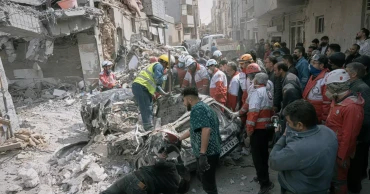
Several children reportedly died in a separate strike on a residential area in Tehran.
Israel strikes Iran nuclear sites; Tehran reports cvilian casualties
Explosions were heard in various parts of the capital, including near the Natanz nuclear facility—central to Iran’s uranium enrichment program. Witnesses and media outlets confirmed blasts, while Israel announced a state of emergency in anticipation of Iranian retaliation.
In a recorded statement, Israeli Prime Minister Benjamin Netanyahu acknowledged that Israel was behind the operation, targeting Iranian scientists involved in nuclear weapons development, ballistic missile systems, and the Natanz facility. "This operation will continue for as long as necessary to eliminate this threat," Netanyahu said.
Calling the moment "decisive" in Israel’s history, Netanyahu said the campaign aimed to roll back Iran's military threat to Israel’s existence.
A senior Israeli military official stated that Israel was hitting “dozens” of nuclear and military targets, including Natanz, and warned that Iran had accumulated enough enriched material to produce up to 15 nuclear bombs within days.
Citing Israeli sources, Axios reported that Mossad had carried out several covert sabotage missions inside Iran targeting strategic missile sites and air defense infrastructure.
Meanwhile, Israel’s Ben Gurion Airport was shut down until further notice, and the country's air defense forces were placed on high alert in anticipation of missile and drone attacks.
US orders partial evacuation of embassy in Iraq amid Iran tensions
“Following Israel’s preemptive strike, a retaliatory missile and UAV (drone) assault on Israeli territory and civilians is anticipated imminently,” Israeli Defense Minister Yoav Gallant said in a statement.
Source: With inputs from agencies
6 months ago
At least 52 killed in Gaza amid Israeli strikes as UN demands ceasefire
Israeli military operations across the Gaza Strip have resulted in at least 52 fatalities since early Thursday, according to medical sources cited by Al Jazeera. The casualties occurred as the United Nations General Assembly approved a resolution calling for an immediate and unconditional ceasefire in the territory.
Al Jazeera’s sources said that 26 of those killed were targeted by drone strikes while waiting in line for aid from the Gaza Humanitarian Foundation (GHF), a relief initiative backed by the United States and Israel.
Gaza civil defence official Mohammed el-Mougher told AFP that al-Awda Hospital received around 10 bodies and approximately 200 injured individuals following an Israeli drone attack near an aid distribution site close to the Netzarim checkpoint in central Gaza. Al-Shifa Hospital in Gaza City reportedly received six more bodies from similar strikes on aid queues in the Netzarim and as-Sudaniya areas.
Since the GHF began distributing aid in late May, dozens of Palestinians have died while trying to access supplies, according to Gaza’s civil defence agency. The GHF’s distribution method has drawn criticism from the United Nations. Philippe Lazzarini, head of the UN agency for Palestinian refugees (UNRWA), described the system as ineffective and potentially dangerous. Writing on X, Lazzarini said, “This model will not address the deepening hunger. The dystopian ‘Hunger Games’ cannot become the new reality,” calling instead for experienced humanitarian actors to be allowed to lead relief efforts.
In a separate incident, two people were reported killed by Israeli shelling in the Bir an-Naaja area west of Jabalia refugee camp in northern Gaza, according to a source at al-Shifa Hospital.
36 Palestinians killed while trying to access aid in Gaza, say officials
Meanwhile, Hamas condemned what it described as a deliberate Israeli move to cut communication infrastructure in Gaza, calling it an “aggressive step” in an ongoing “war of extermination.” The group urged the international community to intervene to protect civilians and critical facilities.
The communications blackout has hampered humanitarian coordination. UNRWA confirmed it had lost contact with its staff in Gaza. Deputy UN spokesperson Farhan Haq said military activity had likely severed the last remaining internet cable into the territory, leaving emergency and humanitarian services disconnected.
These developments coincided with the UN General Assembly’s adoption of a resolution demanding an immediate, unconditional, and permanent ceasefire. The resolution passed with broad support among the 193-member body, despite opposition from Israel, which labeled the measure a “politically motivated” and “counterproductive charade.” A similar resolution was vetoed by the United States in the Security Council last week.
Reporting from UN headquarters, Al Jazeera’s Gabriel Elizondo noted the resolution received two-thirds majority support, including backing from countries such as Germany, Austria, and Ukraine, which had previously abstained from similar votes. The resolution emphasized accountability, urging member states to take action to ensure respect for international humanitarian law.
Israel says Greta Thunberg has been deported after Gaza-bound ship she was on was seized
While the resolution is non-binding, Elizondo said the vote adds diplomatic pressure on Israel by signaling widespread international concern. Palestinian UN envoy Riyad Mansour welcomed the resolution and called for its full implementation. “This is the heart of the resolution,” he said, expressing gratitude to the countries that voted in favor, particularly Spain and others that supported the initiative.
Source: With inputs from Al Jazeera
6 months ago
Israel strikes Iran nuclear sites; Tehran reports cvilian casualties
Israel has confirmed carrying out airstrikes on nuclear facilities in Iran as part of a military operation it has dubbed Operation Rising Lion, amid soaring regional tensions.
According to the Israel Defense Forces (IDF), the strikes targeted multiple nuclear sites across Iran.
Explosions were reported in several parts of Tehran, with residents describing loud blasts and power disruptions in parts of the capital.
Prime Minister Benjamin Netanyahu said the operation was a necessary response to what he described as an "imminent threat to Israel's very survival" posed by Iran’s nuclear ambitions.
The offensive marks one of the most direct and dramatic escalations between the two longtime adversaries.
Israel has since declared a nationwide state of emergency, with authorities stating they expect retaliatory strikes "in the immediate future".
Iranian state media reported that residential areas in Tehran were struck, with children among the casualties. These reports have not been independently verified.
Death toll from Israeli attacks in Palestine exceeds 55, 000
In a separate claim, Iranian broadcasters said Major General Hossein Salami, the commander of the Islamic Revolutionary Guard Corps, was killed during the strikes.
No official confirmation has been issued by Iranian authorities.
The United States has denied any role in the attack. Speaking at a press briefing, US Secretary of State Marco Rubio stressed that the US had “no involvement or assistance in the Israeli operation”.
International responses have started to emerge, with Australia expressing deep concern.
"We are alarmed by the sharp escalation and call for restraint from all sides," a spokesperson for Australia’s Department of Foreign Affairs said.
UK and alies sanction two far-right Israeli ministers over ‘Extremist Violence’ remarks
The situation remains fluid as global powers monitor the fallout from the strikes and potential Iranian retaliation.
UN Secretary-General António Guterres has reportedly called for an emergency Security Council meeting.
Source: With inputs from BBC
6 months ago
US orders nonessential staff to leave Baghdad Embassy as Iran tensions rise
The United States is reducing the number of people deemed nonessential to operations in the Middle East, the State Department has announced. The U.S. is also authorizing nonessential personnel and family members to leave Bahrain and Kuwait, which will give them a choice on whether to leave those countries.
The State Department said it made the orders after evaluating recent tensions, which are on the rise in the region as high-stakes nuclear negotiations between the U.S. and Iran appear to have hit an impasse.
Danish Parliament approves U.S. military base deal amid Greenland concerns
Meanwhile President Donald Trump announced that China will make it easier for American industry to obtain magnets and rare earth minerals, clearing the way for trade talks to continue between the world’s two biggest economies. Trump also said Wednesday that the U.S. will stop efforts to revoke the visas of Chinese nationals on U.S. college campuses.
6 months ago
Death toll from Israeli attacks in Palestine exceeds 55, 000
The Palestinian death toll in the 20-month-long Israel-Hamas war has crossed 55,000, according to Gaza's Health Ministry on Wednesday. Among the latest casualties were at least 21 people reportedly killed while attempting to reach aid distribution points.
The exact circumstances surrounding the deaths near the aid locations remain unclear. The Israeli military said it fired warning shots in central Gaza at individuals it described as “suspects” posing a threat to its troops.
The Gaza Humanitarian Foundation (GHF), which manages several of the aid centers, claimed that five of its local staff members were killed en route to one of the distribution sites in an attack it attributed to Hamas.
While the Gaza Health Ministry does not differentiate between civilians and combatants in its casualty counts, it maintains that women and children make up more than half of the over 55,000 deaths. The ministry, part of Hamas’ de facto government in Gaza, reports 55,104 deaths and 127,394 injuries since the war began. These figures exclude Wednesday's fatalities and do not account for those believed to be trapped under rubble or in areas unreachable by emergency responders. Although Israel has often questioned these statistics, past tallies have generally aligned with independent assessments.
Aid Missions Turn DeadlyGazan health officials reported that 14 individuals were killed near Rafah while heading to collect humanitarian aid, with their bodies taken to Nasser Hospital in Khan Younis. Another seven people were reported dead near an aid site in central Gaza, according to Al-Awda Hospital.
The Israeli military said it had fired warning shots early Wednesday at people it identified as posing a threat in central Gaza but did not comment on the reported casualties near Rafah.
Among the victims was 16-year-old Ghazal Eyad. Her mother, Safaa Farmawi, told the AP she was killed while they were attempting to collect food. “She went ahead of me, and then people told me my daughter was martyred,” Farmawi said.
Frequent gunfire incidents have been reported near new aid centers, run by a recently formed organization not endorsed by the United Nations. While Palestinian witnesses claim Israeli forces have fired on civilians approaching aid, the Israeli army maintains it only fires warning shots at perceived threats.
The GHF said it has seen no violence at its distribution points and has advised people to follow designated routes. It temporarily halted aid operations to coordinate safety measures with Israeli authorities.
UK and alies sanction two far-right Israeli ministers over ‘Extremist Violence’ remarks
GHF Blames Hamas for Deadly Attack on Aid WorkersThe Gaza Humanitarian Foundation accused Hamas of targeting a bus carrying two dozen of its Palestinian aid workers heading to a distribution center near Khan Younis. At least five were killed and several others injured, the foundation said, adding that some may have been taken hostage.
“Our hearts are broken,” the foundation said in a statement. “Our thoughts and prayers are with every victim, every family, and every person still unaccounted for.” The AP has not independently verified the foundation’s account.
New Aid Delivery System Under ScrutinyThe newly introduced aid delivery system — rolled out last month — has been marred by confusion and violence. Meanwhile, the longstanding U.N.-managed system has struggled to function due to ongoing Israeli restrictions and deteriorating security conditions, even after Israel relaxed a strict blockade imposed from March to May.
Experts and rights groups warn that famine looms across Gaza unless Israel fully lifts its blockade and halts military operations. The Israeli government insists its new aid model is intended to prevent Hamas from diverting supplies. However, U.N. agencies and international aid groups argue there’s no evidence of large-scale diversion and claim the system violates humanitarian norms by centralizing control and causing further displacement.
Israeli Forces Recover Hostage RemainsIsrael announced on Wednesday that its forces retrieved the bodies of two hostages from Gaza. One was identified as Yair Yaakov, who was killed during the Hamas-led October 7 attack and whose body was taken into Gaza. His partner and two children were released earlier in a ceasefire deal. The identity of the second hostage was not disclosed.
Israeli Defense Minister Yoav Gallant described the recovery mission as "complex," without offering additional details. According to the military, the operation took place in Khan Younis.
The war began on October 7, 2023, when Hamas-led fighters launched a deadly attack, killing approximately 1,200 people — mostly civilians — and abducting 251 hostages. Israel has since recovered the remains of many hostages and rescued eight alive. Militants are still believed to be holding 53 captives, fewer than half of whom are thought to be alive.
Israel attacks Yemeni port city of Hodeida
Hamas says it will only release the remaining hostages in exchange for a lasting ceasefire, the release of Palestinian prisoners, and full Israeli withdrawal. The group has expressed willingness to transfer authority to a neutral Palestinian body but has not agreed to disarm.
Israeli Prime Minister Benjamin Netanyahu has rejected those terms, committing instead to temporary truces for hostage recovery. He vows to continue the war until all hostages are freed and Hamas is either dismantled or exiled. Netanyahu has also declared that Israel will retain long-term control over Gaza and facilitate what he calls the “voluntary emigration” of a significant portion of the Palestinian population — a proposal widely condemned as forced displacement and a potential breach of international law.
6 months ago
What to know about inspections of Iran's nuclear program by IAEA ahead of key board vote
Iran's nuclear program remains a top focus for inspectors from the International Atomic Energy Agency, particularly as any possible deal between Tehran and the United States over the program would likely rely on the agency long known as the United Nations' nuclear watchdog.
This week, Western nations will push for a measure at the IAEA's Board of Governors censuring Iran over its noncompliance with inspectors, pushing the matter before the U.N. Security Council. Barring any deal with Washington, Iran then could face what's known as “snapback” — the reimposition of all U.N. sanctions on it originally lifted by Tehran's 2015 nuclear deal with world powers, if one of its Western parties declares the Islamic Republic is out of compliance with it.
All this sets the stage for a renewed confrontation with Iran as the Mideast remains inflamed by Israel's war on Hamas in the Gaza Strip. And the IAEA's work in any case will make the Vienna-based agency a key player.
Here's more to know about the IAEA, its inspections of Iran and the deals — and dangers — at play.
Atoms for peace
The IAEA was created in 1957. The idea for it grew out of a 1953 speech given by U.S. President Dwight D. Eisenhower at the U.N., in which he urged the creation of an agency to monitor the world's nuclear stockpiles to ensure that “the miraculous inventiveness of man shall not be dedicated to his death, but consecrated to his life."
Broadly speaking, the agency verifies the reported stockpiles of member nations. Those nations are divided into three categories.
The vast majority are nations with so-called “comprehensive safeguards agreements" with the IAEA, states without nuclear weapons that allow IAE monitoring over all nuclear material and activities. Then there's the “voluntary offer agreements” with the world's original nuclear weapons states — China, France, Russia, the United Kingdom and the U.S. — typically for civilian sites.
Israel attacks Yemeni port city of Hodeida
Finally, the IAEA has “item-specific agreements” with India, Israel and Pakistan — nuclear-armed countries that haven't signed the Nuclear Nonproliferation Treaty. That treaty has countries agree not to build or obtain nuclear weapons. North Korea, which is also nuclear armed, said it has withdrawn from the treaty, though that's disputed by some experts.
The collapse of Iran's 2015 nuclear deal
Iran’s 2015 nuclear deal with world powers, negotiated under then-President Barack Obama, allowed Iran to enrich uranium to 3.67% — enough to fuel a nuclear power plant but far below the threshold of 90% needed for weapons-grade uranium. It also drastically reduced Iran's stockpile of uranium, limited its use of centrifuges and relied on the IAEA to oversee Tehran's compliance through additional oversight.
But President Donald Trump in his first term in 2018 unilaterally withdrew America from the accord, insisting it wasn't tough enough and didn't address Iran's missile program or its support for militant groups in the wider Mideast. That set in motion years of tensions, including attacks at sea and on land.
Iran now enriches up to 60%, a short, technical step away from weapons-grade levels. It also has enough of a stockpile to build multiple nuclear bombs, should it choose to do so. Iran has long insisted its nuclear program is for peaceful purposes, but the IAEA, Western intelligence agencies and others say Tehran had an organized weapons program up until 2003.
IAEA inspections and Iran
Under the 2015 deal, Iran agreed to allow the IAEA even greater access to its nuclear program. That included permanently installing cameras and sensors at nuclear sites. Those cameras, inside of metal housings sprayed with a special blue paint that shows any attempt to tamper with it, took still images of sensitive sites. Other devices, known as online enrichment monitors, measured the uranium enrichment level at Iran's Natanz nuclear facility.
Iran FM reaffirms cooperation after IAEA warns on uranium stockpile
The IAEA also regularly sent inspectors into Iranian sites to conduct surveys, sometimes collecting environmental samples with cotton clothes and swabs that would be tested at IAEA labs back in Austria. Others monitor Iranian sites via satellite images.
In the years since Trump's 2018 decision, Iran has limited IAEA inspections and stopped the agency from accessing camera footage. It's also removed cameras. At one point, Iran accused an IAEA inspector of testing positive for explosive nitrates, something the agency disputed.
The IAEA has engaged in years of negotiations with Iran to restore full access for its inspectors. While Tehran hasn't granted that, it also hasn't entirely thrown inspectors out. Analysts view this as part of Iran's wider strategy to use its nuclear program as a bargaining chip with the West.
What happens next
Iran and the U.S. have gone through five rounds of negotiations over a possible deal, with talks mediated by the sultanate of Oman. Iran appears poised to reject an American proposal over a deal this week.
Without a deal with the U.S., Iran’s long-ailing economy could enter a freefall that could worsen the simmering unrest at home. Israel or the U.S. might carry out long-threatened airstrikes targeting Iranian nuclear facilities. Experts fear Tehran in response could decide to fully end its cooperation with the IAEA, abandon the the Nuclear Nonproliferation Treaty and rush toward a bomb.
If a deal is reached — or at least a tentative understanding between the two sides — that likely will take the pressure off for an immediate military strike by the U.S. Gulf Arab states, which opposed Obama's negotiations with Iran in 2015, now welcome the talks under Trump. Any agreement would require the IAEA's inspectors to verify Iran's compliance.
But Israel, which has struck at Iranian-backed militants across the region, remains a wildcard on what it could do. Last year, it carried out its first military airstrikes on Iran — and has warned it is willing to take action alone to target Tehran's program, like it has in the past in Iraq in 1981 or Syria in 2007.
6 months ago