Middle-East
Israeli announces new strikes against Houthi rebels in Yemen's capital and ports
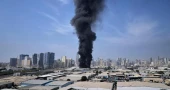
Houthi rebels in Yemen said Israeli airstrikes on Thursday targeted the rebel-held capital of Sanaa and the port city of Hodeida, following several days of Houthi launches setting off sirens in Israel.
The Israeli military said it attacked infrastructure used by the Houthis at the international airport in Sanaa and ports at Hodeida, Al-Salif and Ras Qantib along with power stations. Israeli Prime Minister Benjamin Netanyahu said in a speech on Wednesday that “the Houthis, too, will learn what Hamas and Hezbollah and Assad’s regime and others learned.”
The Iran-backed Houthis' media outlet reported the strikes in a Telegram post, but gave no immediate details. The U.S. military also has targeted the Houthis in Yemen in recent days. The United Nations has noted that the ports are important entryways for humanitarian aid.
Over the weekend, 16 people were wounded when a Houthi missile hit a playground in Tel Aviv. Last week, Israeli jets struck Sanaa and Hodeida, killing nine people, calling it a response to previous Houthi attacks. The Houthis also have been targeting shipping on the Red Sea corridor, calling it solidarity with Palestinians in Gaza.
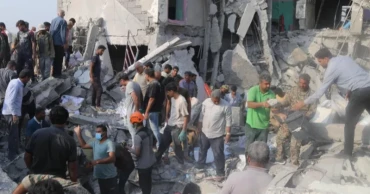
Meanwhile, an Israeli strike killed five Palestinian journalists outside a hospital in the Gaza Strip overnight, the territory's Health Ministry said. The Israeli military said that all were militants posing as reporters.
The strike hit a car outside Al-Awda Hospital in the built-up Nuseirat refugee camp in central Gaza. The journalists were working for the local news outlet Al-Quds Today, a television channel affiliated with the Islamic Jihad militant group.
Israeli strike kills 5 Palestinian journalists in Gaza
Islamic Jihad is a smaller and more extreme ally of Hamas and took part in the Oct. 7, 2023 attack in southern Israel, which ignited the war. The Israeli military identified four of the men as combat propagandists and said that intelligence, including a list of Islamic Jihad operatives found by soldiers in Gaza, had confirmed that all five were affiliated with the group.
Hamas, Islamic Jihad and other Palestinian militant groups operate political, media and charitable operations in addition to their armed wings.
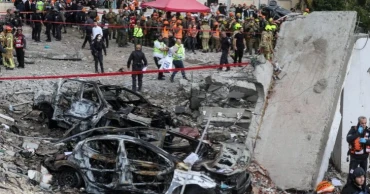
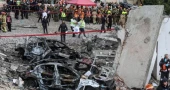
Associated Press footage showed the incinerated shell of a van, with press markings visible on the back doors. Sobbing young men attended the funeral outside the hospital. The bodies were wrapped in shrouds, with blue press vests draped over them.
The Committee to Protect Journalists says that more than 130 Palestinian reporters have been killed since the start of the war. Israel hasn't allowed foreign reporters to enter Gaza except on military embeds.
Israel has banned the pan-Arab Al Jazeera network and accused six of its Gaza reporters of being militants. The Qatar-based broadcaster denies the allegations and accuses Israel of trying to silence its war coverage, which has focused heavily on civilian casualties from Israeli military operations.
Separately, Israel's military said that a 35-year-old reserve soldier was killed during fighting in central Gaza early Thursday. A total of 389 soldiers have been killed in Gaza since the start of the ground operation more than a year ago.
The war began when Hamas-led militants stormed across the border in an attack on nearby army bases and farming communities. They killed around 1,200 people, mostly civilians, and abducted around 250. About 100 hostages are still inside Gaza, at least a third believed to be dead.
Ex-Israeli spy agents describe attack using exploding electronic devices against Hezbollah
Israel's air and ground offensive has killed more than 45,000 Palestinians, according to the Health Ministry. It says more than half the fatalities have been women and children, but doesn't say how many of the dead were fighters. Israel says it has killed more than 17,000 militants, without providing evidence.
The offensive has caused widespread destruction and driven around 90% of the population of 2.3 million from their homes. Hundreds of thousands are packed into squalid tent camps along the coast, with little protection from the cold, wet winter.
Also Thursday, people mourned eight Palestinians killed by Israeli military operations in and around the city of Tulkarem in the occupied West Bank on Tuesday, according to the Palestinian Health Ministry. The Israeli military said that it opened fire after militants attacked soldiers, and it was aware of uninvolved civilians who were harmed in the raid.
1 year ago
Israeli strike kills 5 Palestinian journalists in Gaza
An Israeli strike killed five Palestinian journalists outside a hospital in the Gaza Strip overnight, the Health Ministry said early Thursday. The Israeli military said it had targeted a group of militants.
The strike hit a car outside the Al-Awda Hospital in the built-up Nuseirat refugee camp in the central part of the territory. The journalists were working for the local Quds News Network, which also reported the strike.
The military said it targeted a group of fighters from Islamic Jihad, a militant group allied with Hamas, whose Oct. 7, 2023 attack into southern Israel ignited the war.
The Committee to Protect Journalists says over 130 Palestinian reporters have been killed since the start of the war. Israel has not allowed foreign reporters to enter Gaza except on military embeds.
The war began when Hamas-led militants stormed across the border in a surprise attack on nearby army bases and farming communities. They killed some 1,200 people, mostly civilians, and abducted around 250. Some 100 hostages are still inside Gaza, at least a third of whom are believed to be dead.
Read: Ex-Israeli spy agents describe attack using exploding electronic devices against Hezbollah
Israel's air and ground offensive has killed over 45,000 Palestinians, according to the Health Ministry. It says more than half the fatalities have been women and children but does not say how many of the dead were fighters.
The offensive has caused widespread destruction and driven around 90% of the population of 2.3 million from their. homes. Hundreds of thousands are packed into squalid tent camps along the coast, with little protection from the cold, wet winter.
1 year ago
Ex-Israeli spy agents describe attack using exploding electronic devices against Hezbollah
Two recently retired senior Israeli intelligence agents shared new details about a deadly clandestine operation years in the making that targeted Hezbollah militants in Lebanon and Syria using exploding pagers and walkie talkies three months ago.
Hezbollah began striking Israel almost immediately after Hamas’ Oct. 7, 2023, attack that sparked the Israel-Hamas war.
The agents spoke with CBS “60 Minutes” in a segment aired Sunday night. They wore masks and spoke with altered voices to hide their identities.
One agent said the operation started 10 years ago using walkie-talkies laden with hidden explosives, which Hezbollah didn't realize it was buying from Israel, its enemy. The walkie-talkies were not detonated until September, a day after booby-trapped pagers were set off.
“We created a pretend world,” said the officer, who went by the name “Michael.”
Phase two of the plan, using the booby-trapped pagers, kicked in in 2022 after Israel's Mossad intelligence agency learned Hezbollah had been buying pagers from a Taiwan-based company, the second officer said.
The pagers had to be made slightly larger to accommodate the explosives hidden inside. They were tested on dummies multiple times to find the right amount of explosive that would hurt only the Hezbollah fighter and not anyone else in close proximity.
Mossad also tested numerous ring tones to find one that sounded urgent enough to make someone pull the pager out of their pocket.
Read: Russia expels British diplomat after accusing him of spying
The second agent, who went by the name “Gabriel,” said it took two weeks to convince Hezbollah to switch to the heftier pager, in part by using false ads on YouTube promoting the devices as dustproof, waterproof, providing a long battery life and more.
He described the use of shell companies, including one based in Hungary, to dupe the Taiwanese firm, Gold Apollo, into unknowingly partnering with the Mossad.
Hezbollah also was unaware it was working with Israel.
Gabriel compared the ruse to a 1998 psychological film about a man who has no clue that he is living in a false world and his family and friends are actors paid to keep up the illusion.
“When they are buying from us, they have zero clue that they are buying from the Mossad,” Gabriel said. “We make like ‘Truman Show,’ everything is controlled by us behind the scene. In their experience, everything is normal. Everything was 100% kosher including businessman, marketing, engineers, showroom, everything.”
By September, Hezbollah militants had 5,000 pagers in their pockets.
Israel triggered the attack on Sept. 17, when pagers all over Lebanon started beeping. The devices would explode even if the person failed to push the buttons to read an incoming encrypted message.
The next day, Mossad activated the walkie-talkies, some of which exploded at funerals for some of the approximately 30 people who were killed in the pager attacks.
Gabriel said the goal was more about sending a message than actually killing Hezbollah fighters.
“If he just dead, so he’s dead. But if he’s wounded, you have to take him to the hospital, take care of him. You need to invest money and efforts,” he said. “And those people without hands and eyes are living proof, walking in Lebanon, of ‘don’t mess with us.’ They are walking proof of our superiority all around the Middle East.”
In the days after the attack, Israel's air force hit targets across Lebanon, killing thousands. Hezbollah's leader, Hassan Nasrallah, was assassinated when Israel dropped bombs on his bunker.
By November, the war between Israel and Hezbollah, a byproduct of the deadly attack by Hamas militants in southern Israel on Oct. 7, 2023, ended with a ceasefire. More than 45,000 Palestinians have been killed in the war in Gaza between Israel and Hamas militants, health officials have said.
Read more: Investigation into Chinese hacking reveals 'broad and significant' spying effort, FBI says
The agent using the name “Michael” said that the day after the pager explosions, people in Lebanon were afraid to turn on their air conditioners out of fear that they would explode, too.
“There is real fear,” he said.
Asked if that was intentional, he said, “We want them to feel vulnerable, which they are. We can’t use the pagers again because we already did that. We’ve already moved on to the next thing. And they’ll have to keep on trying to guess what the next thing is.”
1 year ago
Winter is hitting Gaza and many Palestinians have little protection from the cold
As winter sets in, nearly 2 million Palestinians displaced by 14 months of war in the Gaza Strip face severe hardships, struggling to shield themselves from the cold, rain, and wind.
Aid workers and residents report that families lack sufficient blankets, warm clothing, and firewood. Many are living in worn-out tents and makeshift shelters that have deteriorated due to prolonged use. Shadia Aiyada, who fled Rafah for Muwasi, shares a fragile tent with her eight children, relying on a single blanket and a hot water bottle to keep warm.
"We panic whenever we hear forecasts of rain and wind because our tents barely hold up," Aiyada said. "I worry my children will get sick without proper clothing."
Having escaped with only summer attire, her family now depends on borrowed clothes to endure the cold. Night temperatures in Gaza often drop to the mid-to-high single digits Celsius (40s Fahrenheit), increasing the risk of illness, especially among children.
Two US Navy pilots shot down over Red Sea in apparent 'friendly fire' incident
The United Nations has highlighted the precarious conditions, warning that makeshift shelters may not survive the winter. According to the U.N., at least 945,000 people urgently need winterization supplies, which have become unaffordable in Gaza. Rising malnutrition and the threat of infectious diseases further compound the crisis.
The U.N. Relief and Works Agency (UNRWA) has distributed 6,000 tents in northern Gaza over the past month but has been unable to deliver supplies to other areas due to ongoing hostilities. Essential items like 600,000 blankets and 33 truckloads of mattresses remain stuck in Jordan and Egypt, awaiting Israeli approval for transport. Many stored supplies have already been damaged by weather or looted.
The International Rescue Committee is also facing obstacles in delivering children’s winter clothing, citing lengthy approval processes from authorities. Dionne Wong, the group’s deputy director, emphasized the limited ability of Palestinians to prepare for winter.
Syrians celebrate during first Friday prayers since Assad’s ouster
Israel's government claims to have collaborated with international organizations to deliver heaters, clothing, tents, and blankets. However, aid workers say the supplies are far from adequate.
The war has killed over 45,000 Palestinians, according to Gaza's Health Ministry. The ministry states that more than half the casualties are women and children, though Israel claims to have killed over 17,000 militants. The war began after Hamas attacked southern Israel in October 2023, killing 1,200 people and taking 250 hostages.
Negotiators are reportedly making progress toward a ceasefire that could increase aid flow, but for now, displaced families face harsh conditions. Most cannot afford winter clothes, which have become prohibitively expensive.
Reda Abu Zarada, 50, displaced from northern Gaza, described nights spent huddling with her children to keep warm. She fears rats that roam their torn tent and dreads the possibility of finding her children frozen.
Omar Shabet, displaced from Gaza City, avoids lighting fires to stay warm, fearing airstrikes.
"We stay inside our tent after sunset because it gets unbearably cold," he said. "My 7-year-old daughter cries at night from the cold."
1 year ago
Rocket from Yemen Hits Tel Aviv, Injuring 16 People
A rocket launched from Yemen struck an area in Tel Aviv overnight, causing minor injuries to 16 individuals due to shattered glass from nearby windows, the Israeli military reported.
Additionally, 14 more people sustained slight injuries while rushing to shelters after air raid sirens went off just before 4 a.m. Saturday, according to the military.
Israel to close its Ireland Embassy amid Gaza tensions, Palestinian death toll hits 45,000
The incident occurred less than 48 hours after Israeli airstrikes targeted Yemen’s Houthi-controlled capital, Sanaa, and the port city of Hodeida. These strikes, which killed at least nine people, were in retaliation for a Houthi missile attack that hit an Israeli school building. The Houthis also claimed responsibility for a drone strike aimed at an undisclosed military site in central Israel on Thursday.
The Israeli military stated that the Iran-backed Houthis have fired over 200 missiles and drones during the ongoing Israel-Hamas conflict in Gaza. The Houthis have also targeted shipping lanes in the Red Sea and Gulf of Aden, asserting that such attacks will continue until a ceasefire is reached in Gaza.
Syrians celebrate during first Friday prayers since Assad’s ouster
United Nations spokesman Stephane Dujarric noted that Thursday’s Israeli airstrikes inflicted “significant damage” on Houthi-controlled Red Sea ports, which could substantially impact port capacity. The port in Hodeida is crucial for food shipments to Yemen, a country plagued by a decade-long civil war.
U.N. Secretary-General Antonio Guterres warned that the escalating attacks from both sides could further destabilize the region and jeopardize U.N. mediation efforts.
1 year ago
Two Charged for Supplying Tech Used in Deadly Iran-Backed Drone Attack
Two individuals, including a dual Iranian-American citizen, have been accused of aiding in the export of sensitive technology to Iran, which was used in a drone strike in Jordan earlier this year, killing three U.S. soldiers and injuring dozens more, the Justice Department announced Monday.
The arrests followed an FBI investigation linking the drone’s navigation system to an Iranian firm managed by one of the defendants. This individual allegedly collaborated with the second defendant to smuggle parts and technology into Iran, bypassing U.S. export laws, prosecutors said.
Palestinian refugees return to Yarmouk, facing uncertainty in post-war Syria
“These charges demonstrate the very real danger posed by American technology falling into the wrong hands,” said U.S. Attorney Joshua Levy during a press briefing.
The suspects, identified as Mahdi Mohammad Sadeghi, an employee at a Massachusetts semiconductor company, and Mohammad Abedininajafabadi, who was detained in Italy and is awaiting extradition, face multiple charges. Prosecutors claim Abedininajafabadi has significant ties to the Iranian government and runs a Tehran-based company producing navigation systems for military drones used by Iran’s Revolutionary Guard. The pair allegedly created a Swiss front company to facilitate the illegal technology transfer.
Sadeghi, a naturalized U.S. citizen, was arrested in Massachusetts and remains in custody. His legal representative has yet to comment. The charges against them include violations of export control laws, with Abedininajafabadi also facing counts of conspiring to provide material support to Iran.
Migrant workers in Lebanon struggle to return home amid alleged abuse and war
The January 28 drone attack struck a U.S. base in northeastern Jordan, killing Georgia soldiers Sgt. William Rivers, Sgt. Breonna Moffett, and Sgt. Kennedy Sanders. The drone, believed to have been mistaken for an incoming U.S. aircraft, crashed into residential quarters, injuring over 40 personnel. The U.S. attributed the attack to the Islamic Resistance in Iraq, a coalition of Iran-backed militias, including Kataib Hezbollah.
In response, the U.S. launched extensive strikes on militia sites in Iraq and Syria and strengthened defenses at the affected outpost, Tower 22. The base, situated near the borders of Jordan, Syria, and Iraq, housed 350 U.S. personnel at the time and gained strategic importance after escalating regional tensions following the October 7 Hamas attack on Israel.
Prosecutors expressed hope that these charges would bring a sense of justice to the victims and their families.
1 year ago
Israel to close its Ireland Embassy amid Gaza tensions, Palestinian death toll hits 45,000
Israel said Sunday it will close its embassy in Ireland as relations deteriorated over the war in Gaza, where Palestinian medical officials said new Israeli airstrikes killed over 30 people including several children.
The decision to close the embassy came in response to what Israel’s foreign minister has described as Ireland’s “extreme anti-Israel policies.” In May, Israel recalled its ambassador to Dublin after Ireland announced, along with Norway, Spain and Slovenia, it would recognize a Palestinian state.
The Irish cabinet last week decided to formally intervene in South Africa’s case against Israel at the International Court of Justice, which accuses Israel of committing genocide in Gaza. Israel denies it.
“We are concerned that a very narrow interpretation of what constitutes genocide leads to a culture of impunity in which the protection of civilians is minimized,” Ireland’s deputy premier and foreign affairs minister, Micheal Martin, said in a statement.
Germany warns Assad supporters in Syria against trying to flee there
Israeli Foreign Minister Gideon Saar's statement on the embassy closure said that “Ireland has crossed every red line in its relations with Israel.”
Ahead of Israel's announcement, Irish Prime Minister Simon Harris had called the decision to close the embassy “deeply regrettable.” He added on X: “I utterly reject the assertion that Ireland is anti-Israel. Ireland is pro-peace, pro-human rights and pro-international law.”
Israeli strikes hit Gaza
Israeli forces continued Sunday to pound largely isolated northern Gaza, as the Palestinian death toll in the war approached 45,000.
One airstrike hit the Khalil Aweida school in the town of Beit Hanoun and killed at least 15 people, according to nearby Kamal Adwan Hospital where casualties were taken. The dead included two parents and their daughter and a father and his son, the hospital said.
In Gaza City, at least 17 people including six women and five children were killed in three airstrikes that hit houses sheltering displaced people, according to Al-Ahli Baptist Hospital.
Israel's military in a statement said it struck a “terrorist cell” in Gaza City and a “terrorist meeting point” in the Beit Hanoun area.
Another Israeli airstrike killed a Palestinian journalist working for Al Jazeera, Ahmed al-Lawh, in central Gaza, a hospital and the Qatari-based TV station said.
The strike hit a point for Gaza’s civil defense agency in the urban Nuseirat refugee camp, Al-Awda Hospital said. The civil defense is the main rescue agency in Gaza and operates under the Hamas-run government.
The war in Gaza began after Hamas and other militants from Gaza stormed southern Israel on Oct. 7, 2023, killing some 1,200 people and taking well over 200 hostage.
Israel's retaliatory offensive has killed almost 45,000 Palestinians, according to Gaza's Health Ministry. The ministry’s count does not distinguish between combatants and civilians, but it says over half of the dead have been women and children.
1 year ago
Palestinian refugees return to Yarmouk, facing uncertainty in post-war Syria
The Yarmouk refugee camp outside Damascus was considered the capital of the Palestinian diaspora before the war in Syria reduced it to row after row of blasted out buildings where there were once falafel stands, pharmacies and mosques.
Taken over by a series of militant groups then bombarded by government planes, the camp has been all but abandoned since 2018. The buildings that were not destroyed by bombs were demolished by the government or stripped by thieves. Those who wanted to return to rebuild their homes were stymied by Kafkaesque bureaucratic and security requirements.
But bit by bit, the camp’s former occupants have trickled back. After the Dec. 8 fall of former Syrian President Bashar Assad in a lightening offensive by opposition forces, many more hope they will be able do so.
At the same time, Syria's Palestinian refugees — a population of about 450,000 — are unsure of their place in the new order.
Syrians celebrate during first Friday prayers since Assad’s ouster
“The new Syrian leadership, how will it deal with the Palestinian issue?” said Palestinian ambassador to Syria Samir al-Rifai. “We have no information because we have had no contact with each other so far.”
Days after Assad’s government collapsed, women walked in groups through the streets of Yarmouk while children played in the rubble. Motorcycles, bicycles and the occasional car passed between bombed-out buildings. In one of the less heavily damaged areas, a fruit and vegetable market was doing brisk business.
Some people were coming back for the first time in years to check on their homes. Others had been back before but only now were thinking about rebuilding and returning for good.
Ahmad al-Hussein left the camp in 2011, soon after the beginning of the anti-government uprising-turned-civil-war. A few months ago, driven by rising rents elsewhere, he came back to live with relatives in a part of the camp that was relatively untouched.
He is now hoping to rebuild his home in a building that was reduced to a hollowed-out shell and marked for demolition.
Under Assad’s rule, getting permission from security agencies to enter the camp “wasn’t easy,” al-Hussein said. “You would have to sit at a table and answer who’s your mother, who’s your father, and who in your family was arrested and who was with the rebels. … Twenty-thousand questions to get the approval,”
Ukraine's new procurement agency aims to boost NATO ambitions
He said people who had been reluctant now want to return, among them his son, who fled to Germany.
Taghrid Halawi came with two other women on Thursday to check on their houses. They spoke wistfully of the days when the streets of the camp used to buzz with life until 3 or 4 a.m.
“You really feel that your Palestine is here, even though you are far from Palestine,” Halawi said. “Even with all this destruction, I feel like it’s like heaven. I hope that everyone returns, all the ones who left the country or are living in other areas.”
Yarmouk was built in 1957 as a Palestinian refugee camp but grew into a vibrant suburb where many working-class Syrians settled. Before the war, some 1.2 million people lived in Yarmouk, including 160,000 Palestinians, according to the U.N. agency for Palestinian refugees, UNRWA. Today, it houses some 8,160 Palestinian refugees who remained or have returned.
Palestinian refugees in Syria are not given citizenship, ostensibly to preserve their right to go back to the homes they fled or were forced from during the 1948 creation of the state of Israel and where they are currently banned from returning.
But in contrast to neighboring Lebanon, where Palestinians are banned from owning property or working in many professions, in Syria, Palestinians historically had all the rights of citizens except the right to vote and run for office — a negligible matter given that the outcome of Syrian elections was largely predetermined.
At the same time, Palestinian factions have had a complicated relationship with Syrian authorities. Former Syrian President Hafez Assad and Palestinian Liberation Organization leader Yasser Arafat were bitter adversaries. Many Palestinians were imprisoned for belonging to Arafat's Fatah movement.
Mahmoud Dakhnous, a retired teacher who returned to Yarmouk to check on his demolished house, said he used to be frequently called in for questioning by the Syrian intelligence services.
“Despite their claims that they are with the (Palestinian) resistance, in the media they were, but on the ground the reality was something else," he said of the Assad dynasty.
In recent years, the Syrian government began to roll back the right of Palestinians to own and inherit property.
Syria struggles; Gaza nears famine, WFP warns
As for the country's new rulers, “we need more time to judge” their stance toward Syria's Palestinians, Dahknous said.
“But the signs so far in this week, the positions and proposals that are being put forward by the new government are good for the people and the citizens,” he said.
Yarmouk’s Palestinian factions tried to remain neutral when Syria’s civil war broke out, but by late 2012, the camp was pulled into the conflict and different factions took opposing sides.
Since the fall of Assad, the factions have been angling to solidify their relationship with the new government. A group of Palestinian factions said in a statement Wednesday that they had formed a body, headed by the Palestinian ambassador, to manage relations with Syria's new authorities.
The new leadership — headed by Hayat Tahrir al-Sham, an Islamic militant group — has not officially commented on the status of Palestinian refugees or regarding its stance toward Israel, which the previous Syrian government never recognized.
The Syrian interim government on Friday sent a complaint to the U.N. Security Council denouncing the incursion by Israeli forces into Syrian territory in the Golan Heights and their bombardment of multiple areas in Syria. But HTS leader Ahmad al-Sharaa, formerly known as Abu Mohammed al-Golani, has said the new administration does not seek a conflict with Israel.
Al-Rifai said the new government's security forces had entered the offices of three Palestinian factions and removed the weapons that were there, but that it was unclear whether there had been an official decision to disarm Palestinian groups.
“We are fully aware that the new leadership has issues that are more important” than the issue of Palestinian refugees, he said, including “the issue of stability first.”
For now, he said, Palestinians are hoping for the best. "We expect the relationship between us to be a better relationship.”
1 year ago
Syrians celebrate during first Friday prayers since Assad’s ouster
Thousands of Syrians gathered in Damascus on Friday for the first Muslim Friday prayers since the ousting of President Bashar Assad, marking a pivotal moment in the country’s dramatic political shift. The scene unfolded at the Umayyad Mosque, one of the world’s oldest and a powerful symbol of Syria’s heritage. Large crowds also filled the capital’s main square, celebrating the fall of the Assad regime after insurgents seized the city last Sunday, ending nearly five decades of authoritarian rule.
The gatherings were a major display of both jubilation and hope, coming almost a week after a surprise insurgent offensive ousted Assad's government. It also coincided with U.S. Secretary of State Antony Blinken’s diplomatic mission in the region to guide Syria’s political transition, urging the formation of an "inclusive and non-sectarian" interim government.
The key insurgent group, Hayat Tahrir al-Sham (HTS), has been working to establish security and start political reforms in the wake of Assad’s sudden fall. The group’s leadership, which had previously been associated with extremist views, has vowed to break from its past and promote a more inclusive government. However, HTS remains labeled a terrorist organization by the United States and the European Union.
HTS leader Ahmad al-Sharaa (formerly Abu Mohammed al-Golani) addressed the nation in a video message on Friday, celebrating the “victory of the blessed revolution” and urging Syrians to celebrate peacefully without resorting to violence. He promised that the insurgents would work to build a new Syria, united under a government that includes all citizens.
The Friday prayers at the Umayyad Mosque were a highly symbolic occasion. The mosque, which has been a center of worship and power for over 1,200 years, was once tightly controlled under Assad’s regime, with sermons strictly censored. In the early days of the uprising in 2011, it was here that many anti-regime protests began after Friday prayers, which were met with violent crackdowns.
Read: Syria struggles; Gaza nears famine, WFP warns
One worshipper, Ibrahim al-Araby, expressed his joy at being able to attend the prayers after more than a decade of restrictions. "Since 2011, I haven’t been this happy," he said, reflecting on the newfound sense of freedom under the new government. However, others like Khair Taha expressed mixed emotions, balancing hope for the future with uncertainty over the country's transition.
In Umayyad Square, the city’s largest roundabout, thousands of Syrians continued the celebrations, chanting slogans like "Unified Syria to build Syria." Some protesters, emboldened by the regime's collapse, even shouted insults at the late President Hafez al-Assad and his son Bashar, something unthinkable under the previous regime.
Khaled Abu Chahine, a 51-year-old from Daraa, the birthplace of the 2011 uprising, shared his hope for a new Syria: "I hope for freedom and coexistence between all Syrians—Alawites, Sunnis, Shiites, and Druze."
The Friday’s prayers and celebrations were part of a broader shift in Syria, with the country now under the control of HTS, a group long based in the opposition-controlled enclave of Idlib. The group has promised to build a government free of corruption, similar to the one in Idlib, which many in the capital saw as a positive step.
The Syrian insurgents face several challenges, including the need to win international recognition for their new government and to ease fears from minority communities about the group’s future direction. Key regional players like Turkey and the U.S. are closely monitoring developments, with Blinken advocating for a transition that guarantees minority rights and regional stability.
Read more: US keen to support Syrian leaders on conditions
In the midst of this, the U.S. continues to have troops in eastern Syria, focusing on defeating remnants of ISIS, while Israel carries out airstrikes in the country, reportedly targeting weapon shipments to extremist groups.
With Syria’s future still uncertain, global powers are keen to shape the country’s post-Assad era, aiming to ensure that extremist groups do not regain control and that stability is restored in the war-torn nation.
1 year ago
Over 50 killed in Israeli strikes in Gaza
An Israeli airstrike flattened a multistory building in central Gaza, killing at least 25 people and wounding dozens more, according to Palestinian medical officials, after strikes Thursday across the Gaza Strip killed at least 28 others.
The latest deadly strike hit the urban Nuseirat refugee camp just hours after U.S. President Joe Biden’s national security adviser, Jake Sullivan, told reporters in Jerusalem that the recent ceasefire in Lebanon has helped clear the way for a potential deal to end the war in Gaza between Israel and Hamas.
Israeli airstrikes in Gaza kill 28: Palestinian Officials Report
The Israeli military did not immediately comment on the deadly strike in Nuseirat. Israel says it is trying to eliminate Hamas, which led the attack on southern Israel in October 2023 that sparked the war in Gaza. The Israeli military says Hamas militants hide among Gaza’s civilian population.
The fighting has plunged Gaza into a severe humanitarian crisis, with experts warning of famine in some of the hardest-hit parts of the territory.
Israel’s offensive has killed over 44,800 Palestinians in Gaza, more than half of them women and children, according to the Gaza Health Ministry, which does not say how many were combatants. The Israeli military says it has killed over 17,000 militants, without providing evidence.
Israeli strike kills 19 people in northern Gaza
The Oct. 7, 2023 attack by Hamas killed some 1,200 people, mostly civilians, and around 250 others were taken hostage. Some 100 hostages are still inside Gaza, at least a third of whom are believed to be dead.
1 year ago