others

Lightning deaths in Bangladesh: Lack of shelters, awareness leaves rural people vulnerable
Lightning strikes have killed at least 11 people, including seven farmers, since Monday evening, highlighting a worsening and often overlooked climate threat in Bangladesh.
Among them at least nine people were killed by lightning strikes in Gaibandha, Bogura, Thakurgaon, Sirajganj and Natore districts on Sunday.
Besides, two farmers were killed in separate lightning strikes in Sunamganj Sadar upazila on Monday afternoon while harvesting paddy in haor areas, and three more people were injured in Shantiganj upazila.
Experts say the rising death toll is closely linked to climate change, which is intensifying storm patterns and increasing the frequency of lightning strikes across the country.
Data compiled by the Save the Society and Thunderstorm Awareness Forum (SSTF) show that 297 people — 242 men and 55 women — died from lightning between February and September in 2024. In an earlier period, from April 2022 to May 3, 2023, at least 340 people were killed.
Bangladesh, long vulnerable to extreme weather, records an average of around 300 lightning-related deaths annually, according to UN estimates.
By contrast, the United States — with nearly double Bangladesh’s population — reports fewer than 20 such deaths each year.
In the 1990s, annual fatalities in Bangladesh were only in the dozens, indicating a sharp upward trend over the decades.
Scientists and agencies, including NASA and the United Nations, attribute the increase to heightened atmospheric instability driven by global warming, leading to more frequent and intense thunderstorms.
Recognising the growing danger, the government has included lightning strikes in the official list of natural disasters in 2016 alongside floods, cyclones, earthquakes and droughts but the death toll from lightning keeps rising apparently for government inadequate measures and lack of people’s awareness.
Farmers most at risk
A majority of lightning victims are farmers, who spend long hours in open fields during the monsoon — the peak lightning season.
With limited access to safe shelters, they are particularly exposed when sudden storms develop.
In the low-lying areas of Sunamganj in north-eastern Sylhet Division, vast haors and wetlands sustain local livelihoods—but they also leave communities dangerously exposed to lightning strikes.
As climate change intensifies extreme weather, frequent thunderstorms have made lightning an increasingly deadly threat across these open landscapes.
The government is ramping up efforts to curb lightning deaths through early warnings, plantation drives and protective infrastructure, Disaster Management and Relief Minister Asadul Habib Dulu told parliament on Monday.
Responding to a notice raised by Sunamganj-1 lawmaker Kamruzzaman Kamrul, he said steps are being taken to protect people in haor and other high-risk areas, where farmers and fishers are especially exposed during summer and monsoon storms.
Kamrul said vast haor wetlands in his constituency leave residents vulnerable year-round, noting that at least 12 people were recently killed by lightning, including four in his area.
Citing NASA data, he added that Sunamganj’s haor belt records over 25 strikes per square kilometre.
Despite lightning being declared a national disaster, he pointed to gaps in effective programmes, data, equipment and shelters, urging science-based planning and more research.
The minister said lightning incidents have increased in recent years, particularly in haor and north-eastern regions.
He highlighted measures including awareness campaigns, planned sirens for early alerts, expanded palm tree plantation, and installation of lightning protection towers.
In an effort to reduce casualties, SSTF has stepped up awareness campaigns in rural areas.
It issued a three-point safety guideline for those working outdoors:
First, people should avoid getting wet in the rain or taking shelter under trees in open areas — one of the most common causes of fatalities.
Second, anyone in fields, rivers, canals or ponds should immediately seek refuge in a nearby building or concrete structure. If that is not available, they should move to a relatively safer, lower-lying area.
Third, children should be kept away from open fields during storms, and outdoor activities should be suspended.
SSTF also called for coordinated efforts by government agencies and civil society to expand awareness programmes during the peak lightning months of May and June, provide free treatment to the injured, and ensure compensation of Tk 5 lakh for families of victims.
Simple steps can save lives
Safety experts stress that many lightning deaths are preventable with basic precautions. The safest place during a thunderstorm is inside a fully enclosed building or a vehicle with a metal roof.
People are advised to avoid open spaces, elevated areas, tall trees and small temporary shelters. Doors and windows should be kept closed, and contact with metal objects, water and electrical appliances should be avoided.
If caught outdoors with no shelter, individuals should crouch low to the ground, minimising contact rather than lying flat. Those on water bodies should return to land immediately, as swimming or boating during storms significantly increases risk.
In forested areas, safer spots are low-lying zones with shorter, closely spaced trees rather than isolated tall ones.
As climate risks intensify, experts warn that without sustained awareness and protective measures, lightning will continue to claim hundreds of lives each year — many of them in vulnerable rural communities where a moment’s delay can prove fatal.
1 month ago
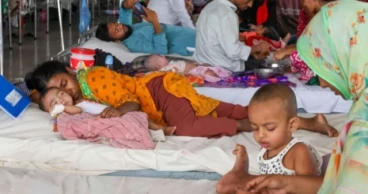
Five die of measles, similar symptoms in 24 hours: DGHS
Five children have died from measles and measles-like symptoms in the country in the last 24 hours till 8:00am on Monday, according to the Directorate General of Health Services (DGHS).
Of the deaths reported, one was confirmed as measles-related, while four others were classified as suspected.
With this, the total number of confirmed deaths from measles has risen to 44 and suspected deaths to 220 since March 15.The DGHS data shows that a total of 1,358 suspected measles cases were recorded in the past 24 hours. Since March 15, the cumulative number of suspected cases has risen to 33,386.
During the 24-hour period, 90 new confirmed measles cases were reported, bringing the total number of confirmed infections to 4,693.
A total of 22,442 suspected measles patients have been hospitalised since March 15 and 19,018 of them have recovered and been released.
1 month ago
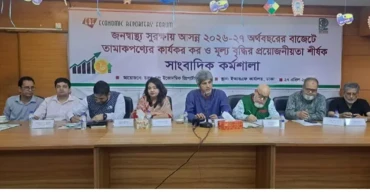
Prioritizing tobacco tax hikes to bolster internal revenue and increase spend in health: Planning State Minister
State Minister for Planning Md. Junaid Abdur Rahim Saki on Monday emphasized the need to strengthen national budget by increasing internal revenue, identifying higher taxes on tobacco as a top priority for both fiscal stability and public health.
Speaking as the chief guest at a seminar titled ‘Necessity of Effective Tobacco Tax and Price Hikes in the Upcoming FY 2026-27 Budget to Protect Public Health,’ the state minister stressed that reducing debt dependency is essential for the country’s true development.
Youth demand effective tobacco tax and pricing in upcoming budget
The event was jointly organized by the Economic Reporters' Forum (ERF) and the Development Organisation of the Rural Poor (DORP) at the ERF auditorium in the capital.
Saki expressed sharp dissatisfaction with the current state of digitalization at the National Board of Revenue (NBR). "Although Tk 400 crore has been spent on NBR digitalization, it is not functioning effectively. Paying for maintenance year after year without results has turned into a process of draining state resources rather than collecting them," he said.
He argued that without genuine institutional capacity, relying on loans for the Annual Development Programme (ADP) would not lead to sustainable progress.
State Minister Saki called for setting the base price and taxes of tobacco products at a level that significantly discourages consumption.
However, he balanced this by advocating for the rights of tobacco farmers and workers.
"Tobacco companies keep product prices low by underpaying workers and farmers. If we ensure fair wages for laborers, the price of these products will naturally rise, which will indirectly help reduce tobacco use," he noted.
The state minister also highlighted the issue of "fake bandrolls" being smuggled from abroad to evade taxes. He directed the NBR to establish a specialized monitoring system to close these loopholes, which cause massive revenue losses for the government every year.
Special Guest Md. Mashiur Rahman, First Secretary (VAT Policy) of the NBR, informed the session that cigarette supply has seen a decline following the tax measures taken in 2024.
He recommended a licensing system for retail cigarette sales and a more robust "tracking and tracing" system in coordination with the Health Ministry.
Presenting a research paper, Professor Dr. Shafiun Nahin Shimul of the Institute of Health Economics, Dhaka University, noted that 90 percent of the cigarette market in Bangladesh is dominated by low and medium-tier products.
He proposed merging these two tiers and imposing significantly higher supplementary duties.
The seminar concluded with a warning from former Secretary Md. Azhar Ali Talukdar, who noted that while the government earns revenue from tobacco, it spends more than double that amount addressing the resulting health and environmental damages.
ERF president Doulat Akter Mala and General Secretary Abul Kashem also spoke at the event.
1 month ago
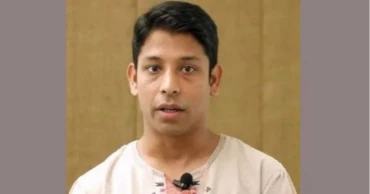
Mimo’s death: DU teacher Sudip Chakroborthy lands in jail
A Dhaka court on Monday sent Dr Sudip Chakroborthy, an associate professor of the Department of Theatre and Performance Studies at Dhaka University (DU), to jail in a case filed over the alleged abetment of the suicide of department student Munira Mahjabin Mimo.
Dhaka Metropolitan Magistrate Md Ripon Hossain passed the order after rejecting his bail petition.
The investigation officer of the case, Sub-Inspector Kazi Iqbal Hossain of Badda Police Station, appealed to the court to keep the accused in custody.
In the plea, he said primary findings indicate Sudip Chakroborthy’s involvement in the incident, while verification of his identity and address is still underway.
The IO also stated that keeping him in jail is necessary for the sake of a fair investigation.
Police arrested Sudip Chakraborty from Uttar Badda on Sunday after Mimo was found hanging at her residence in the same area.
A note was recovered from the scene, which reportedly mentioned the involvement of the teacher in the incident.
Following the incident, Mimo’s father filed a case against Sudip Chakroborthy, accusing him of abetting his daughter’s suicide.
1 month ago
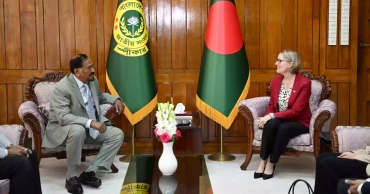
British High Commissioner meets Speaker
British High Commissioner to Bangladesh Sarah Cooke paid a courtesy call on Speaker Hafiz Uddin Ahmad, Bir Bikram, at his Jatiya Sangsad Bhaban office on Monday.
During the meeting, the Speaker said Bangladesh and the United Kingdom have always enjoyed friendly relations and recalled that the people of the UK extended wholehearted support to Bangladesh during the 1971 Liberation War.
He said Bangladesh follows the Westminster system of democracy and mentioned that former Prime Minister Khaleda Zia restored parliamentary democracy in 1991.
Hafiz Uddin said the latest parliamentary election was free, fair and participatory, reflecting the aspirations of the people.
The current government remains accountable to the people, he said.
Highlighting development efforts, the Speaker praised the Prime Minister’s initiatives to address the problems of grassroots people and marginal farmers, describing them as widely appreciated.
He also emphasised that the government is working relentlessly to expand quality and technical education, adding that the UK could play a significant role in improving the standard of tertiary education in Bangladesh.
The two sides discussed bilateral cooperation in education, foreign direct investment, and the migration crisis, including possible solutions.
They also exchanged views on parliamentary democracy, including UK support for democratic reform, women's political participation and Commonwealth parliamentary cooperation.
High Commissioner Sarah Cooke reaffirmed that the UK will continue to stand by Bangladesh in its democratic journey. Referring to the ongoing tensions in the Middle East, she said the British government discourages any form of war and conflict.
She congratulated the Speaker on his election to the post. The Speaker, in turn, stressed the importance of forming a parliamentary friendship group with the UK and enhancing exchange visits between parliamentary delegations, according to a press release.
1 month ago

CPJ writes letter to Law Minister in favour of jailed journalists
The Committee to Protect Journalists (CPJ) has written to Law, Justice and Parliamentary Affairs Minister Md Asaduzzaman, urging the new government to fulfill its election promise to withdraw ‘politically motivated’ cases against journalists, and to drop charges and release Mozammel Haq Babu, Shyamal Dutta, Farzana Rupa and Shakil Ahmed.
The journalists have been detained for more than 18 months on murder charges, for which no credible evidence has been presented and no charge sheet served, CPJ said.
In the letter on Monday, CPJ noted that the journalists’ arrests under the previous government appeared to be in retaliation for perceived political affiliations.
In almost 600 days, and in violation of legal regulations, the police have failed to file charge sheets substantiating the charges on which the journalists were arrested.
CPJ also raised ‘serious humanitarian concerns’ and said Dutta has documented cardiac and severe sleep apnea conditions that remain unassessed.
On the other hand, Babu underwent major invasive surgery for prostate cancer in late 2023, but has not received follow-up care, CPJ said.
It said Rupa was held for two weeks in November 2024 in a “condemnation cell” reserved for death-row inmates.
The CPJ also shared with Attorney General Barrister Md Ruhul Quddus Kazal, Home Minister Salahuddin Ahmed and Information and Broadcasting Minister Zahir Uddin Swapon.
1 month ago

River erosion threatens farmland, homes in Barishal; locals seek urgent project approval
River erosion in Babuganj and Ujirpur upazilas of Barishal has reached alarming levels, threatening agricultural land, rural infrastructure and the livelihoods of thousands living along the Sugandha and Sandha rivers.
In a formal appeal to the Ministry of Water Resources, Member of Parliament for Barishal-2 constituency Sardar Sarfuddin Ahmed urged the government to expedite the approval and implementation of a long-pending riverbank protection project.
The appeal highlights severe losses of farmland and agricultural production, along with growing risks to connectivity and local economic activities.
According to the letter, nearly 6,805 hectares of fertile land are lost to erosion each year in the affected areas. The erosion also causes an estimated annual loss of 862 metric tons of paddy, raising concerns over local and national food security.
“The situation has become extremely critical. Every year, rivers are swallowing vast areas of cultivable land, leaving farmers helpless,” the MP said in the letter.
Residents of Ujirpur upazila live in constant fear, especially during the monsoon, as riverbanks collapse unpredictably. Many families stay awake at night monitoring water levels, worried about losing their homes, land and livestock.
Dr Enayet Karim, president of Barishal Zila Samity, said river erosion has become a persistent threat to local communities. During the rainy season, families remain anxious as their houses and fields could disappear into the river at any time, he added.
The ongoing erosion has also damaged roads, bridges, culverts and power lines, disrupting communication and forcing repeated government spending on repairs without permanent solutions.
The letter also points to the economic importance of the affected areas. Satla union is known for its red lotus fields, attracting domestic tourists, while Harta union serves as a major fish market supplying different parts of the country. Agriculture, fisheries and tourism together form the backbone of local livelihoods.
However, a key road connecting five unions runs close to the erosion-prone riverbanks. Officials fear that continued erosion could destroy the road, cutting off transport links and affecting tourism.
“If the road is lost, communication for five unions will be severed and a major tourist attraction will be affected,” the letter warned.
According to official information, the proposed river protection project has already undergone a verification meeting at the Ministry of Water Resources and is listed under the revised Annual Development Programme for FY2025-26.
The MP called on the Planning Ministry and the Executive Committee of the National Economic Council to prioritise approval of the project, stressing that immediate action is needed to protect lives, livelihoods and infrastructure.
Local representatives and residents have also urged the government to treat the issue as a national priority, warning that delays could lead to irreversible economic losses.
Experts say the situation reflects a broader pattern of worsening river erosion across Bangladesh, particularly in coastal and riverine districts, driven by climate change, unregulated river flow and weak embankment systems.
1 month ago
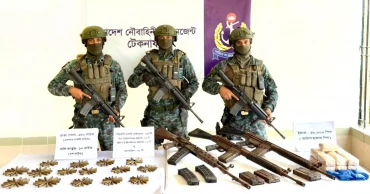
Navy seizes foreign firearms, ammunition and yaba in Teknaf drive
Bangladesh Navy seized a large cache of foreign firearms, ammunition and yaba pills during a special operation in Teknaf upazila of Cox’s Bazar late Sunday night, officials said.
The Navy has been conducting regular drives in its responsible area to curb drugs, recover illegal arms, and suppress terrorism and crime, they added.
Acting on secret information, two well-coordinated operational teams of the Bangladesh Navy, including specialised force SWADS, carried out the drive in the Phuler Dail area under Hnila union of Teknaf.
During the drive, law enforcers searched the house of M Delwar Hossain, an associate of warrant-listed accused Bhuttu Saiful, and recovered two G3 rifles, one MA1 rifle, eight magazines, 190 rounds of live ammunition and 10 empty cartridges.
They also seized 28,000 yaba pills that had been stockpiled for smuggling, officials said.
The recovered arms, ammunition and seized narcotics were later handed over to the relevant authorities for further legal action.
Officials said Bangladesh Navy will continue its anti-drug drives, operations against terrorism and crime, and arms recovery missions in Teknaf and other responsible areas, maintaining strict vigilance to ensure national security.
1 month ago
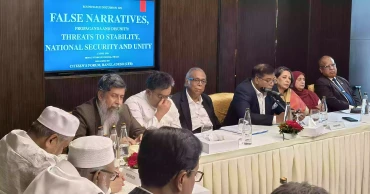
Misinformation surge threatens national unity, security: Citizen’s Forum
A prominent civil society platform has called for immediately curbing the spread of online misinformation in Bangladesh, warning that the unchecked flow of false narratives poses a grave threat to national unity and security.
The call came at a discussion organised on Monday by Citizen’s Forum Bangladesh (CFB) titled “False Narratives, Propaganda and Disunity: Threats to Stability, National Security and Unity” where speakers outlined the alarming scale and speed at which disinformation is proliferating across social media platforms.
Bangladesh seeks UNDP’s help in tackling misinformation, disinformation
Participants noted that deliberate misinformation campaigns have been particularly active during the country’s ongoing fuel crisis, periods of student political activity, and in the aftermath of elections.
University Grants Commission (UGC) Chairman Prof Mamun Ahmed cautioned that university campuses have already been destabilised by coordinated disinformation. “If the spread of misinformation in university areas is not stopped, the country will become unstable once again. It is propaganda alone that has turned these campuses volatile.”
Mahfuz Kabir, Research Director at the Bangladesh Institute of International and Strategic Studies (BIISS), stressed the critical need for real-time counter-responses, warning that the current pace of institutional rebuttals is no match for the speed of disinformation.
Citing a recent false claim that Bangladesh Bank was printing money to fund the government, he said it took seven days to debunk the report – far too long. “In that prolonged interval, a large number of people had already accepted the fabrication as fact. We cannot afford such delays; misinformation must be countered instantly.”
Abidul Islam Khan, Joint General Secretary of Dhaka University unit of Jatiyatabadi Chhatra Dal, alleged that actors who previously operated covertly are now openly running propaganda campaigns.
“Those who once called us oppressed in July are now branding us oppressors. These are bot pages, systematically tarnishing our reputation,” he said, adding that sustaining legitimate political activity would become untenable if such propaganda is not swiftly curtailed
CFB Chairman M Anwarullah Chowdhury presided over the event, urging all stakeholders to reject falsehoods, embrace truth, and champion a culture of principled politics in the national interest.
1 month ago
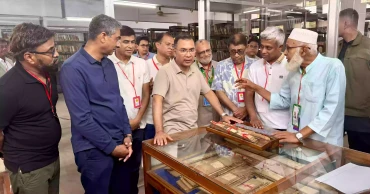
PM for reducing screen time, promoting reading habit among children
Prime Minister Tarique Rahman on Monday said the government has taken a plan to build a reading habit among children, keep them away from excessive mobile phone use and reduce their dependence on digital devices.
“We want to develop the practice of reading books. We want to bring children out of mobile phones and into playgrounds and books. This is our plan,” he said while visiting the historic Jashore Institute Public Library in the afternoon.
The Prime Minister was speaking to citizens present at the library.
PM urges people not to pamper those trying to create chaos
“How successful we will be is a different matter. But we want to start the work. When we see people like you, we feel encouraged. Personally, I feel inspired that there are still people who love reading books. I believe we will succeed in this work,” he said.
Tarique Rahman said the government will seek cooperation from citizens to implement the initiative.
“We expect your support. The government starts this work, and with organisations like the Bishwo Shahitto Kendro, we want to work together. We will need support from people like you across the country to expand reading habits quickly,” he added.
The Prime Minister said his aim is to reduce children’s dependence on mobile phones and encourage reading habits.
“I had this wish, as I said, to bring children away from mobile phones and develop reading habits. You may have seen that I sat with Professor Abdullah Abu Sayeed. His organisation Bishwo Shahitto Kendro is working on book reading,” he said.
Tarique Rahman added that the government plans to work with the organisation to promote reading.
“We are thinking of selecting two primary schools in each upazila where we will provide books for children. These will not be political books. There are many educational books outside politics that will help children learn about the world, religion, and life,” he said.
The Prime Minister also said reading will be linked with education assessment.
“We will gradually build reading habits by giving books. The content they read will also be included in examinations, meaning questions will come from those books, and they will be assessed based on them,” he added.
He also spoke with officials of the Jashore Institute Public Library.
Earlier, after inaugurating the 500-bed Jashore Medical College Hospital building, the Prime Minister visited the public library and toured the historic facility.
The Jashore Public Library was established in 1851 and is one of the oldest libraries in Bangladesh as well as one of the oldest in South Asia. It was established during the early phase of the public library movement in the Indian subcontinent.
According to Wikipedia, Jashore Town Hall was built in 1904 and Arya Theatre in 1919. In 1927, Rai Bahadur Jatindranath Majumder combined the Arya Theatre, Town Club and the Public Library to form a unified cultural and community centre in Jashore. This later became Jashore Institute, which was renamed Jashore Institute Public Library by the government.
Health and Family Welfare Minister Sardar Md Sakhawat Husain, Water Resources Minister Shahid Uddin Chowdhury Anee, State Minister Forhad Hossain Azad, State Minister for Power, Energy and Mineral Resources Aninda Islam Amit, and Prime Minister’s Press Secretary Abu Abdullah M Saleh (Saleh Shibly) and Additional Press Secretary Atikur Rahman Rumon, among others, were present.
1 month ago