bangladesh
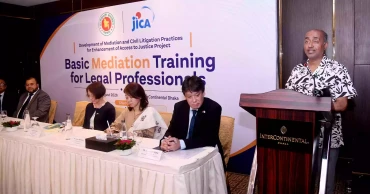
Effective mediation can significantly reduce case backlog: Law Minister
Law Minister Md Asaduzzaman on Saturday said effective mediation could significantly reduce the backlog of around 4.5 million cases pending in courts across the country.
Speaking at the closing ceremony of a two-day Basic Mediation Training for Legal Professionals programme at Hotel InterContinental in the capital, the minister said mediation saves litigants time, money and mental distress while ensuring faster justice.
The training was organised under the project titled Mediation and Civil Case Management System Development to Increase Access to Justice.
Asaduzzaman said ensuring justice for the poor, marginalised, disadvantaged and victims of human rights violations remains one of the government's priorities.
He said the Bangladesh Legal Aid Department has been working to deliver justice to people's doorsteps.
He said mediators need not only legal knowledge but also humanity, wisdom, patience and the ability to build trust between disputing parties. In this regard, he encouraged participants to read the Japanese book Justice with a Smile, saying it would help them develop a more humane approach to dispute resolution.
The minister said there is a common perception that lawyers are often reluctant to encourage settlements, but in reality they play an important role in many successful mediations and arbitrations both at home and abroad.
He said a positive culture of negotiation-based dispute resolution is gradually developing within the legal profession and should be further strengthened.
Describing mediation as beneficial for both parties, Asaduzzaman said prolonged court proceedings often consume years, financial resources and considerable effort, while also causing mental stress and other health problems.
He said a culture of resolving most disputes through mediation should be promoted, except in cases involving murder and other serious cognisable offences.
Under the project, the best-performing female and male mediators will receive advanced training in Japan, he said, expressing hope that the initiative would encourage mediators to perform their duties more efficiently, impartially, transparently and professionally.
The minister thanked the Government of Japan, the Japan International Cooperation Agency (JICA), Professor Miyatake Masako of Keio University Law School, and all others involved in the project.
He also expressed hope that cooperation between Bangladesh and Japan would continue to grow and stressed the need to increase the number of direct flights between Dhaka and Narita.
2 days ago
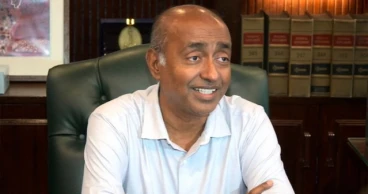
Enforced Disappearance bill ready for Cabinet approval: Law Minister
Law, Justice and Parliamentary Affairs Minister Md. Asaduzzaman on Saturday said the proposed “Enforced Disappearance Prevention and Remedies Act” is in its final stage of preparation and is expected to be placed before the Cabinet shortly, with the government aiming to table the bill in the next session of parliament.
Speaking to reporters after the closing ceremony of a two-day Basic Mediation Training for Legal Professionals programme at Hotel InterContinental Dhaka, the Minister said the draft law has undergone inter-ministerial scrutiny, consultations with stakeholders and review by the Secretaries' Committee.
He said the government had announced during the first session of the 13th Jatiya Sangsad that the draft law would be further reviewed and refined before being placed in parliament. Following multiple rounds of consultations and assessments, the draft has now been finalised and is awaiting Cabinet approval.
On the proposed cyber law, the Minister said the government is working to formulate a modern and balanced legal framework that safeguards the constitutional right to freedom of expression while effectively addressing cybercrime, defamation, the spread of misinformation and the misuse of artificial intelligence (AI) and other technologies.
He said the government does not want to rush the process and will finalise the law only after further scrutiny and consultations with relevant stakeholders.
"The government does not intend to silence people or restrict freedom of expression. At the same time, it is committed to ensuring an effective legal framework to protect citizens' rights and reputations," he said.
2 days ago

Tourist dies while parasailing at Cox's Bazar beach
A tourist died after falling into the sea while parasailing at the Sea Sports Parasailing Point in the Dariyanagar area along Cox's Bazar's Marine Drive on Saturday.
The deceased was identified as Shouvik Roy, a resident of Khulna district. He had travelled to Cox's Bazar with a tour group.
Sheikh Mohammad Ali, Officer-in-Charge (OC) of Cox's Bazar Sadar Model Police Station, said the accident occurred at around 12:30 pm in the Dariyanagar beach area.
Subaktagin Mohammad Sahel, Resident Medical Officer (RMO) of Cox's Bazar Sadar Hospital, said Shouvik was brought to the hospital at around 2:10 pm but had died before arrival.
"Initially, it is believed that he died after falling into the sea. However, the exact cause of death will be known after the autopsy report is received," he said.
2 days ago
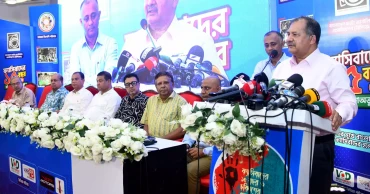
No room for obstacles to nation building, warns Swapon
Information Minister Zahir Uddin Swapon on Saturday warned that no one would be allowed to create obstacles to the country's nation building efforts, saying the government would act in the interest of the state and the people if necessary.
"The era of fascist upheaval is over. Now is our responsibility to build the country," he said.
Swapon said the government would first seek constructive and peaceful solutions to any problems, but would not hesitate to take necessary action if the country's interests were at stake.
He made the remarks while speaking at a photo exhibition and discussion titled '15 Years of Fascism and the Mass Uprising of 2024' at Jatiya Press Club.
The minister said young people possess courage and energy, but experience and wisdom are equally important. "There is no shame in admitting this. Those who fail to understand it risk a bleak future," he said.
Swapon said Bangladesh had entered a new phase after the fall of fascism and stressed the need to strengthen democratic institutions and parliamentary culture.
"When we want to practise democratic culture in a fascism-free Bangladesh and establish an effective parliamentary system, we see that some people prefer street politics over parliament," he said.
He also alleged that some groups were trying to create disorder through social media and street agitation instead of contributing constructively to the democratic process.
Swapon said the government was aware of attempts to create instability but would continue to respond responsibly and seek peaceful solutions.
2 days ago
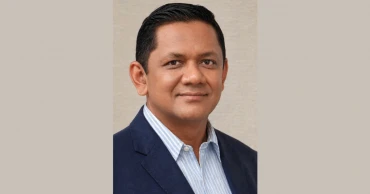
AGM of DNCC’s LOCC held; Omar Sadat new president
The Annual General Meeting (AGM) of the ‘Law and Order Coordination Council’ (LOCC), formed in view of maintaining the law and order and safe citizen life, was held today, Friday, at the LOCC office in the city's Gulshan Police Station.
The meeting unanimously elected Barrister Omar Sadat as the President and Mr. Shamsul Arefin as the Secretary General for the term 2026-2028.
This platform is being operated by the joint initiative of Dhaka North City Corporation (DNCC), Dhaka Metropolitan Police (DMP), Gulshan, Banani, Baridhara and Niketan Societies and Gulshan Youth Club.
DNCC Administrator Shafiqul Islam Khan Milton was present as the chief guest at the annual general meeting. DMP Joint Commissioner (Traffic) Mokhles Islam and RAJUK Chairman Riazul Islam, among others, were present as special guests.
Speakers at the meeting said that since its establishment, LOCC has been playing a significant role in improving the overall law and order situation in the Gulshan police station area.
With the coordinated participation of the police, city corporation, local residents, various societies and the public, it has been possible to turn this area into one of the safest and most orderly areas in the country.
LOCC's contribution in transforming Gulshan into a 'zero crime' model area through modern CCTV surveillance, successful community policing and effective crime prevention was particularly appreciated.
The newly elected President Barrister Omar Sadat said in his speech, "The main driving force of LOCC is the unprecedented partnership between government agencies, law enforcement agencies and civil society. In the next two years, through coordinated initiatives, we will continue to work tirelessly to make Gulshan, Banani, Baridhara and Niketan areas safer, technology-friendly and orderly."
Senior officials of Dhaka Metropolitan Police and RAJUK, representatives of related societies and leaders of Gulshan Youth Club were present at the event, among others.
At the end of the meeting, all those present congratulated the newly elected committee and expressed their hope to further accelerate the overall activities of LOCC.
2 days ago
No link between Motijheel explosive recovery and Mirpur, Farmgate incidents: CTTC
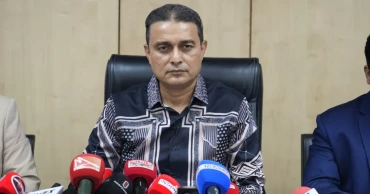
The Counter Terrorism and Transnational Crime (CTTC) unit of Dhaka Metropolitan Police (DMP) on Saturday said it has found no connection between the explosive recovered beneath Motijheel Metro Rail Station in last week and the bomb-like objects reported at Mirpur-10 and Farmgate metrorail station on Saturday noon.
Briefing reporters at the DMP Media Centre on Minto Road on Saturday afternoon, CTTC Chief and Additional Police Commissioner of tbe DMP Mohammad Shamsul Haque said investigations so far have found no link between the Motijheel incident and today's two other incidents.
"We have not found any relationship or connection between the explosive recovered at Motijheel and the bomb-like objects found at Mirpur-10 and Farmgate. Investigation and other necessary activities are continuing," he said.
Responding to a question, Shamsul Haque said the bag recovered at Mirpur-10 Metro Rail Station contained betel leaf, areca nut, zarda and some other ordinary items, while the sack found at Farmgate contained discarded waste.
"No explosives were found at either location. Therefore, the two incidents are being treated as isolated incidents ," he said.
Asked whether any criminal group was behind the incidents, he said it would not be appropriate to comment before the investigation is completed.
Replying to another question on whether there was any militant involvement, he said no comments could be made until the investigation is over.
On the progress of the Motijheel explosive recovery case, the CTTC chief said police, CTTC and the Detective Branch (DB) are jointly investigating the incident and any new findings will be shared with the media.
Regarding the unavailability of CCTV footage or cameras being out of service at different locations, he said all related issues, including CCTV footage, are under investigation and the matter would become clearer after the inquiry is completed.
Referring to reports of bomb scares across the capital, Shamsul Haque urged people not to panic, saying police take precautionary measures whenever any suspicious object is reported.
He also called on people to refrain from spreading rumours or unnecessary panic.
Earlier, in his written statement, Shamsul Haque said the CTTC Bomb Disposal Unit responded immediately after receiving reports of bomb-like objects at Mirpur-10 Metro Rail Station and Farmgate on Saturday.
After conducting examinations using modern equipment, the unit confirmed that neither of the recovered objects contained explosives.
He said the bag recovered at Mirpur-10 contained betel leaf, areca nut, zarda and other ordinary items, while the sack found at Farmgate contained discarded waste, posing no threat to public safety.
Shamsul Haque also noted that the CTTC Bomb Disposal Unit had earlier professionally handled the recovery of an explosive-like object beneath Motijheel Metro Rail Station, ensuring public safety.
Urging people not to be misled by rumours or misinformation, he requested the public not to touch any suspicious object. Instead, they should maintain a safe distance and immediately inform the nearest police station, the national emergency service 999, or law enforcement agencies.
He also sought public cooperation by sharing necessary information to help ensure public safety.
2 days ago

Primary school recruitment logjam to break as 14,384 teachers set to join from October
The Ministry of Primary and Mass Education has said the joining process for 14,384 recommended assistant teachers for government primary schools will begin within October, ending months of uncertainty over their appointments.
The announcement came after an emergency virtual meeting on teacher recruitment held at the ministry on Saturday, according to a message issued by the ministry the same day.
Primary and Mass Education Secretary Shakhawat Hossain said the government is prioritising the joining of the 14,384 recommended assistant teachers for primary schools, adding that the process had been delayed due to investigation and procedural complexities.
"The joining process will begin by the upcoming October 30," he said.
More than 175 days have passed since the publication of the final results, yet the 14,384 selected candidates are yet to receive their appointment letters. The candidates had earlier demanded that the joining notification be issued by July 29.
With that deadline passing without any notification, the job aspirants had announced a fresh round of continuous sit-in demonstrations at Shahbagh from Sunday.
2 days ago

Swecchasebak Dal leader killed in Narsingdi over land dispute
A Swecchasebak Dal leader was allegedly beaten to death by neighbours over a long-standing land dispute in Narsingdi's Monohardi upazila on Saturday.
The deceased was identified as Mizan Mia, 45, vice-president of Ward No. 4 Swecchasebak Dal under Borchapa Union and son of Safur Uddin of Borchapa Purbopara village.
The accused are Shahidullah, 65, former vice-president of Ward No. 4 Awami League, and his son, Jibon Mia.
The victim's family said Mizan and Shahidullah had been at odds over a road adjacent to their houses for a long time. Although the dispute had been taken to local arbitration on several occasions, Shahidullah did not accept the decisions.
The family said the incident occurred around noon when Mizan attempted to cut down a tree standing on the disputed road, triggering an argument between the two sides. During the altercation, Shahidullah and his son allegedly struck Mizan on the head with sticks, leaving him critically injured.
Locals rescued Mizan and took him to Monohardi Upazila Health Complex, where the attending physician declared him dead.
Jahangir Badsha, Officer-in-Charge (OC) of Monohardi Police Station, said the body was sent to the Narsingdi Sadar Hospital morgue for an autopsy, and legal action was underway.
The OC also clarified that the incident was not a political clash, as the two sides are close relatives and the dispute was family-related.
2 days ago
PM sees economic transformation through govt-business partnership
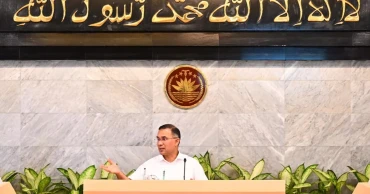
Prime Minister Tarique Rahman on Saturday expressed optimism that Bangladesh's economy could undergo a positive transformation within the next four to five years if the government and the private sector work together to address existing challenges.
"There are problems in some areas, but if we work together, we can overcome them," the Prime Minister said while speaking at an interactive session with leading business leaders and industrialists.
The nearly four-hour meeting, which began around 10am at the Prime Minister's Office in Tejgaon, was organised by the Bangladesh Investment Development Authority (BIDA), PM's Deputy Press Secretary Hasan Shiplu said.
According to Shiplu, the meeting focused on improving the investment climate, addressing the energy crisis, resolving challenges facing the industrial sector, taxation and attracting foreign investment.
2 days ago

Half-decomposed body found beside railway tracks in Chapainawabganj
Police recovered the half-decomposed body of an unidentified man from a pond beside a railway bridge in Chapainawabganj on Saturday noon.
The body was recovered from the Mahadanga area under Chapainawabganj municipality, near the railway bridge adjacent to the railway tracks.
Ekramul Hossain, Officer-in-Charge (OC) of Chapainawabganj Sadar Model Police Station said locals spotted the half-decomposed body lying on the pond bank beside the Mahadanga railway bridge and informed police.
Police rushed to the scene, recovered the body and sent it to the morgue of the 250-bed Chapainawabganj District Hospital for an autopsy.
Legal action has been initiated in connection with the incident, the OC added.
2 days ago