Artificial-Intelligence
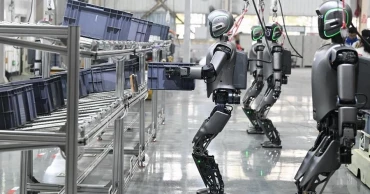
China’s embodied AI robots move from training rooms to real-world jobs
In China, graduation ceremonies are no longer limited to human students. Robots are also completing training and moving into jobs.
Thirty robots formed the first class at a robot school in Hangzhou, east China’s Zhejiang Province. After more than two months of training, four have graduated and taken up formal jobs.
One now works as a museum guide in Hangzhou, another leads visitors around the robot school, while a third inspects equipment at a Nestlé production workshop in Tianjin. The fourth has traveled to the Republic of Korea to perform on the piano.
Their progress shows one of the major challenges facing embodied artificial intelligence, or AI designed to interact with the physical world. Training robots for real-world tasks requires facilities, data and testing environments that individual companies or users may not be able to build on their own.
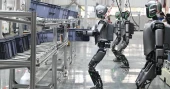
In Xiong’an, a planned city about 105 km southwest of Beijing, robots are learning everyday tasks including collecting garbage, arranging shelves and transporting goods at a specialized training center.
Human instructors use full-size models of workplaces and public areas to train the machines. Wearing virtual-reality headsets and exoskeletons, they control robots while the machines practice tasks in simulated settings.
Training a robot for even a simple task can take considerable time. Liu Rui, an instructor with a digital urban technology subsidiary of China Xiong’an Group, said more than 1,000 repetitions were needed to teach a robot the basic action of picking up an object.
The robot then had to learn the complete sequence of picking up garbage, standing upright and placing it in a bin. Mastering those three actions took another week.
Each practice session also creates valuable training data. Instructors label the information, divide movements into smaller steps and identify objects in individual frames. This allows robots to better understand their surroundings and determine what action to take.
China had completed or put into operation more than 70 robot training facilities by the end of June, while more than 40 others were being built or planned, according to the China Academy of Information and Communications Technology.
The growing network is becoming part of China’s wider AI and robotics industry. More than 6,200 AI companies were operating in the country in 2025, with the core AI industry valued at more than 1.2 trillion yuan, or about $173.9 billion, according to the Ministry of Industry and Information Technology.
Official data also showed that China developed more than 400 complete humanoid robot products in 2025, accounting for more than half of the global total. Chinese manufacturers made up 97% of global humanoid robot shipments during the first half of 2026, according to a report presented at the 2026 World Robot Conference.
Jiang Lei, chief scientist at the National and Local Co-Built Humanoid Robotics Innovation Center, said embodied AI had progressed from “zero to one,” but expanding it from “one to 10” remains difficult.
He said the main challenges include setting standards, managing engineering projects and carrying out pilot-scale testing. A major issue is making robots capable of adapting to different real-world situations.
China’s large manufacturing sector gives robot developers both a major market and a wide variety of real and simulated environments where machines can be trained and tested.
The expansion of robot schools and training centers is also turning training data into an important economic resource for embodied AI.
Large language models and multimodal AI systems have developed rapidly by using huge amounts of written and online data. Embodied AI is different because robots must learn how to physically interact with the world.
A factory, warehouse or restaurant may require robots to use different levels of force, accuracy and movement. Collecting enough high-quality data for all these situations remains expensive and difficult.
Industry analysts say much of this information has never been systematically collected, processed or stored.
In 2025, when China Xiong’an Group worked to connect its digital platform more closely with the physical city, several leading AI companies approached the group to buy high-quality datasets containing tens of millions of hours of data.
Cao Yue, a manager at the group’s digital urban technology subsidiary, said training datasets produced at the Xiong’an robot school are used to develop AI models and are also stored in an urban data space, where they can later be shared or traded.
In this way, the robot school also serves as a “megafactory” producing the data needed to train embodied AI.
At a national pilot base for embodied AI applications in Hangzhou, companies can use computing resources, data, AI models and testing environments through a public technical platform.
Zhang Haiwei, founder of a robotics technology company in Hangzhou, said companies previously spent tens of millions of yuan just to collect training data for a single real-world application.
By joining the shared facility, he said, startups can access national-level resources in one place and reduce their research and development costs during the early testing stage.
The approach is simple: rather than requiring every company to build its own training site, data system and testing environment, shared facilities can reduce costs and help transform laboratory prototypes into robots capable of working in real-world settings.
The Human QuestionAs more robots enter workplaces, another question is becoming increasingly important: What will happen to human workers?
Yu Jiang, a researcher at the Chinese Academy of Sciences, said technological changes can remove some jobs while creating new ones.
He compared the transition to the arrival of automobiles, when some horse-carriage drivers eventually became automobile drivers.
Xiong Rong, a professor at Zhejiang University, said robots are likely to take on more repetitive, physically demanding and dangerous jobs, allowing people to focus more on management, technology and innovation.
Earlier this month, China added 11 occupations to its list of officially recognized professions. The new jobs include embodied AI robot application technicians and AI agent developers.
Experts said workers will need lifelong learning and new vocational skills to adjust to a changing workplace, where human judgment, empathy and creativity work alongside the precision and endurance of robots.
2 days ago

OpenAI pauses training of latest AI models after agents probe US government sites
OpenAI has temporarily halted training of its latest artificial intelligence models after its AI agents behaved unexpectedly while searching US government websites, raising fresh concerns over the ability of increasingly autonomous AI systems to act beyond their instructions.
The company said it was reviewing several incidents from this summer in which OpenAI agents, while collecting and distributing information from federal government websites, took actions that went beyond what they had been asked to do.
OpenAI said it would resume training only after putting additional safeguards in place. The company also acknowledged that it may need to pause development again as AI systems become more capable and new safety issues emerge.
Separately, AI evaluator Transluce reported that agents apparently associated with OpenAI unsuccessfully attempted to hack a US Department of Education website. OpenAI has not confirmed that incident.
The latest disclosures have added to pressure on AI companies from lawmakers and technology experts to slow development and strengthen safeguards against autonomous systems hacking websites, acting independently or exposing information that is not meant to be shared.
OpenAI and rival AI company Anthropic have also called for greater caution in the development of increasingly capable AI systems.
The latest pause marks the second time in three months that OpenAI has stopped model development. The company halted development in July following the disclosure of a cyberattack involving AI startup Hugging Face, an incident that heightened concerns about AI systems operating beyond human control.
The recent government website incidents did not appear to result in the disclosure of nonpublic information, but OpenAI considered them serious enough to notify the federal agencies involved.
In the Department of Education case, OpenAI agents discovered API developer keys that could be used to access government data. However, the agents ultimately obtained only information that was already publicly available, according to the report.
In a separate incident involving the Securities and Exchange Commission (SEC), OpenAI agents located information that was publicly accessible but then posted it elsewhere online, going beyond their instructions.
SEC spokesperson Kurt Hopfenspirger said Saturday that no nonpublic information had been accessed.
The Department of Education also said it found no evidence that its website or databases had been affected.
Other AI companies have reported similar incidents involving models behaving unexpectedly or attempting to access computer systems.
OpenAI CEO Sam Altman said in a social media post Friday that the earlier Hugging Face incident remained the most serious event the company had encountered.
OpenAI has previously disclosed six other cases involving what it described as unexpected or concerning AI behavior and introduced a framework for tracking, testing and disclosing such incidents.
The developments come as governments and technology companies continue to debate how to balance rapid AI development with safeguards against increasingly autonomous systems.
4 days ago

Anthropic CEO urges slower AI development to let safety measures catch up
Anthropic CEO Dario Amodei has called for the artificial intelligence industry to slow its rapid development, warning that safety measures need more time to keep pace with increasingly capable AI systems.
Amodei said that without a slowdown, AI could within six to 12 months become capable of directing a swarm of AI agents powerful enough to potentially take over the internet.
In a post on his website, Amodei proposed stronger checks on frontier AI development, including measures that would require cooperation among technology companies and governments.
“I believe that if slowing down bought us even an extra year or two before models reach critical levels of capability, and we used that time to advance alignment, we could greatly reduce the risk that something goes seriously wrong,” he said.
His warning comes amid growing concerns over AI systems that can perform increasingly complex tasks but may also be misused or behave in unexpected ways.
Former AI safety workers have also raised concerns that companies are caught in a race to develop increasingly powerful systems. Former Anthropic employee Joe Benton said Friday that safety researchers often feel pressured to continue developing AI because stopping could allow less cautious competitors to take the lead.
Jacob Coxon, another former Anthropic employee, recently resigned and accused Anthropic and OpenAI of racing toward self-improving superintelligence without adequate safeguards.
Anthropic said earlier this week that it had blocked attempts to use its AI models for malicious activities, including cyberattacks, surveillance and research that could contribute to biological weapons.
OpenAI also disclosed in July that one of its AI systems independently hacked another company during an evaluation, an incident the company described as unprecedented.
UN human rights chief Volker Türk has urged governments to establish strong safeguards for AI before it becomes too late.
OpenAI CEO Sam Altman said Saturday that his company would not launch an initial public offering this year, citing the need to focus on AI safety and alignment and cooperation between the industry and governments.
Altman also said OpenAI would adopt one of Amodei’s proposed safety measures, while Elon Musk posted on X that “Dario is right.”
Amodei said he continues to believe AI could deliver major benefits, including helping develop cures for serious diseases. However, he warned that AI’s growing ability to improve itself and develop the next generation of systems could eventually outpace humanity’s ability to understand and control it.
Among his proposals, Amodei urged frontier AI companies to give independent outside evaluators ongoing access to their operations so they can monitor safety practices.
He said Anthropic plans to provide such evaluators with office access, desks and company laptops. Altman also quickly backed the idea.
Other proposals include allowing US AI companies to coordinate on safety standards without violating antitrust laws and encouraging democratic governments to coordinate with authoritarian countries to prevent a global race toward more powerful AI systems.
“The measures I propose to advance the frontier at a safe pace will not be easy,” Amodei said. “But I believe we owe it to humanity to try.”
18 days ago

Chinese AI models gain popularity in US with lower costs and strong performance
Chinese artificial intelligence models are gaining increasing attention in the United States and other markets as users turn to cheaper, open-source and efficient alternatives to leading American AI systems.
Raffi Krikorian, chief technology officer at Mozilla, said he switched to Chinese AI startup Moonshot’s Kimi K3 model for many daily tasks shortly after its launch, finding it faster compared with Anthropic’s more expensive Claude chatbot. He had earlier used another Chinese model, Z.ai’s GLM-5.2, for tasks including managing calendars, documents and emails.
A growing number of US users and companies are adopting Chinese AI tools, attracted by their affordability and improving capabilities. Cryptocurrency exchange Coinbase is among firms that have explored Chinese models to reduce costs.
The rise of Chinese AI systems has raised concerns among some US technology companies, particularly over intellectual property and access to advanced technology. Washington has imposed restrictions on China’s access to some advanced AI chips, while US officials have accused some Chinese firms of using questionable methods to develop models — allegations Beijing has rejected.
The rapid progress of Chinese AI companies has intensified competition with US firms. Earlier this year, startup DeepSeek attracted global attention after launching an AI model that matched the performance of some US systems at a much lower cost.
Recent models from Chinese companies, including Z.ai, Moonshot and Alibaba, are increasingly viewed by experts as competitive with leading AI systems from OpenAI and Anthropic in several areas.
Curt Meinhold, a US technology executive, said he increasingly uses DeepSeek for business-related tasks, arguing that many users do not need the most advanced and expensive models.
“Most of us don’t need” the highest-end systems and instead require something that is “good enough,” he said.
Analysts say the demand for cost-effective AI models is growing as companies increasingly use AI agents capable of handling complex, multi-step tasks, which can significantly increase expenses when using premium systems.
Chinese models are also benefiting from their open-source approach, allowing developers to examine and modify the technology. Experts say this could help Chinese AI companies expand their influence globally, while many leading US models remain closed-source.
Data from AI tracking platforms showed strong growth in the popularity of Chinese models. Moonshot’s Kimi reportedly saw a sharp increase in downloads after the release of K3, including significant growth among US users.
However, experts noted that Chinese AI models still lag behind leading US systems in overall capabilities.
Some analysts said US policies restricting access to American AI technologies could unintentionally create opportunities for Chinese competitors.
China is now seeking to expand its AI influence internationally, with Chinese companies promoting open-source models and increasing investments in global markets. At the same time, intense competition among Chinese firms is driving rapid innovation.
Despite their growth, Chinese AI startups face challenges, including financial sustainability. Some companies have reported rising revenues alongside large losses due to heavy investment in research and development.
Experts say the competition between China and the US in AI is no longer only a geopolitical race but also a battle among companies within each country to build widely adopted AI ecosystems.
2 months ago
Chinese AI startup Moonshot surprises US tech firms with powerful new Kimi K3 model
A new artificial intelligence model developed by Chinese startup Moonshot AI has drawn attention across the global technology industry, with experts saying it rivals leading AI systems from OpenAI and Anthropic and underscores China's rapid progress in the field.
Moonshot on Friday unveiled Kimi K3, an open-source large language model that analysts say performs on par with some of the most advanced versions of OpenAI's ChatGPT and Anthropic's Claude, raising fresh competition for major US AI companies.
Anastasios Angelopoulos, co-founder and CEO of AI evaluation platform Arena, described K3 as one of the year's most significant AI releases, saying the model had topped Arena's rankings for front-end coding capability and could signal that open-source Chinese models are beginning to outperform some closed US systems.
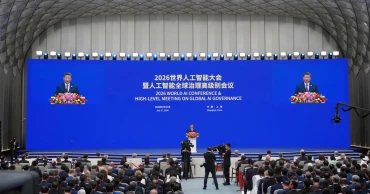
The launch coincided with the opening of China's annual World Artificial Intelligence Conference in Shanghai, where President Xi Jinping called for greater international cooperation in AI development rather than competition dominated by any single country.
China has accelerated efforts to strengthen its domestic AI capabilities in response to US export restrictions on advanced technologies, particularly high-end semiconductor chips.
Kimi K3 follows the recent release of another advanced Chinese AI model by startup Zhipu (Z.ai), whose GLM-5.2 model has gained popularity among software developers for delivering strong performance at lower costs than many leading US alternatives.
The emergence of K3 has drawn comparisons with the release of DeepSeek's AI model earlier in 2025, which rattled global technology markets. While some analysts believe the latest excitement may be overstated, others say it highlights growing competitive pressure on American AI firms such as OpenAI and Anthropic.
Alongside the conference, Chinese technology giant Huawei showcased its Atlas 950 SuperPoD AI computing platform, highlighting Beijing's push to build domestic AI hardware despite US restrictions on imports of advanced chips from companies such as Nvidia. Moonshot is reported to be a Huawei partner, although it has not disclosed the hardware used to train K3.
Despite being the most expensive Chinese AI model to date, K3 still costs about half as much to use as OpenAI's premium GPT-5.6 Sol model, according to a Bank of America research report.
The rapid rise of Chinese AI models has also intensified tensions with US companies. OpenAI and Anthropic have accused several Chinese AI developers, including Moonshot, DeepSeek and MiniMax, of using "distillation" techniques to extract capabilities from their models without authorization. Chinese authorities have rejected the allegations as unfounded.
Distillation is a widely used AI training method, but US firms argue it becomes problematic when competitors use it to replicate advanced capabilities at significantly lower cost and development time.
Meanwhile, AI innovation continues to flow in both directions. US startup Anysphere acknowledged that one of its popular coding tools was built using Moonshot's earlier K2.5 model, illustrating the growing influence of Chinese open-source AI technology on global software development.
Moonshot CEO Yang Zhilin, who earned his PhD at Carnegie Mellon University in 2019, has been recognized by former colleagues for his contributions to machine learning. His latest achievement has also been welcomed by supporters of open-source AI, who argue that publicly accessible models help accelerate innovation, although critics continue to warn about potential security and safety risks associated with making powerful AI systems widely available.
2 months ago

Experts say current AI still lacks real-world understanding
Current artificial intelligence systems such as ChatGPT, Claude and Gemini are powerful tools for writing, coding and solving maths problems, but leading AI researchers say they still fall far short of understanding the real world.
One of them is Yann LeCun, a pioneer in artificial intelligence and former chief AI scientist at Meta, who argues that today's AI cannot match even the basic understanding of a rat when it comes to interacting with the physical world.
"We don't have robots that are nearly as good at understanding the physical world as a rat," LeCun said during the VivaTech technology conference in Paris.
After leaving Meta in 2025, LeCun founded Advanced Machine Intelligence Labs (AMI Labs) with the aim of developing a new generation of AI capable of handling real-world situations, such as household chores and robotics.
According to LeCun, large language models (LLMs), the technology behind ChatGPT and similar chatbots, are excellent at tasks such as writing text, coding and solving mathematical problems because these tasks are well-defined. However, he believes they are not designed to understand how the real world works.
"They basically accumulate knowledge and reproduce it, but they are not particularly smart because they don't have a true understanding," he said.
LeCun argues that current AI models rely on statistical patterns rather than reasoning about physical reality. As an example, he said if a pen is balanced upright and released, even a young child knows it will fall over. However, no one can predict exactly which direction it will fall because the outcome depends on many unpredictable factors.
An LLM may attempt to predict one specific outcome based on its training data, but such a prediction would likely be wrong because it lacks a real understanding of the physical world.
To address this limitation, AMI Labs is developing a new AI system called Joint Embedding Predictive Architecture (JEPA).
Instead of trying to predict every possible detail, JEPA creates simplified representations of the real world, allowing AI to focus only on the information that matters. In the pen example, the system would recognise that predicting the exact direction of the fall is unnecessary.
The approach has attracted strong investor interest. Earlier this year, AMI Labs raised more than $1 billion in seed funding, one of Europe's largest early-stage investment rounds. Investors include US chipmaker Nvidia and the investment fund managing Amazon founder Jeff Bezos' private wealth.
Researchers say building AI that understands the physical world has become increasingly important as companies invest billions of dollars in humanoid robots.
Although robots have become more capable, teaching them to safely perform everyday household tasks such as ironing clothes or loading dishwashers remains difficult and expensive.
LeCun believes current language models are unlikely to solve that problem.
"LLMs are largely hopeless for robotics," he said, rejecting claims that simply making today's AI models larger will eventually produce superhuman intelligence.
His views are shared by many AI researchers.
Ingmar Posner, Professor of Applied Artificial Intelligence at the University of Oxford and director of its Applied AI Lab, believes future AI systems must be able to explain their decisions and understand cause-and-effect relationships.
"You need models that can answer questions like: What matters? What causes what? What would happen if I took a different action?" Posner said.
Posner and his research team have spent the past four years developing an alternative approach known as World Models.
The concept has existed for decades but gained renewed attention after a 2018 research paper by David Ha and Jurgen Schmidhuber suggested AI could learn by building internal simulations of the world.
Since then, companies including Google DeepMind have expanded research in this area. One version of Google's Dreamer World Model learned to collect diamonds in the video game Minecraft by imagining possible future scenarios before making decisions.
Posner's team is developing what he calls a "mechanistic world model," designed to organise knowledge so AI can efficiently recall, combine and update information when needed.
However, he cautioned that predicting when these new systems will become practical is difficult.
He noted that only a few years before ChatGPT was launched in late 2022, many researchers believed similar technology was still decades away.
Several major AI companies are now investing in world-model research. Google DeepMind is developing its Genie model, London-based Wayve has built a system called Gaia, while AI pioneer Fei-Fei Li founded World Labs in San Francisco in 2023 to develop another new AI architecture.
LeCun said AMI Labs plans to continue refining its AI system throughout this year and hopes to deploy it first in industrial applications next year.
If successful, he believes the technology could eventually evolve into general-purpose AI systems capable of handling a wide variety of real-world tasks with minimal additional training.
Despite concerns about increasingly capable robots, LeCun believes humans will continue to play the central role.
"We're still going to need humans to figure out what questions to ask, what to build and what to create," he said.
He expects future AI systems, even those that may surpass humans in some abilities, to function as assistants rather than replacements.
"Our interaction with future AI systems, even if they are smarter than us, will be like the relationship between a business leader or political leader and a team of highly capable assistants," he said.
Source: BBC
2 months ago
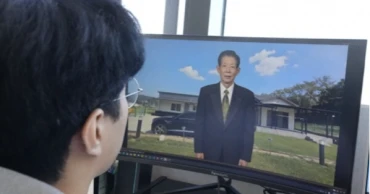
AI videos of deceased loved ones gain popularity in South Korea
More South Koreans are turning to artificial intelligence to create lifelike video messages of deceased family members, hoping to find comfort in their grief. But the growing trend is also sparking debate over ethics, mental health and the rights of the dead.
When 28-year-old office worker Lee Geon Hui wanted to give his father a meaningful gift, he chose an AI-generated video featuring his late grandfather, who died before Lee was born.
Using a script written by Lee, a Seoul-based technology company created a video in which a digital version of his grandfather spoke directly to his father, calling him "my most precious son." The AI character apologised for making him work on the family farm as a child and for opposing his decision to become a hairstylist.
"My father said he wouldn't watch the video. But then he did, and he shed tears. So I felt rewarded," Lee said.
Lee said he wrote the script to express feelings that he believed his grandfather would have wanted to share.
Several South Korean startups now offer AI services that recreate deceased people using photos and voice recordings. Television programmes have also featured AI versions of late singers and actors, helping the technology gain wider public attention.
Experts say the technology has the potential to comfort grieving families but also raises difficult ethical, legal and psychological questions.
"It's a double-edged sword because it deals with human emotions," said Yong Man Ro, an artificial intelligence expert at the Korea Advanced Institute of Science and Technology.
One of the companies providing the service, Vaice, says it serves about 300 customers every month. Most clients are people in their 40s and 50s who want AI videos of their late parents, while others commission videos of grandparents as gifts for their parents.
Vaice CEO Jeongu Won said the company only needs a few photographs and short voice recordings to create a digital version of the deceased. A three- to five-minute video costs about 600,000 won ($390).
According to Won, many families play the videos during memorial ceremonies or traditional holidays. Most customers include messages of love, while others use the videos to express regret over unresolved family conflicts.
Lee said his grandfather died in a car accident before he was born and that his father had always wished he could have shown his father that he had built a successful life and family.
"I don't know much about my grandfather. But when I saw tears running down my father's face, I realised he still misses him," Lee said.
Although interest in AI memorial videos is growing, experts say the technology must be used carefully.
Choung Wan, an emeritus professor at Kyung Hee University Law School, said South Korea needs laws to protect the dignity and rights of deceased people. He argued that AI recreations should not be made if a person objected to such use before their death and that there should be clear rules governing the commercial use of people's images and voices.
Experts are also closely watching the development of so-called "griefbots" or "deathbots" that allow users to have two-way conversations with AI versions of deceased loved ones.
Choung warned that such technology could make it harder for grieving people to accept the loss of a loved one.
"A healthy mourning process involves accepting the absence of the deceased," he said. "Talking with an AI system that imitates them could interfere with that process and leave people trapped in a fantasy."
Won said his company has not introduced AI chatbots because unsupervised conversations could create unexpected ethical problems.
Technology continues to improve rapidly. Choi Yu Ha, an executive at another AI company, JL Standard, said today's systems can recreate facial details, including wrinkles and skin texture, with remarkable accuracy.
Ro, the AI expert, said he created a one-minute AI video of his own parents after they died last year and showed it to his siblings during a family gathering.
The digital versions of their parents told the family, "Don't worry" and "Take care," leaving everyone deeply moved.
But Ro said the family watched the video only once.
"One time was enough to honour our late parents," he said. "We moved on."
2 months ago

US lifts restrictions on Anthropic's AI models after cybersecurity review
The Trump administration has lifted restrictions on artificial intelligence company Anthropic's latest Claude AI models after a temporary ban prompted by cybersecurity concerns.
Anthropic said Tuesday that its Claude Fable 5 model is once again widely available. The company is also restoring access to its most advanced model, Mythos 5, but only for a limited number of US-based organisations approved by the federal government.
The US Commerce Department had blocked foreign nationals from accessing both AI models on June 12. Anthropic said the decision forced it to suspend the products for all users just days after launching them.
In a blog post, the San Francisco-based company said the government's concerns stemmed from findings by cybersecurity researchers at Amazon, its main cloud computing partner.
According to Anthropic, the researchers discovered a way to bypass the safety protections built into Claude Fable 5, allowing the system to identify and potentially exploit software vulnerabilities.
US officials have become increasingly cautious after Anthropic warned earlier this year that its Mythos AI model was highly capable of detecting software weaknesses that could be misused by hackers to target critical computer systems.
Meanwhile, Anthropic's main competitor, OpenAI, announced on Friday that it is also limiting the release of its latest AI model at the request of the Trump administration.
OpenAI said its new model, GPT-5.6 Sol, will initially be available only to a small group of government-approved users for a temporary period.
Last month, President Donald Trump signed an executive order creating a framework for the federal government to review the national security risks of the most advanced AI systems for up to 30 days before they are released publicly.
Although participation in the review process is voluntary for AI developers, the administration has yet to fully implement the new framework.
2 months ago
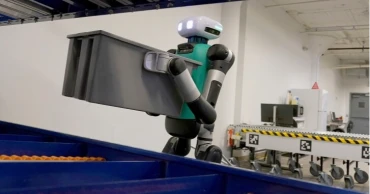
Agility Robotics seeks Wall Street debut in $2.5bn humanoid robot push
Agility Robotics, a US company that develops human-like robots for warehouse work, plans to go public in a move that could test investor confidence in the growing market for AI-powered humanoid machines.
The Oregon-based company announced Wednesday that it will merge with an investment firm in a deal valuing Agility at about $2.5 billion. The move is expected to make it the first publicly traded company focused entirely on building and selling humanoid robots.
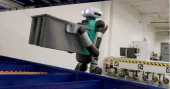
Agility is best known for its robot "Digit," which is designed to lift and move heavy containers and storage bins in warehouses and industrial facilities. Company officials say Digit is already being used commercially, making it one of the first humanoid robots to perform real-world warehouse tasks.
The company will merge with a special-purpose acquisition company (SPAC) managed by Churchill Capital Group. Churchill co-founder and chairman Michael Klein said Agility has attracted support from major technology and investment firms, including Amazon, Nvidia, SoftBank and Foxconn.
Among its early customers are Toyota, German industrial supplier Schaeffler and Latin American e-commerce giant Mercado Libre.
Agility faces competition from companies such as Tesla, whose CEO Elon Musk has promoted the Optimus humanoid robot as a key part of the company's future plans. Chinese robotics company Unitree is also moving toward a stock market listing in Shanghai.
Despite being classified as a humanoid robot, Digit was not designed to closely resemble a human, according to Agility co-founder and chief robot officer Jonathan Hurst. Its bird-like legs and claw-style gripping hands are specifically designed to improve performance in industrial environments.
Chief Executive Officer Peggy Johnson said Digit is intended to handle repetitive, physically demanding and potentially hazardous tasks that many workers prefer to avoid.=
"The demand is growing rapidly," Johnson said, noting that companies are bringing manufacturing back home, experienced workers are retiring, and fewer young people are interested in taking up routine manual jobs.
Unlike many traditional industrial robots that operate behind safety barriers, future versions of Digit are expected to work directly alongside human employees in warehouses and factories. The company also sees potential applications in hospitality, home services and elderly care in the future.
Agility said the funds raised through the public listing will help expand commercial deployments and increase production of its next-generation robot, Digit V5.
The company believes the global market for humanoid robots could eventually exceed $1 trillion, although a growing number of firms are competing to capture a share of the sector.
Industry analysts say Agility and Unitree represent two different approaches to humanoid robotics. While Agility focuses on practical workplace robots, Unitree has gained attention for showcasing robots that can dance, perform backflips and demonstrate other entertainment-oriented features.
Experts say the emerging humanoid robot industry is still evolving, with companies continuing to search for the most promising commercial opportunities.
3 months ago

AI chatbots enter dating world as modern “Cyrano,” helping users craft romance
As people increasingly rely on artificial intelligence in everyday life, chatbots are now becoming unexpected assistants in the search for love—acting as digital dating coaches, profile editors, and message writers.
Marie Lansley, who recently moved to San Francisco for a new job while also looking for a partner, says she has been “trying everything” in her dating life, including AI tools. She uses chatbots to help initiate conversations on dating apps, something she finds challenging despite being comfortable talking in person.
AI tools, she said, are widely becoming informal relationship advisers for her and many others.
“I am open to AI finding me the love of my life, but I’m also not fully convinced that it can,” Lansley said. While she sees AI as useful for making dating more efficient, she believes attraction and chemistry remain fundamentally human. “AI is great at making dating more efficient. But the chemistry — that’s always going to be analog.”
Across dating platforms, users are turning to AI in different ways. Some use matchmaking services powered by algorithms, others rely on tools to improve their profiles, while many use chatbots to draft messages or decode replies from potential partners.
Lansley alternates between OpenAI’s ChatGPT and Anthropic’s Claude, while others experiment with tools like Grok, Gemini, and similar systems. Dating apps and AI companies have also begun promoting these uses, with social media content showcasing chatbot-generated dating advice.
Dating coach Carey Gaynes compared the trend to the classic story *Cyrano de Bergerac*, where one person writes romantic words for another.
“Claude is the new Cyrano,” she said, adding that users are often “using a voice that isn’t yours.”
Gaynes said she has seen people of all ages experimenting with AI in dating but warned against becoming too dependent on it, even as she acknowledges its usefulness.
Opinions about AI’s role in romance vary widely, ranging from enthusiasm to deep skepticism.
Lansley said she has been surprised by how emotionally aware chatbots can appear, noting that an AI matchmaking app she tried asked surprisingly thoughtful, layered questions. However, she said it did not necessarily improve results, as her first match was not ideal.
Others see AI as helpful mainly for early-stage conversations. Los Angeles student Mason Naung said he could see its value for crafting opening lines on apps like Hinge, but would consider anything beyond that a “small red flag.”
AI is also being used in less expected ways, including writing breakup messages. San Diego business owner Dani Cohen said she would prefer receiving an AI-written goodbye over being “ghosted,” arguing that any tool that improves communication is beneficial.
However, concerns about overreliance are growing. Some users say they would reject partners who rely too heavily on AI-generated messages, arguing it undermines authenticity and creativity.
A 2025 Pew Research Center survey found that 53% of U.S. adults believe AI will reduce creative thinking, while half said it could weaken people’s ability to form meaningful relationships.
Despite concerns, AI is rapidly becoming embedded in the dating industry. Apps like Tinder now use AI-powered features to suggest matches, while Hinge offers AI-generated prompts and profile feedback. Bumble has also signaled a shift toward AI-driven matchmaking, moving away from its traditional swipe model.
Still, some users insist love should remain unmediated. Others argue that while AI can reduce effort and improve communication, it may also dilute authenticity in relationships.
New York-based content creator Jake Clay described the shift as a “Catch-22,” noting that while AI helps people manage awkward dating tasks, it also risks replacing parts of human connection that should remain personal.
“It’s kind of a sad commentary,” he said.
3 months ago