europe
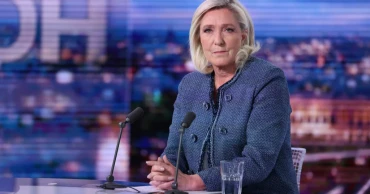
French far-right leader Le Pen barred from office for 5 years
A French court has convicted Marine Le Pen of embezzlement and prohibited her from seeking public office for five years, dealing a significant blow to her presidential ambitions and sending shockwaves through French politics.
Le Pen, speaking to French TV channel TF1, condemned the verdict as politically motivated, accusing it of being aimed at preventing her from running in the 2027 presidential election. She argued that millions of French citizens were “outraged” by the ruling and called it a violation of the rule of law.
She announced her intention to appeal the decision and requested that the court proceedings take place before the 2027 campaign. As a result, she will remain ineligible for candidacy until the appeal is concluded.
In addition to the ineligibility, Le Pen received a four-year prison sentence, with two years under house arrest and two years suspended—though the sentence will not apply pending the appeal.
The ruling has far-reaching political consequences, undermining one of the top contenders to succeed President Emmanuel Macron after his second term ends. The implications are so significant that even some of Le Pen's political adversaries have expressed concerns that the court's decision was overly harsh.
However, it is uncertain how this ruling will impact voters. The potential disqualification of Le Pen might energize her devoted supporters, similar to how legal issues have galvanised some of Donald Trump’s base in the U.S. On the other hand, it might push her further out of the political spotlight, halting her rising political momentum.
Le Pen argued that the court’s decision to declare her ineligible before exhausting her appeals was clearly intended to prevent her from running for president. “If that’s not a political decision, I don’t know what is,” she said during the TF1 interview. She lamented that the ruling represented a “fateful day for our democracy,” but insisted she would continue to pursue her “now admittedly narrow” path to the presidency.
Le Pen had already left the courtroom before the judge delivered the sentence, and her supporters immediately voiced their disapproval. Jordan Bardella, her 29-year-old protégé, called the verdict unjust and claimed that French democracy was being “executed.” Hungary’s populist Prime Minister Viktor Orbán showed solidarity by posting “Je suis Marine!” on social media.
Even among Le Pen’s political opponents, some expressed unease about the ruling. Conservative lawmaker Laurent Wauquiez described it as a heavy blow to French democracy.
The conviction could prevent Le Pen from making a fourth run for the presidency in 2027, which she has previously described as a “political death.” Having been a runner-up to Macron in both the 2017 and 2022 elections, Le Pen’s party has seen increasing electoral support. However, unless an appellate court overturns the ban on public office, her prospects of running again are uncertain. With the election just two years away, time is running out, and appeals in France can take several years.
The ruling represents a significant defeat for Le Pen's National Rally party, previously known as the National Front. She and 24 other party officials were accused of using European Union parliamentary funds to pay staff who worked for the party between 2004 and 2016, violating EU regulations.
The judge found that Le Pen was central to a system designed to divert EU funds, though they did not personally profit. The embezzlement was described as a “democratic bypass” that deceived both the European Parliament and the electorate.
During the trial, Le Pen showed no immediate reaction when the judge initially declared her guilty. However, she appeared increasingly agitated as the details of the verdict were read out, shaking her head in disagreement when the judge explained how her party misused EU funds. She left abruptly, leaving many in the courtroom in disbelief.
While the electoral ineligibility takes effect immediately, the house arrest will be suspended during her appeal. Le Pen remains a lawmaker in France’s National Assembly, a role unaffected by the ruling for now. However, if President Macron calls early legislative elections, Le Pen would be barred from standing.
1 year ago
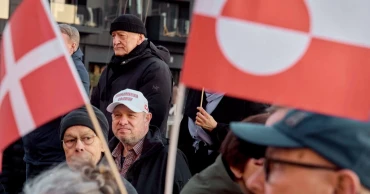
Danish FM rebukes Trump administration's criticism of Denmark, Greenland
The Danish foreign minister rebuked the Trump administration on Saturday for its critical stance toward Denmark and Greenland, particularly regarding the tone of its remarks.
He emphasised that Denmark is already enhancing its investment in Arctic security and remains open to further collaboration with the United States.
Foreign Minister Lars Løkke Rasmussen conveyed these sentiments in a video shared on social media following U.S. Vice President JD Vance’s visit to Greenland, a strategically significant island.
“A great number of accusations and allegations have been made. We are, of course, open to criticism,” Rasmussen said in English. “However, to be completely frank, we do not appreciate the manner in which it is being delivered. This is not the way to address close allies. And I continue to regard Denmark and the United States as close allies.”
On Friday, Vance accused Denmark of “underinvesting” in Greenland’s security and urged the country to revise its approach, aligning with President Donald Trump’s push to assert control over the Danish territory.
During his visit to Pituffik Space Base—an American military installation in mineral-rich Greenland—Vance was accompanied by his wife and other senior U.S. officials. However, the trip was ultimately scaled back following backlash from Greenlanders and Danes, who had not been consulted on the initial itinerary.
“Our message to Denmark is straightforward: You have not served the people of Greenland well,” Vance stated on Friday. “You have underinvested in them, as well as in the security infrastructure of this extraordinary and beautiful land, home to remarkable people. This must change.”
On the same day, Trump posted a video on his social media platform, Truth Social, titled “America Stands With Greenland,” featuring archival footage of U.S. troops stationed there during World War II.
While in Greenland, Vance asserted that the U.S. has “no choice” but to play a major role in securing the island. He also encouraged a movement toward Greenlandic independence from Denmark.
“I believe that in the end, they will choose to align with the United States,” Vance remarked. “We could enhance their security significantly, provide greater protection, and, economically, they would likely benefit far more.”
However, the response from Greenland’s parliament members and citizens suggests that such an outcome is improbable. Outrage has erupted over the Trump administration’s efforts to annex the vast Arctic island. Danish Prime Minister Mette Frederiksen dismissed Vance’s claim that Denmark is neglecting Arctic defense, asserting that her country remains “a strong and reliable ally.”
Greenlandic lawmakers also took action on Thursday, agreeing to form a new government in a united effort to counter Trump’s ambitions. Four out of the five parties elected to Greenland’s parliament earlier this month have joined forces to create a coalition commanding 23 of the legislature’s 31 seats.
The next day, Danish King Frederik X expressed his sentiments in a Facebook post, stating, “We are living in a changed reality. There should be no doubt about my love for Greenland and my deep connection with its people.”
Meanwhile, in the Danish capital of Copenhagen, hundreds of protesters gathered outside the U.S. Embassy on Saturday, with some holding placards reading, “Back off, USA,” according to Danish broadcaster TV2.
Even Greenland’s national dogsled race, Avannaata Qimussersu, which began on Saturday with 37 mushers and 444 dogs, was affected by the diplomatic tensions. Usha Vance, the vice president’s wife, had originally planned to attend the event. However, after her husband decided to accompany the delegation to the military base instead, she opted out, reducing the likelihood of direct interaction with Greenlanders.
In his video message, Løkke Rasmussen reminded viewers of the 1951 defense agreement between Denmark and the United States. He noted that since 1945, the American military presence in Greenland has shrunk from thousands of soldiers across 17 bases and installations to roughly 200 personnel stationed at the remote Pituffik Space Base in the northwest.
The 1951 agreement “provides ample opportunities for the United States to establish a much stronger military presence in Greenland,” the foreign minister stated. “If that is your desire, let us discuss it.”
Løkke Rasmussen further highlighted that Denmark has been increasing its own investment in Arctic defense. In January, the Danish government pledged 14.6 billion Danish kroner (US$2.1 billion) for Arctic security initiatives, which include three new naval vessels, long-range drones, and satellites.
1 year ago
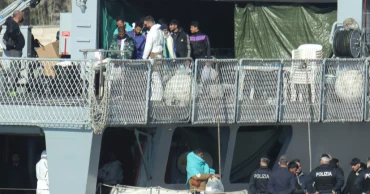
Italy approves decree to use Albanian migration centres for repatriation
Italy's far-right-led government has approved a new decree that broadens the use of Albanian fast-track asylum processing centers to include repatriation hubs, aligning with a recent EU proposal.
The two Albanian centers, originally intended to process non-vulnerable migrants rescued at sea, will now also accommodate migrants who arrived in Italy, had their asylum applications denied, and have been issued deportation orders.
In a separate decree, the government introduced stricter requirements for acquiring Italian citizenship.
The Albanian centers, which opened in October, have largely remained inactive due to legal challenges and strong opposition from human rights groups, who argue they violate international laws and jeopardize migrants’ rights.
The initiative, which has cost nearly 800 million euros over five years, has disappointed Italy’s conservative government led by Prime Minister Giorgia Meloni. After lengthy construction delays, the first groups of migrants transferred to Albania in October, November, and January were quickly sent back to Italy after Italian courts refused to approve their detention in a non-EU country.
Interior Minister Matteo Piantedosi explained in a news conference on Friday that while the new decree does not alter the terms of Italy’s agreement with Albania, it introduces new functions for the centers. "The decree changes the law that ratifies the protocol with Albania, but doesn’t alter its content, making it possible to transfer migrants from Italy to the existing repatriation center in Gjader," Piantedosi said. "This would allow us to reactivate that center, ensuring it doesn’t lose its function."
This move by Italy, which gives new life to the costly Albanian centers, follows a proposal by the European Commission in March to establish new “return hubs” in third countries for rejected asylum seekers. According to the European Commission, only 20% of deportation orders in the EU are enforced, and the "European System for Returns" aims to address this by setting a standard for all EU member states and allowing one country’s authorities to enforce another country’s deportation order. This mechanism was absent from the EU’s migration and asylum pact approved last year.
Italy is also awaiting a ruling from the European Court of Justice, expected this summer, which could allow the Albanian centers to operate as initially planned.
In a separate decree, the Italian government has also tightened rules on citizenship. Italian descendants born abroad will automatically acquire citizenship for only two generations, and only those with at least one parent or grandparent born in Italy will gain citizenship by birth. Foreign Minister Antonio Tajani clarified that while many descendants of Italian emigrants will still be able to acquire citizenship, the new measures aim to prevent misuse and "commercialization" of Italian passports.
From 2014 to 2024, the number of Italian citizens living abroad grew by 40%, from 4.6 million to 6.4 million, with over 60,000 citizenship applications currently pending.
1 year ago
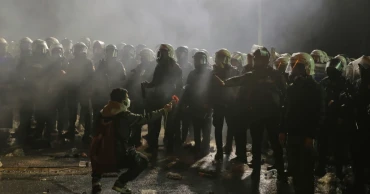
Turkish police crackdown on university protests amid anti-govt unrest
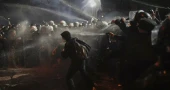
In the early hours of Thursday, police deployed pepper spray, plastic pellets, and water cannons against protesters in Turkey’s capital.
The incident is part of the most significant wave of anti-government demonstrations the country has witnessed in over a decade.
Turkish court orders key Erdogan rival jailed pending trial on corruption charges
The protests erupted last week after the arrest of Istanbul Mayor Ekrem Imamoglu, a prominent opponent of President Recep Tayyip Erdogan. Imamoglu was jailed pending trial on corruption charges that many believe are politically motivated. He is also accused of supporting terrorism. While the government maintains that the judiciary operates independently, critics argue that the case is based on secret witnesses and lacks credible evidence.
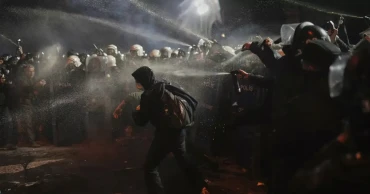
On Thursday morning, student demonstrators attempted to march and gathered near the gates of Middle East Technical University to read a statement, according to reports from the pro-opposition broadcaster Halk TV and local media. Security forces confronted them, using pepper spray, water cannons, and plastic pellets. A standoff ensued as students sought refuge behind a barricade of dumpsters before police moved in to detain them.
Melih Meric, a legislator from Imamoglu’s Republican People’s Party (CHP), was seen drenched and suffering from the effects of pepper spray.
“My student friends merely wanted to make a press statement, but the police refused to allow it. This is the outcome,” Meric stated in social media videos.
Nearly 1,900 Arrested
Interior Minister Ali Yerlikaya announced on Thursday that nearly 1,900 individuals had been arrested during eight days of large-scale protests across the country. He reported that 1,879 suspects had been detained, including 260 who remain in custody pending trial. Another 468 were released under judicial control while their cases proceed, and legal proceedings are still underway for 662 others.
The minister stated that some detainees faced charges related to drug offenses and assault, adding that 150 police officers had been injured. While he did not specify further details, previous statements have cited offenses such as resisting arrest and violating bans on protests and gatherings.
Mass demonstrations, primarily peaceful, have swept through major cities, with opposition-led rallies outside Istanbul City Hall drawing large crowds. Additional protests have taken place in Istanbul’s Kadikoy and Sisli districts in recent days.
However, some demonstrations have escalated into violent confrontations as police have used water cannons, tear gas, plastic pellets, and pepper spray to disperse protesters in cities such as Istanbul, Ankara, and Izmir, where demonstrations have been officially banned.
On Thursday morning, authorities continued to conduct house raids targeting protesters. Most of those arrested in their homes were reportedly affiliated with left-wing parties, trade unions, and civil society groups.
Journalists Arrested, BBC Reporter Deported
On Wednesday, eleven journalists were detained and jailed for covering the protests. The Media and Law Studies Association reported that at least eight of them were released under judicial control the following day, though they still face protest-related charges.
Meanwhile, BBC reporter Mark Lowen was deported from Turkey after being arrested on Wednesday, the British news organisation confirmed. He was taken from his hotel, detained for 17 hours, and then issued a notice labelling him a “threat to public order,” according to a BBC statement released on Thursday.
Mayor and Over 100 Others Facing Trial
Istanbul Mayor Ekrem Imamoglu was arrested in a pre-dawn raid on his home last Wednesday and subsequently jailed. He faces charges linked to two investigations into the opposition-led Istanbul Metropolitan Municipality—one involving allegations of corruption and another accusing him of supporting terrorism.
As the main opposition candidate expected to challenge Erdogan in the next presidential election—currently scheduled for 2028 but potentially happening sooner—Imamoglu’s arrest has heightened political tensions.
Justice Minister Yilmaz Tunc stated on Thursday that 106 individuals had been arrested in connection with the municipality investigations, with 51 currently in jail awaiting trial, including Imamoglu. The detainees include municipal officials and business figures facing allegations of bribery, extortion, and bid-rigging.
Many believe Imamoglu’s case is politically driven. Protesters frequently cite concerns over Turkey’s democratic decline, growing authoritarianism, and worsening economic conditions as reasons for taking to the streets.
Turkey and Israel facing rising tensions over Syria's post-Assad future
Imamoglu was officially confirmed as the CHP’s presidential candidate on the same day he was imprisoned. His strong performance in recent polls against Erdogan and his victory in Istanbul’s 2019 mayoral election—seen as a major political setback for the president—have made him a key figure in Turkey’s opposition movement.
1 year ago
Prosecutors seek arrest of Istanbul Mayor Imamoglu, Erdogan’s key rival, amid protests
Turkish prosecutors on Sunday formally requested the arrest of Istanbul Mayor Ekrem Imamoglu, a leading opposition figure and key challenger to President Recep Tayyip Erdogan, over allegations of corruption and links to terrorism.
A court is expected to rule on whether Imamoglu will be charged and held in custody pending trial.
His detention has triggered nationwide protests, with demonstrators rallying in multiple cities, decrying what they see as a politically motivated effort to sideline him ahead of Turkey’s 2028 presidential election. The government denies the accusations, insisting the judiciary operates independently.
Imamoglu faced two rounds of questioning—first over corruption allegations and later regarding claims of aiding the outlawed Kurdistan Workers’ Party (PKK), according to Cumhuriyet newspaper. He rejected all charges before being transferred to a courthouse along with about 90 others detained in the same operation.
Authorities restricted access to the courthouse, blocking roads and closing metro stations. Despite the heavy police presence, protesters gathered outside, chanting: “Rights, law, justice!”
Largest Protests in Over a DecadeFor a fourth consecutive night, demonstrators took to the streets, including outside Istanbul’s city hall, in what has become Turkey’s biggest wave of protests in more than a decade.
While most rallies remained peaceful, some protesters attempting to breach police barricades threw flares and stones, prompting security forces to respond with pepper spray. In Ankara, water cannons and tear gas were used to disperse crowds.
Interior Minister Ali Yerlikaya said 323 people were detained overnight, warning that authorities would not tolerate unrest.
Turkey and Israel facing rising tensions over Syria's post-Assad future
Mounting Political TensionsImamoglu was arrested Wednesday in a dawn raid on his residence, part of a sweeping crackdown that also saw the detention of two district mayors and several other officials.
In response, Istanbul authorities expanded a ban on demonstrations until March 26 and imposed restrictions on vehicles suspected of transporting protesters.
Erdogan accused the opposition Republican People’s Party (CHP) of turning “a blind eye to municipal corruption” and seeking to divide the nation.
Opposition Pushes BackImamoglu’s detention comes just ahead of the CHP’s presidential primary, where he was expected to be nominated. Party leader Ozel confirmed that the vote, open to 1.5 million delegates, would proceed as planned on Sunday.
In a show of defiance, CHP leaders encouraged citizens to participate in a symbolic nationwide vote using makeshift ballot boxes.
Explosion at in Northwest Turkey leaves 12 dead
Shortly before arriving at the courthouse, Imamoglu urged the public to “protect the ballot boxes,” warning that the government fears the people’s democratic rights. He previously described his arrest as a “coup” and accused authorities of using the judiciary for political gain.
Source: With input from agency
1 year ago

Teenager who killed family, planned massacre gets 49 years
A 19-year-old British man who murdered his mother and two younger siblings, and planned a high-profile school shooting, has been sentenced to at least 49 years in prison without the possibility of parole.
During the sentencing at Luton Crown Court on Wednesday, Justice Bobbie Cheema-Grubb stated that although she had considered issuing a full life sentence for Nicholas Prosper, she decided against it due to his age — he was 18 at the time of the killings — and his guilty plea.
Last month, Prosper admitted to the murders of his 48-year-old mother, Juliana Falcon, and his younger siblings, 13-year-old Giselle and 16-year-old Kyle Prosper, at their Luton, Bedfordshire home on September 13. He also stabbed his brother over 100 times.
The judge noted that Prosper sought to replicate and surpass infamous global massacres, such as the 2012 Sandy Hook Elementary School shooting in Connecticut, where 26 people, mostly children, were killed, and the 2007 Virginia Tech shooting that claimed 30 lives.
“You aimed for notoriety,” the judge told Prosper, who had to be forced into court to hear his sentence. “You wanted to be posthumously known as the most famous school shooter of the 21st century.”
The judge remarked that Prosper's case shared several common traits with other school shootings worldwide, including an unhealthy interest in children, a retreat into online spaces, a lack of empathy for victims, and a premeditated “uniform” for the killings.
The court was informed that Prosper, unable to remain in education or hold down a job, forged a gun license and purchased a shotgun and 100 cartridges from a legitimate dealer the day before the murders. His plan was to carry out a mass shooting at his former elementary school on Friday the 13th.
Early that morning, Prosper fired a test shot into a teddy bear in his bedroom. His mother, waking up first, sensed something was wrong, and Prosper killed her, leaving a copy of the book How to Kill Your Family on her legs. He then shot his sister as she hid under a table and stabbed and shot his brother.
“The lives of your mother and younger brother and sister were merely collateral damage in your pursuit of fame,” the judge commented.
As police flooded the area following the family attack, Prosper flagged down officers in a nearby street and led them to where he had concealed a loaded shotgun and 33 cartridges.
In a statement read by Bedfordshire Police Detective Superintendent Rob Hall, Prosper's father, Raymond, expressed that the deaths of his ex-partner and children carried “far more meaning and importance.” He added, “Their deaths and the swift action of Bedfordshire Police prevented any other family from experiencing the pain we have suffered.”
1 year ago
Zelenskyy says Putin's vow on Ukraine's energy infrastructure unrealistic
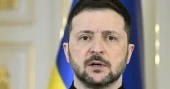
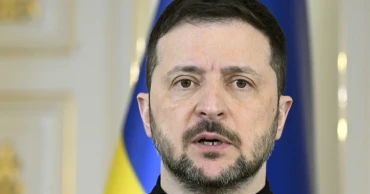
Ukrainian President Volodymyr Zelenskyy stated on Wednesday that Russian President Vladimir Putin's promise not to attack Ukraine's energy infrastructure was "very much at odds with reality" following a series of drone strikes across the country overnight.
Just before Zelenskyy spoke with U.S. President Donald Trump, the Ukrainian leader expressed his anticipation to hear more about Trump's recent phone call with Putin regarding a potential limited ceasefire and discuss subsequent steps.
Tens of thousands rally in Rome in support of Europe amid defense spending debate
"Even last night, after Putin's conversation with Trump, when Putin claimed to have ordered a halt to strikes on Ukrainian energy, 150 drones were launched, including on energy facilities," Zelenskyy said during a press conference in Helsinki with Finnish President Alexander Stubb.
Russia responded by claiming it had stopped targeting Ukraine’s energy facilities and accused Kyiv of attacking equipment near one of its pipelines.
“We unfortunately see that there is no reciprocity from the Kyiv regime,” said Kremlin spokesman Dmitry Peskov.
Despite Putin’s refusal to agree to a full 30-day ceasefire in discussions with Trump, he pledged to immediately halt attacks on Ukraine’s power grid.
The White House described the call between Trump and Putin as the first step toward a "movement to peace," with hopes for a maritime ceasefire in the Black Sea and a full end to the conflict.
However, there was no sign that Putin had softened his stance on the conditions for peace, which are strongly opposed by Kyiv.
The Institute for the Study of War, a U.S.-based think tank, stated that Putin's demands during the call amounted to “Ukrainian capitulation.”
“Putin is attempting to hold the temporary ceasefire proposal hostage to extract preemptive concessions before formal peace talks,” the Institute said in an analysis of the call.
Stubb called the talks between Trump and Putin a positive development but emphasized that Russia needed to end its aggression.
"There are only two ways to respond to the U.S. president's proposal: yes or no—no buts, no conditions," Stubb said. “Ukraine accepted a ceasefire without any conditions. If Russia refuses, we must increase our support for Ukraine and intensify pressure on Russia to return to the negotiating table.”
White House national security adviser Mike Waltz stated on social media that he and his Russian counterpart, Yuri Ushakov, agreed on a meeting in Riyadh, Saudi Arabia, to focus on implementing and expanding the partial ceasefire secured by Trump.
It was unclear who would attend the talks in Riyadh or if Ukrainian officials would be involved.
Following the lengthy phone conversation between Trump and Putin on Tuesday, air raid sirens sounded in Kyiv, followed by explosions as residents sought shelter.
Despite efforts to defend against the attack, several strikes hit civilian infrastructure, including two hospitals, a railway, and over 20 houses, according to Zelenskyy. Russian drones were reported over Kyiv, Zhytomyr, Sumy, Chernihiv, Poltava, Kharkiv, Kirovohrad, Dnipropetrovsk, and Cherkasy regions.
Russia’s Defence Ministry claimed its military launched seven drones at power facilities in Ukraine’s Mykolaiv region, but these were shot down after receiving Putin’s order to avoid targeting energy infrastructure.
Moscow accused Ukraine of targeting its energy facility in the Krasnodar region, bordering the Crimean Peninsula, hours after the Putin-Trump talks. The ministry said three drones targeted oil transfer equipment, causing a fire and loss of pressure in one oil tank.
"It is clear that this is another provocation fabricated by Kyiv to sabotage President Trump’s peace initiatives," the ministry stated.
Russia and Ukraine trade overnight aerial attacks after Putin sets out conditions for ceasefire
Russia also claimed its air defences intercepted 57 Ukrainian drones over the Azov Sea and various Russian regions, including Kursk, Bryansk, Oryol, and Tula.
Zelenskyy stated that "words of a ceasefire" were not enough.
"If the Russians don’t hit our facilities, we certainly won’t hit theirs," he said.
Zelenskyy rejected Putin’s key condition that Western nations halt military aid and intelligence support to Ukraine. He argued that such an action would endanger lives by leaving citizens unaware of incoming airstrikes and prolong the war.
“I don’t think anyone should make concessions in helping Ukraine; instead, aid to Ukraine should be increased,” Zelenskyy said. “This would signal that Ukraine is ready for any surprises from Russia.”
Nigel Gould-Davies, a senior fellow at the International Institute for Strategic Studies, called Putin’s rejection of the ceasefire unsurprising, noting that it was unwise for Putin to express it directly to President Trump, who has made ending the war a top priority.
“What we now have is a rivalry between Kyiv and Moscow to persuade Trump that the other side is preventing him from achieving his goal of ending the war,” Gould-Davies said.
Zelenskyy noted that one of the most challenging issues in future negotiations would be territorial concessions.
"For us, the red line is recognizing the temporarily occupied Ukrainian territories as Russian," he said. “We will not agree to that.”
1 year ago
Tens of thousands rally in Rome in support of Europe amid defense spending debate
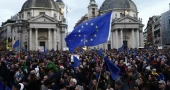
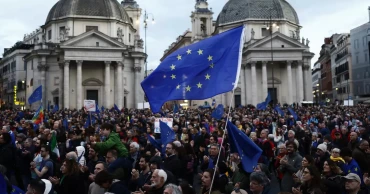
Tens of thousands of Italians gathered in central Rome on Saturday, waving European Union flags in a show of unity as debate intensifies over the EU’s push for increased defense spending.
The rally, backed by most center-left opposition parties despite their differing stances, was initiated by Italian journalist Michele Serra. His call for action came in late February through an editorial in La Repubblica titled “Let’s say something European.”
“My goal was to organize a major demonstration of citizens in support of Europe—its unity and its freedoms—without party banners, only European flags,” Serra said, coining the slogan: “Here we make Europe, or we die.”
The movement emerged as a response to escalating tensions between the U.S. and Europe, exacerbated by U.S. President Donald Trump’s policies, which have widened divisions over the war in Ukraine and trade disputes.
Italian Premier Giorgia Meloni has reluctantly backed an EU proposal to bolster European defense capabilities, a plan spearheaded by European Commission President Ursula von der Leyen. However, she has expressed concerns about its potential impact on Italy’s already massive debt, fearing that increased military spending could divert crucial funds from other national priorities.
Trump clarifies his 24-hour Russia-Ukraine war promise as 'Sarcastic'
The EU’s rearmament plan aims to raise approximately 800 billion euros over four years, primarily through increased defense and security expenditures by member states.
Meloni has been vocal in challenging the wording of the proposal, arguing that “rearmament” is misleading. Instead, she has urged European leaders to focus on broader security and defense cooperation.
Saturday’s demonstration packed Rome’s Piazza del Popolo with an estimated 30,000 people. Organizers described it as a rare moment of unity, bringing together Italians from different political backgrounds under the common cause of defending democracy.
“We are here to protect freedom and democracy,” said participant Daniela Condotto. “These are values we’ve enjoyed for over 80 years, but they must not be taken for granted. They need to be defended.”
Meloni’s right-wing government allies largely ignored the demonstration, siding with her cautious approach toward the EU plan.
Foreign Minister and Vice Premier Antonio Tajani dismissed the protest as symbolic, stating, “Support for Europe is necessary, but it must come with real reforms, not just public displays.”
China, Russia and Iran call for end to US sanctions on Iran and the restart of nuclear talks
Meanwhile, Vice Premier Matteo Salvini, leader of the euroskeptic League party, openly criticized the rally. “While some wave flags, we work to change Europe—a Europe that burdens workers, farmers, and entrepreneurs with senseless regulations,” he said.
Source: With input from agency
1 year ago
Russia and Ukraine trade overnight aerial attacks after Putin sets out conditions for ceasefire
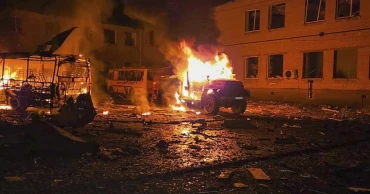
Russia and Ukraine traded heavy aerial blows overnight, with both sides on Saturday reporting more than 100 enemy drones over their respective territories.
The attacks comes less than 24 hours after Russian President Vladimir Putin met with U.S. envoy Steve Witkoff to discuss details of the American proposal for a 30-day ceasefire in the war with Ukraine.
Putin told a press conference on Thursday that he supported a truce in principle but set out a host of details that need to be clarified before it is agreed. Kyiv has already endorsed the truce proposal, although Ukrainian officials have publicly raised doubts as to whether Moscow will commit to such a deal.
Speaking to reporters in Kyiv on Saturday, after virtual talks between Western allies hosted by U.K. Prime Minister Keir Starmer, Zelenskyy voiced Ukraine’s support for the 30-day full ceasefire proposal to discuss a longer-term peace plan, but said Russia would attempt to derail talks with conditions and “buts”.
Starmer has told allies to “keep the pressure” on Putin to back a ceasefire in Ukraine, hailing Ukraine as the “party of peace.” Starmer said Putin will “sooner or later” have to “come to the table.
In a statement earlier on Saturday, Zelenskyy had accused Moscow of building up forces along the border.
“The build up of Russian forces indicates that Moscow intends to keep ignoring diplomacy. It is clear that Russia is prolonging the war,” he said.
However, Zelenskyy stressed that if Russia did not agree with the U.S. proposal there would be “specific, harsh and straightforward” response from the administration of U.S. President Donald Trump.
Trump clarifies his 24-hour Russia-Ukraine war promise as 'Sarcastic'
He also said that Kyiv’s troops were maintaining their presence in Russia’s Kursk region after Trump said Friday that “thousands” of Ukrainian troops had been surrounded by the Russian military.
“The operation of our forces in the designated areas of the Kursk region continues,” Zelenskyy said. “Our troops continue to hold back Russian and North Korean groupings in the Kursk region. There is no encirclement of our troops.”
U.S. Secretary of State Marco Rubio spoke Saturday with Russian Foreign Minister Sergei Lavrov. In the call, they discussed next steps to follow up on recent meetings in Saudi Arabia and agreed to continue working towards restoring communication between the United States and Russia, State Department spokesperson Tammy Bruce said in a statement.
Ukraine’s air force said Saturday that Russia had launched a barrage of 178 drones and two ballistic missiles over the country overnight. The attack was a mixture of Shahed-type drones and imitation drones designed to confuse air defenses. Some 130 drones were shot down, while 38 more failed to reach their targets.
Russia attacked energy facilities, causing significant damage, striking energy infrastructure in the Dnipropetrovsk and Odesa regions, Ukraine’s private energy company DTEK said in a statement on Saturday. Some residents were left without electricity.
“The damage is significant. Energy workers are already working on the ground. We are doing everything possible to restore power to homes as soon as possible,” the energy firm said.
Falling drone debris in Russia’s Volgograd region sparked a fire in the Krasnoarmeysky district of the city, close to a Lukoil oil refinery, according to Gov. Andrei Bocharov, who provided no further details. Nearby airports temporarily halted flights, local media outlets reported. No casualties were reported.
US resumes military aid as Ukraine signals ceasefire possibility
The Volgograd refinery has been targeted by Kyiv’s forces on several occasions since Moscow launched its full-scale invasion of Ukraine more than three years ago, most recently in a drone attack on Feb. 15.
Source: With input from agency
1 year ago
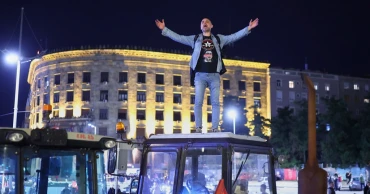
Serbia prepares for anti-govt protest amid rising tensions
The piercing sound of whistles and vuvuzelas resonated through downtown Belgrade on Saturday as the city braced for a large-scale protest against populist President Aleksandar Vucic and his administration.
Massive crowds have been gathering in downtown Belgrade for what is considered the peak of months-long, nearly daily anti-corruption demonstrations, posing the most significant challenge to Vucic’s 13-year stronghold on Serbia’s leadership.
Serbian lawmakers injured as smoke bombs, flares thrown in parliament
On Friday evening, tens of thousands enthusiastically welcomed students who had been walking or cycling for days from various parts of Serbia to reach Belgrade for Saturday afternoon’s main protest. From early morning, people began assembling in different parts of the city, preparing to march towards the centre.
Tensions have intensified in the lead-up to the demonstration, with Vucic repeatedly alleging plans for unrest and issuing threats of arrests and severe penalties for any disturbances.
Raising concerns of potential clashes, Vucic’s supporters have set up camp in central Belgrade in front of his headquarters. Among them are former members of a notorious paramilitary unit implicated in the 2003 assassination of Serbia’s first democratic Prime Minister, Zoran Djindjic, along with football hooligans known for inciting violence.
On Saturday, private broadcaster N1 aired footage showing dozens of young men wearing baseball caps entering the pro-Vucic encampment.
Interior Minister Ivica Dacic informed state broadcaster RTS that 13 people had been detained overnight, though no major incidents were reported on Friday. He stated that six opposition activists were arrested on allegations of plotting to instigate a coup and provoke unrest on Saturday.
Serbia's prime minister resigns as anti-corruption protests grow
Students have spearheaded the nationwide anti-corruption movement, which emerged following the collapse of a concrete canopy at a train station in northern Serbia on 1 November, killing 15 people.
Many in Serbia attribute the tragedy to widespread government corruption, negligence, and disregard for construction safety regulations.
Vucic has accused Western intelligence agencies of orchestrating the near-daily student-led protests as part of an effort to remove him from power.
The students have resonated with citizens frustrated by politicians and disillusioned with state institutions. Previous student-led protests in other Serbian cities have remained peaceful while attracting vast crowds.
1 year ago