usa-canada

Ted Kaczynski, known as the Unabomber for years of attacks that killed 3, dies in prison at 81
Theodore "Ted" Kaczynski, the Harvard-educated mathematician who retreated to a dingy shack in the Montana wilderness and ran a 17-year bombing campaign that killed three people and injured 23 others, died Saturday. He was 81.
Branded the "Unabomber" by the FBI, Kaczynski died at the federal prison medical center in Butner, North Carolina, Kristie Breshears, a spokesperson for the federal Bureau of Prisons, told The Associated Press. He was found unresponsive in his cell early Saturday morning and was pronounced dead around 8 a.m., she said. A cause of death was not immediately known.
Also read: 9 people wounded in San Francisco mass shooting; 1 remains in critical condition
Before his transfer to the prison medical facility, he had been held in the federal Supermax prison in Florence, Colorado, since May 1998, when he was sentenced to four life sentences plus 30 years for a campaign of terror that set universities nationwide on edge. He admitted committing 16 bombings from 1978 and 1995, permanently maiming several of his victims.
Years before the Sept. 11 attacks and the anthrax mailing, the Unabomber's deadly homemade bombs changed the way Americans mailed packages and boarded airplanes, even virtually shutting down air travel on the West Coast in July 1995.
He forced The Washington Post, in conjunction with The New York Times, to make the agonizing decision in September 1995 to publish his 35,000-word manifesto, "Industrial Society and Its Future," which claimed modern society and technology was leading to a sense of powerlessness and alienation.
Also read: US confirms China has had a spy base in Cuba since at least 2019
But it led to his undoing. Kaczynski's brother, David, and David's wife, Linda Patrik, recognized the treatise's tone and tipped off the FBI, which had been searching for the Unabomber for years in nation's longest, costliest manhunt.
Authorities in April 1996 found him in a 10-by-14-foot (3-by-4-meter) plywood and tarpaper cabin outside Lincoln, Montana, that was filled with journals, a coded diary, explosive ingredients and two completed bombs.
As an elusive criminal mastermind, the Unabomber won his share of sympathizers and comparisons to Daniel Boone, Edward Abbey and Henry David Thoreau.
But once revealed as a wild-eyed hermit with long hair and beard who weathered Montana winters in a one-room shack, Kaczynski struck many as more of a pathetic loner than romantic anti-hero.
Even in his own journals, Kaczynski came across not as a committed revolutionary but as a vengeful hermit driven by petty grievances.
"I certainly don't claim to be an altruist or to be acting for the 'good' (whatever that is) of the human race," he wrote on April 6, 1971. "I act merely from a desire for revenge."
A psychiatrist who interviewed Kaczynski in prison diagnosed him as a paranoid schizophrenic.
"Mr. Kaczynski's delusions are mostly persecutory in nature," Sally Johnson wrote in a 47-page report. "The central themes involve his belief that he is being maligned and harassed by family members and modern society."
Kaczynski hated the idea of being viewed as mentally ill and when his lawyers attempted to present an insanity defense, he tried to fire them. When that failed, he tried to hang himself with his underwear.
Also read: Boris Johnson’s bombshell exit from Parliament leaves UK politics reeling
Kaczynski eventually pleaded guilty rather than let his defense team proceed with an insanity defense.
"I'm confident that I'm sane," Kaczynski told Time magazine in 1999. "I don't get delusions and so forth."
He was certainly brilliant.
Kaczynski skipped two grades to attend Harvard at age 16 and had published papers in prestigious mathematics journals. His explosives were carefully tested and came in meticulously handcrafted wooden boxes sanded to remove possible fingerprints. Later bombs bore the signature "FC" for "Freedom Club."
The FBI called him the "Unabomber" because his early targets seemed to be universities and airlines. An altitude-triggered bomb he mailed in 1979 went off as planned aboard an American Airlines flight; a dozen people aboard suffered from smoke inhalation.
Kaczynski killed computer rental store owner Hugh Scrutton, advertising executive Thomas Mosser and timber industry lobbyist Gilbert Murray. California geneticist Charles Epstein and Yale University computer expert David Gelernter were maimed by bombs two days apart in June 1993.
Mosser was killed in his North Caldwell, New Jersey, home on Dec. 10, 1994, a day he was supposed to be picking out a Christmas tree with his family. His wife, Susan, found him grievously wounded by a barrage of razor blades, pipes and nails.
"He was moaning very softly," she said at Kaczynski's 1998 sentencing. "The fingers on his right hand were dangling. I held his left hand. I told him help was coming. I told him I loved him."
When Kaczynski stepped up his bombs and letters to newspapers and scientists in 1995, experts speculated the Unabomber was jealous of the attention being paid to Oklahoma City bomber Timothy McVeigh.
A threat to blow up a plane out of Los Angeles before the end of the July Fourth weekend threw air travel and mail delivery into chaos. The Unabomber later claimed it was a "prank."
The Washington Post printed the Unabomber's manifesto at the urging of federal authorities, after the bomber said he would desist from terrorism if a national publication published his treatise.
Patrik had had a disturbing feeling about her brother-in-law even before seeing the manifesto and eventually persuaded her husband to read a copy at the library. After two months of arguments, they took some of Ted Kaczynski's letters to Patrik's childhood friend Susan Swanson, a private investigator in Chicago.
Swanson in turn passed them along to former FBI behavioral science expert Clint Van Zandt, whose analysts said whoever wrote them had also probably written the Unabomber's manifesto.
"It was a nightmare," David Kaczynski, who as a child had idolized his older brother, said in a 2005 speech at Bennington College. "I was literally thinking, 'My brother's a serial killer, the most wanted man in America.'"
Swanson turned to a corporate lawyer friend, Anthony Bisceglie, who contacted the FBI. The investigation and prosecution were overseen by now-Attorney General Merrick Garland, during a previous stint at the Justice Department.
David Kaczynski wanted his role kept confidential, but his identity quickly leaked out and Ted Kaczynski vowed never to forgive his younger sibling. He ignored his letters, turned his back on him at court hearings and described David Kaczynski in a 1999 book draft as a "Judas Iscariot (who) ... doesn't even have enough courage to go hang himself."
Ted Kaczynski was born May 22, 1942, in Chicago, the son of second-generation Polish Catholics — a sausage-maker and a homemaker. He played the trombone in the school band, collected coins and skipped the sixth and 11th grades.
His high school classmates thought him odd, particularly after he showed a school wrestler how to make a mini-bomb that detonated during chemistry class.
Harvard classmates recalled him as a lonely, thin boy with poor personal hygiene and a room that smelled of spoiled milk, rotting food and foot powder.
After graduate studies at the University of Michigan at Ann Arbor, he got a job teaching math at the University of California at Berkeley but found the work difficult and quit abruptly. In 1971, he bought a 1½-acre parcel about 4 miles (6 kilometers) outside of Lincoln and built a cabin there without heating, plumbing or electricity.
He learned to garden, hunt, make tools and sew, living on a few hundred dollars a year.
Also read: Top UN court allows a record 32 countries to intervene in Ukraine's genocide case against Russia
He left his cabin in Montana in the late 1970s to work at a foam rubber products manufacturer outside Chicago with his father and brother. But when a female supervisor dumped him after two dates, he began posting insulting limericks about her and wouldn't stop.
His brother fired him and Ted Kaczynski soon returned to the wilderness to continue plotting his vengeful killing spree.
3 years ago

Poor air quality from Canadian wildfires affects people as far as away as North Carolina
On air quality maps, purple signifies the worst of it. In reality, it’s a thick, hazardous haze that’s disrupting daily life for millions of people across the U.S. and Canada, blotting out skylines and turning skies orange.
With weather systems expected to barely budge, the smoky blanket billowing from wildfires in Quebec and Nova Scotia and sending plumes of fine particulate matter as far away as North Carolina and northern Europe should persist into Thursday and possibly the weekend.
That means at least another day of a dystopian-style detour that’s chased players from ballfields, actors from Broadway stages, delayed thousands of flights and sparked a resurgence in mask wearing and remote work — all while raising concerns about the health effects of prolonged exposure to such bad air.
The weather system that’s driving the great Canadian-American smokeout — a low-pressure system over Maine and Nova Scotia — “will probably be hanging around at least for the next few days,” U.S. National Weather Service meteorologist Bryan Ramsey said.
READ: Smoky haze blanketing US and Canada could last into the weekend
“Conditions are likely to remain unhealthy, at least until the wind direction changes or the fires get put out,” Ramsey said. “Since the fires are raging — they’re really large — they’re probably going to continue for weeks. But it’s really just going be all about the wind shift.”
Across the eastern U.S., officials warned residents to stay inside and limit or avoid outdoor activities again Thursday, extending “Code Red” air quality alerts in some places for a third straight day as forecasts showed winds continuing to push smoke-filled air south.
The smoke has moved over Greenland and Iceland since June 1, and was expected to reach Norway on Thursday, the Norwegian Climate and Environmental Research Institute said, but wasn’t expected to be a health concern.
In Washington, D.C., Mayor Muriel Bowser ordered schools to cancel outdoor recess, sports and field trips Thursday. In suburban Philadelphia, officials set up an emergency shelter so people living outside can take refuge from the haze.
New York Gov. Kathy Hochul said the state was making a million N95 masks — the kind prevalent at the height of the COVID-19 pandemic — available at state facilities, including 400,000 in New York City. She also urged residents to stay put.
READ: Russia says top UN court should dismiss Ukraine's case over Crimea and terrorism funding
“You don’t need to go out and take a walk. You don’t need to push the baby in the stroller,” Hochul said Wednesday night. “This is not a safe time to do that.”
The message may be getting through. So far, officials said Wednesday, New York City has yet to see an uptick in 911 emergency calls related to respiratory issues and cardiac arrests.
More than 400 blazes burning across Canada have left 20,000 people displaced. The U.S. has sent more than 600 firefighters and equipment to Canada. Other countries are also helping.
Canadian Prime Minister Justin Trudeau spoke to President Joe Biden by phone Wednesday. Trudeau’s office said he thanked Biden for his support and that both leaders “acknowledged the need to work together to address the devastating impacts of climate change.”
Canadian officials say this is shaping up to be the country’s worst wildfire season ever. It started early on drier-than-usual ground and accelerated quickly. Smoke from the blazes has been flowing into the U.S. since last month but intensified with recent fires in Quebec, where about 100 were considered out of control Wednesday.
“I can taste the air,” Dr. Ken Strumpf said in a Facebook post from Syracuse, New York, where the sky took on the colorful nickname of the local university: Orange.
READ: WHO, Global Fund announce commitment for enhanced collaboration
The smoke was so thick in Canada’s capital, Ottawa, that office towers just across the Ottawa River were barely visible. In Toronto, Yili Ma said her hiking group canceled a planned hike this week, and she was forgoing the restaurant patios that are a beloved summer tradition in a nation known for hard winters.
“I put my mask away for over a year, and now I’m putting on my mask since yesterday,” Ma lamented.
Eastern Quebec got some rain Wednesday, but Montreal-based Environment Canada meteorologist Simon Legault said no significant rain is expected for days in the remote areas of central Quebec where the wildfires are more intense.
In the U.S., federal officials delayed some flights bound Thursday morning for New York’s LaGuardia Airport; Newark, New Jersey; and Philadelphia because smoke was limiting visibility. The Federal Aviation Administration said in a statement that it will likely need to take steps to manage the flow of air traffic into Washington, D.C., and Charlotte, North Carolina, as well.
Major League Baseball’s Yankees and Phillies had their games postponed. On Broadway, “Hamilton” and “Camelot” canceled Wednesday performances and “Prima Facie” star Jodie Comer left a matinee after 10 minutes because of difficulty breathing. The show restarted with an understudy, show publicists said.
It was not to be at Central Park’s outdoor stage, either. Shakespeare in the Park canceled its Thursday and Friday performances of “Hamlet,” saying ’tis not nobler in the mind to suffer the slings and arrows of wretched air.
3 years ago

Smoky haze blanketing US and Canada could last into the weekend
On air quality maps, purple signifies the worst of it. In reality, it's a thick, hazardous haze that's disrupting daily life for millions of people across the U.S. and Canada, blotting out skylines and turning skies orange.
And with weather systems expected to hardly budge, the smoky blanket billowing from wildfires in Quebec and Nova Scotia and sending plumes of fine particulate matter as far away as North Carolina and northern Europe should persist into Thursday and possibly the weekend.
That means at least another day, or more, of a dystopian-style detour that's chased players from ballfields, actors from Broadway stages, delayed thousands of flights and sparked a resurgence in mask wearing and remote work — all while raising concerns about the health effects of prolonged exposure to such bad air.
Read more: Millions breathing hazardous air as smoke from Canadian wildfires streams south over US
The weather system that's driving the great Canadian-American smoke out — a low-pressure system over Maine and Nova Scotia — "will probably be hanging around at least for the next few days," U.S. National Weather Service meteorologist Bryan Ramsey said.
"Conditions are likely to remain unhealthy, at least until the wind direction changes or the fires get put out," Ramsey said. "Since the fires are raging — they're really large — they're probably going to continue for weeks. But it's really just going be all about the wind shift."
Across the eastern U.S., officials warned residents to stay inside and limit or avoid outdoor activities again Thursday, extending "Code Red" air quality alerts in some places for a third-straight day as forecasts showed winds continuing to push smoke-filled air south.
The smoke has moved over Greenland and Iceland since June 1, and was expected to reach Norway on Thursday, the Norwegian Climate and Environmental Research Institute said, but wasn't expected to be a health concern.
Read more: 'I can taste the air': Canadian wildfire smoke spreads hazardous haze at home and in the US
In Washington, D.C., Mayor Muriel Bowser ordered schools to cancel outdoor recess, sports and field trips Thursday. In suburban Philadelphia, officials set up an emergency shelter so people living outside can take refuge from the haze.
New York Gov. Kathy Hochul said the state was making a million N95 masks — the kind prevalent at the height of the COVID-19 pandemic — available at state facilities, including 400,000 in New York City. She also urged residents to stay put.
"You don't need to go out and take a walk. You don't need to push the baby in the stroller," Hochul said Wednesday night. "This is not a safe time to do that."
The message may be getting through. So far, officials said Wednesday, New York City has yet to see an uptick in 911 calls related to respiratory issues and cardiac arrests.
More than 400 blazes burning across Canada have left 20,000 people displaced. The U.S. has sent more than 600 firefighters and equipment to Canada. Other countries are also helping.
Canadian Prime Minister Justin Trudeau spoke to President Joe Biden by phone on Wednesday. Trudeau's office said he thanked Biden for his support and that both leaders "acknowledged the need to work together to address the devastating impacts of climate change."
Canadian officials say this is shaping up to be the country's worst wildfire season ever. It started early on drier-than-usual ground and accelerated quickly. Smoke from the blazes has been lapping into the U.S. since last month but intensified with recent fires in Quebec, where about 100 were considered out of control Wednesday.
"I can taste the air," Dr. Ken Strumpf said in a Facebook post from Syracuse, New York, where the sky took on the colorful nickname of the local university: Orange.
The smoke was so thick in Canada's capital, Ottawa, that office towers just across the Ottawa River were barely visible. In Toronto, Yili Ma said her hiking group canceled a planned hike this week, and she was forgoing the restaurant patios that are a beloved summer tradition in a nation known for hard winters.
"I put my mask away for over a year, and now I'm putting on my mask since yesterday," Ma lamented.
Eastern Quebec got some rain Wednesday, but Montreal-based Environment Canada meteorologist Simon Legault said no significant rain is expected for days in the remote areas of central Quebec where the wildfires are more intense.
In the U.S., federal officials paused some flights bound Wednesday for New York's LaGuardia Airport and slowed planes to Newark and Philadelphia because smoke was limiting visibility.
Major League Baseball's Yankees and Phillies had their games postponed. On Broadway, "Hamilton" and "Camelot" canceled Wednesday performances and "Prima Facie" star Jodie Comer left a matinee after 10 minutes because of difficulty breathing. The show restarted with an understudy, show publicists said.
It was not to be at Central Park's outdoor stage, either. Shakespeare in the Park canceled its Thursday and Friday performances of "Hamlet," saying 'tis not nobler in the mind to suffer the slings and arrows of wretched air.
3 years ago

'I can taste the air': Canadian wildfire smoke spreads hazardous haze at home and in the US
Smoke from Canadian wildfires poured into the U.S. East Coast and Midwest on Wednesday, covering the capitals of both nations in an unhealthy haze, holding up flights at major airports and prompting people to fish out pandemic-era face masks.
While Canadian officials asked other countries for help fighting more than 400 blazes nationwide that already have displaced 20,000 people, air quality with what the U.S. rates as hazardous levels of pollution extended into central New York. Massive tongues of unhealthy air extended as far as Virginia and Indiana, affecting millions of people.
"I can taste the air," Dr. Ken Strumpf said in a Facebook post from Syracuse, New York, which was enveloped in an amber pall. The smoke, he later said by phone, even made him a bit dizzy.
In Baltimore, where officials warned residents to stay indoors when possible, Debbie Funk sported a blue surgical mask as she and husband, Jack Hughes, took their daily walk around Fort McHenry, a national monument overlooking the Patapsco River. The air hung thick over the water, obscuring the horizon as distant ships pushed slowly through the haze.
"I walked outside this morning and it was like a waft of smoke," said Funk, who said the couple had considered skipping the walk but wanted some exercise. The two planned to stay inside later Wednesday.
Canadian officials say this is shaping up to be the nation's worst wildfire season ever. It started early on drier-than-usual ground and accelerated very quickly, exhausting firefighting resources across the country, fire and environmental officials said.
Smoke from the blazes in various parts of the country has been lapping into the U.S. since last month but intensified with a recent spate of fires in Quebec, where more than 100 were burning and considered out of control Tuesday.
"The smoke was insane yesterday. I had to close my window because the fresh air just smelled like campfire," said Zachary Kamel, 36, of Montreal.
Quebec Premier François Legault has said the province has the capacity to fight about 40 fires at the moment — and the usual reinforcements from other provinces have been strained by fires in Nova Scotia and elsewhere.
"There are a lot of fires that have been not been fought," Legault said.
Canadian Interagency Forest Fire Centre spokesperson Jennifer Kamau said more than 950 firefighters and other personnel have already arrived from the U.S., Australia, New Zealand and South Africa, and more will be arriving soon.
The largest town in Northern Quebec — Chibougamau, population about 7,500 — was evacuated Tuesday, after another Quebec community was left to burn Monday, drawing the ire of local residents. Legault said authorities had no choice because the fire around the hamlet of Clova was too intense to send in water bombers. No homes had burned as of Tuesday.
Eastern Quebec got some rain Wednesday, but none is expected for days in the remote areas of central Quebec where the wildfires are more intense, Legault said.
U.S. National Weather Service meteorologist Zach Taylor said the current weather pattern in the central and eastern U.S. is essentially funneling in the smoke. Some rain should help clear the air somewhat in the Northeast and Mid-Atlantic this weekend or early next week, though more thorough relief will come from containing or extinguishing the fires, he noted.
Across the border, New York Gov. Kathy Hochul warned the public to "prepare for this over the long haul," New York City Mayor Eric Adams told residents to limit outdoor activities as much as possible.
The Federal Aviation Administration temporarily held up flights at LaGuardia and Newark airports for weather and low visibility and said smoke was contributing to delayed arrivals at Dulles International Airport outside Washington.
Schools in multiple states canceled sports and other outdoor activities, shifting recess and lunch time inside. Live horse racing was canceled Wednesday and Thursday at Delaware Park Wilmington. Organizers of Global Running Day, a virtual 5K and celebration of running, posted a warning on their website advising participants to monitor the air quality in their cities and change their running plans accordingly.
Some political demonstrations in spots from Manhattan to Harrisburg, Pennsylvania, were moved indoors or postponed, and striking Hollywood writers were pulled off picket lines in the New York metropolitan area.
Sitting in a Brooklyn park with a black face mask on, nanny Meagan Bobb said she was surprised by how bad the air was.
"The little girl was coughing, and I was having problems breathing when I was walking around, so we're looking to go inside somewhere soon," Bobb said.
The smoke exacerbated health problems for people such as Vicki Burnett, 67, who has asthma and has had serious bouts with bronchitis.
After taking her dogs out Wednesday morning in Farmington Hills, Michigan, Burnett said, "I came in and started coughing and hopped back into bed."
Still, she stressed that she's concerned for Canadians, not just herself.
"It's unfortunate, and I'm having some problems for it, but there should be help for them," she said.
3 years ago

New York City passes bill banning weight discrimination
Discriminating against someone because of weight when it comes to work, housing or in public accommodation would be barred in New York City under a bill passed Thursday by the City Council.
The measure would amend city law to add weight and height to the list of identifiers that are considered protected, like race, sexual orientation, gender identity and national origin.
“People with different body types are not only denied jobs and promotions that they deserve, their whole existence has also been denied by a society that has offered no legal remedy for this prejudice,” said Councilmember Shaun Abreu, who sponsored the legislation.
He said New York would join a handful of cities in the country with similar protections. Michigan is the only state with a law that expressly bans weight discrimination, while in Washington state, a court ruled that obesity is covered under an anti-discrimination law for employees with disabilities.
A few other states have had legislation introduced on the issue for consideration.
The New York City bill carves out exemptions such as jobs where height or weight considerations are integral to the role being performed.
It now goes to Mayor Eric Adams, who has said in the past that weight shouldn’t be a basis for treating people differently. There was no immediate response to an email sent to his office seeking comment.
3 years ago

800,000 people without electricity in Canada as freezing rain hits Ontario and Quebec
Freezing rain and thunderstorms pummeled parts of Ontario and Quebec on Wednesday, knocking out power for about 800,000 people, officials reported.
Quebec's power utility said shortly after 5 p.m. that more than 676,000 of its 4.5 million customers had no electricity as much of the province remained under a freezing rain warning.
"What's causing the outages is the mixture of precipitation and wind," Hydro-Québec spokeswoman Gabrielle Leblanc said. "It weighs down the vegetation. There can be branches and trees that fall on the lines."
In Montreal, more than 316,000 customers had lost power, while 171,000 people were hit with outages in the Montérégie region, south of the city.
Leblanc said many of the outages were small in area, each affecting only a few customers, so crews would need to repair numerous breaks to restore power to everyone.
In Montreal, there were numerous reports of downed trees. Transport Quebec said weather conditions forced it to close the Victoria Bridge, which connects Montreal with its southern suburbs.
Public Security Minister François Bonnardel said his department has put a coordination center in place to deal with the storm.
3 years ago

39 dead in fire at Mexico migrant center near US border
A fire in a dormitory at a Mexican immigration detention center near the U.S. border left more than three dozen migrants dead, a government agency said Tuesday, in one of the deadliest incidents ever at an immigration lockup in the country.
Hours after the fire broke out late Monday, rows of bodies were laid out under shimmery silver sheets outside the facility in Ciudad Juarez, which is across from El Paso, Texas, and a major crossing point for migrants. Ambulances, firefighters and vans from the morgue swarmed the scene.
Thirty-nine people died and 29 were injured and are in "delicate-serious" condition, according to the National Immigration Institute. There were 68 men from Central and South America held in the facility at the time of the fire, the agency said.
It was the deadliest incident inside a Mexican immigration facility in recent memory. Authorities are investigating the cause of the fire and the governmental National Human Rights Commission had been called in to help the migrants.
Tensions between authorities and migrants had apparently been running high in recent weeks in Ciudad Juarez, where shelters are full of people waiting for opportunities to cross into the U.S. or who have requested asylum there and are waiting out the process.
More than 30 migrant shelters and other advocacy organizations published an open letter March 9 that complained of a criminalization of migrants and asylum seekers in the city. It accused authorities of abuse and using excessive force in rounding up migrants, complaining that municipal police were questioning people in the street about their immigration status without cause.
The high level of frustration in Ciudad Juarez was evident earlier this month when hundreds of mostly Venezuelan migrants acting on false rumors that the United States would allow them to enter the country tried to force their way across one of the international bridges to El Paso. U.S. authorities blocked their attempts.
The national immigration agency said Tuesday that it "energetically rejects the actions that led to this tragedy" without any further explanation of what those actions might have been.
In recent years, as Mexico has stepped up efforts to stem the flow migration to the U.S. border under pressure from the American government, the agency has struggled with overcrowding in its facilities. And the country's immigration lockups have seen protests and riots from time to time.
Mostly Venezuelan migrants rioted inside an immigration center in Tijuana in October that had to be controlled by police and National Guard troops. In November, dozens of migrants rioted in Mexico's largest detention center in the southern city of Tapachula near the border with Guatemala. No one died in either incident.
3 years ago

Biden's Canada agenda stacked: NORAD, migration deals likely
President Joe Biden arrived in Canada on Thursday for talks with Prime Minister Justin Trudeau on several of the world's most difficult challenges: the war in Ukraine, climate change, trade, mass migration and an increasingly assertive China.
Two important agreements appeared to be in hand before Biden even departed Washington. Canada will escalate its timeline for military upgrades to the North American Aerospace Defense Command and the two nations have reached an agreement to update rules for migrants seeking asylum, according to U.S. and Canadian officials. The officials were not authorized to comment publicly and requested anonymity.
The migration deal eliminates a loophole under existing rules that will allow both countries to turn away asylum seekers at the countries' borders. The loophole resulted in thousands of migrants annually crossing into Canada from the U.S. at a non-official checkpoint, enabling them to stay in the country as they seek asylum instead of letting the process play out while staying in the U.S.
As part of the agreement, Canada is expected to announce that 15,000 migrants from the Western Hemisphere will be given slots to apply to enter the country, according to a Canadian official.
The new policy applies to people without U.S. or Canadian citizenship who are caught within 14 days of crossing the border between the two countries. Biden and Trudeau did not respond to questions from reporters about the agreement when the president and first lady Jill Biden arrived for a private gathering at the prime minister's residence.
The White House declined to comment on the agreement, which is expected to be formally announced Friday.
The visit comes as the Biden administration has made strengthening its relationship with Canada a priority over the past two years. Both sides see the meetings in the capital of Ottawa as an opportunity to set plans for the future.
National security and air defenses are top of mind after a Chinese spy balloon last month traversed North America. Canada plans to update its radar systems and has agreed to an accelerated timeline for spending billions more on military upgrades for NORAD, which monitors the skies above the continent, according to the senior Canadian government official.
Canada announced last year it is investing $3.8 billion (Canadian $4.9 billion) over the next six years to modernize NORAD radar systems and billions more years later, but David Cohen, the U.S. ambassador to Canada, has said the current threat climate calls for quicker investment.
The loophole in the U.S.-Canada migration rules allowed thousands of migrants to cross into Canada from the U.S. at a non-official checkpoint, enabling them to stay in the country as they seek asylum instead of letting the process play out while staying in the U.S.
A quirk in a 2002 agreement between the U.S. and Canada says people seeking asylum must apply in the first country they arrive in. Migrants who go to an official crossing are returned to the U.S. and told to apply there. But those who arrive in Canada at a location other than a port of entry are allowed to stay and request protection, as has been happening on Roxham Road between Champlain, New York, and Quebec.
More than 39,000 claims were filed in 2022 by people who were intercepted by Canadian police, the vast majority of them in Quebec and at Roxham Road.
The broadened focus of Biden's visit represents an evolution of a friendship between the two countries that exceeds 150 years. The emphasis had more frequently been on issues like trade that had defined relations between the two countries, which share a 5,525-mile border.
"This visit is about taking stock of what we've done, where we are and what we need to prioritize for for the future," said John Kirby, a spokesman for the White House National Security Council. "We're going to talk about our two democracies stepping up to meet the challenges of our time."
There will still be an emphasis on trade, yet Canada and the U.S. see the partnership as crucial in supporting Ukraine against Russia's invasion, reducing their dependence on Chinese goods and shifting toward cleaner energy sources amid the planetary damage caused by burning fossil fuels.
The leaders are also expected to discuss tapping critical minerals that will enable the production of electric vehicles, and military and economic commitments at a moment that observers say is the most dangerous since World War II. Chinese President Xi Jinping this week visited Russian President Vladimir Putin, pledging to deepen their economic ties in ways that could help fund Putin's ongoing war to take Ukraine.
"The United States is coming with big strategic issues on their mind," said Vincent Rigby, a former national security adviser to Trudeau. "It's a world where they're looking to allies to help."
Trade between the U.S. and Canada totaled an estimated record of $950 billion (Canadian $1.3 trillion) in 2022. Each day, about 400,000 people cross the world's longest international border, and about 800,000 Canadian citizens live in the United States. There is close cooperation on defense, border security and law enforcement, and a vast overlap in culture, traditions and pastimes.
Biden will address Parliament and Trudeau will host him for a state dinner Friday evening. It is Biden's first visit to Canada since he became president, but Trudeau also gave Biden a state dinner when he was vice president in December 2016 just before Donald Trump took office.
"It didn't need to have happened. It was an incredibly well timed and wise investment on the prime minister's part to do that and I think it's paid dividends," said Bruce Heyman, who was U.S. ambassador to Canada at the time.
Last year, Canada was exempted from the subsidy restrictions for electric vehicles in Biden's Inflation Reduction Act. Heyman called it a huge win for Canada.
The NORAD partnership was in the spotlight recently when NORAD tracked a suspected Chinese spy balloon that passed over the two countries before being shot down over the coast of South Carolina. A U.S. fighter jet later shot down an unidentified flying object in Canadian airspace.
The British, Australians and Japanese are all investing more in defense given the threats posed by Beijing and Moscow, and the U.S. expects its northern neighbor to do its part.
Canada has long faced calls to increase its defense spending to 2% of its gross domestic product, the agreed-upon target by NATO members. Ottawa spends about 1.2% now. Canada announced in January it will purchase 88 F-35 fighter jets but at the time of the announcement said the first four won't arrive for another three years.
The U.S. is also pushing Canada to lead an international force in Haiti but Canada's top military official has suggested the country doesn't have the capacity.
3 years ago
Trudeau: US fighter shot down object over northern Canada
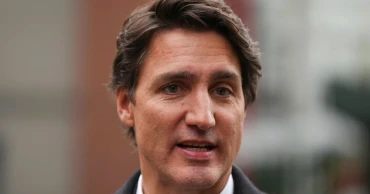
Canadian Prime Minister Justin Trudeau said Saturday that on his order a U.S. fighter jet shot down an “unidentified object” that was flying high over the Yukon, acting a day after the U.S. took similar action over Alaska.
North American Aerospace Defense Command, the combined U.S.-Canada organization that provides shared defense of airspace over the two nations, detected the object flying at a high altitude Friday evening over Alaska, U.S. officials said. It crossed into Canadian airspace on Saturday.
Trudeau spoke with President Joe Biden, who also ordered the object to be shot down. Canadian and U.S. jets operating as part of NORAD were scrambled and it was a U.S. jet that shot down the object.
Canadian Defense Minister Anita Anand told a news conference in Ottawa that the object, flying at around 40,000 feet, had been shot down at 3:41 p.m. EST, approximately 100 miles from the Canada-U.S. border in the central Yukon. A recovery operation was underway involving the Canadian Armed Forces and the RCMP.
Hours later, in the U.S., the Federal Aviation Administration said Saturday night it had closed some airspace in Montana to support Defense Department activities. NORAD later said the closure, which lasted a little more than an hour, came after it had detected “a radar anomaly” and sent fighter aircraft to investigate. The aircraft did not identify any object to correlate to the radar hits, NORAD said.
F-22 fighter jets have now taken out three objects in the airspace above the U.S. and Canada over seven days, a stunning development that is raising questions on just what, exactly, is hovering overhead and who has sent them.
At least one of the objects downed was believed to be a spy balloon from China, but the other two had not yet been publicly identified.
While Trudeau described the object Saturday as “unidentified,” Anand said it appeared to be “a small cylindrical object, smaller than the one that was downed off the coast of North Carolina." A NORAD spokesman, Maj. Olivier Gallant, said the military had determined what it was but would not reveal details.
Anand refused to speculate whether the object shot down over Canada came from China.
“We are continuing to do the analysis on the object and we will make sure that analysis is thorough,” she said. “It would not be prudent for me to speculate on the origins of the object at this time.”
Anand said to her knowledge this was the first time NORAD had downed an object in Canadian airspace.
“The importance of this moment should not be underestimated,” she said. “We detected this object together and we defeated this object together.”
She was asked why a U.S. jet, and not a Canadian plane, shot the object down.
“As opposed to separating it out by country, I think what the important point is, these were NORAD capabilities, this was a NORAD mission and this was NORAD doing what it is supposed to do,” she said.
Anand didn’t use the word “balloon” to describe the object. But later, Gen. Wayne Eyre, chief of the defense staff, said the instructions given to the planes was “who ever had the first, best shot to take out the balloon had the go-ahead.”
Trudeau said Canadian forces would recover the wreckage for study. The Yukon is westernmost Canadian territory and the among the least populated part of Canada.
After the airspace closure over Montana, multiple members of Congress, including Montana Sens. Steve Daines and Jon Tester, said they were in touch with defense officials. Daines tweeted that he would “continue to demand answers on these invasions of US airspace.”
Just about a day earlier, White House National Security Council spokesman John Kirby said an object roughly the size of a small car was shot out of the skies above remote Alaska. Officials couldn’t say if it contained any surveillance equipment, where it came from or what purpose it had.
Kirby said it was shot down because it was flying at about 40,000 feet (13,000 meters) and posed a “reasonable threat” to the safety of civilian flights, not because of any knowledge that it was engaged in surveillance.
According to U.S. Northern Command, recovery operations continued Saturday on sea ice near Deadhorse, Alaska.
In a statement, the Northern Command said there were no new details on what the object was. It said the Alaska Command and the Alaska National Guard, along with the FBI and local law enforcement, were conducting search and recovery.
“Arctic weather conditions, including wind chill, snow, and limited daylight, are a factor in this operation, and personnel will adjust recovery operations to maintain safety,” the statement said.
On Feb. 4, U.S. officials shot down a large white balloon off the coast of South Carolina.
The balloon was part of a large surveillance program that China has been conducting for “several years,” the Pentagon has said. The U.S. has said Chinese balloons have flown over dozens of countries across five continents in recent years, and it learned more about the balloon program after closely monitoring the one shot down near South Carolina.
China responded that it reserved the right to “take further actions” and criticized the U.S. for “an obvious overreaction and a serious violation of international practice.”
The Navy continued survey and recovery activities on the ocean floor off South Carolina, and the Coast Guard was providing security. Additional debris was pulled out Friday, and additional operations will continue as weather permits, Northern Command said.
3 years ago

Toronto mayor steps down after affair with ex-staffer
The mayor of Canada’s largest city has stepped down after acknowledging he had an affair with a former staffer.
Toronto Mayor John Tory said at a late Friday night news conference that he developed a relationship with an employee in his office.
The 68-year-old was known as a straight-laced, button down moderate conservative — almost the polar opposite of previous Toronto Mayor Rob Ford, whose term was plagued by scandals involving public drinking and illegal drug use.
“I recognize that permitting this relationship to develop was a serious error in judgment on my part,” Tory said after the Toronto Star reported on the affair.
“It came at a time when Barb, my wife of 40-plus years and I were enduring many lengthy periods apart while I carried out my responsibilities during the pandemic," he said.
"As a result, I have decided I will step down as Mayor so I can take the time to reflect on my mistakes and to do the work of rebuilding the trust of my family.”
Tory was first elected mayor in 2014, in part on a promise to restore respectability to the office after the turbulent term of Ford. Tory recently won a third term.
Rob Ford’s four-year tenure as mayor of Canada’s largest city was marred by his drinking and crack cocaine use. He later died from a rare form of cancer.
Tory said he is “deeply sorry” to the people of Toronto.
3 years ago