science-innovation
.jpg)
Scientists: Up to 25,000 barrels at DDT dump site in Pacific
Marine scientists say they have found what they believe to be as many as 25,000 barrels that possibly contain DDT dumped off the Southern California coast near Catalina Island, where a massive underwater toxic waste site dating back to World War II has long been suspected.
The 27,345 “barrel-like” images were captured by researchers at the University of California San Diego’s Scripps Institution of Oceanography. They mapped more than 36,000 acres of seafloor between Santa Catalina Island and the Los Angeles coast in a region previously found to contain high levels of the toxic chemical in sediments and in the ecosystem.
Historical shipping logs show that industrial companies in Southern California used the basin as a dumping ground until 1972, when the Marine Protection, Research and Sanctuaries Act, also known as the Ocean Dumping Act, was enacted.
Also read: China extends anti-dumping tariffs on Indian optical fiber
Resting deep in the ocean, the exact location and extent of the dumping was not known until now.
The territory covered was “staggering,” said Eric Terrill, chief scientist of the expedition and director of the Marine Physical Laboratory at Scripps Institution of Oceanography.
Underwater drones using sonar technology captured high-resolution images of barrels resting 3,000 feet (900 meters) below the surface all along the steep seafloor that was surveyed. They also were seen beyond the dumpsite limits.
“It really was a surprise to everybody who’s worked with the data and who sailed at sea,” he told reporters Monday.
The survey provides “a wide-area map” of the barrels, though it will be up to others to confirm through sediment sampling that the containers hold DDT, Terrill said. It’s estimated between 350 and 700 tons of DDT were dumped in the area, 12 miles (20 kilometers) from Los Angeles, and 8 miles (12 kilometers) from Catalina Island.
The long-term impact on marine life and humans is still unknown, said Scripps chemical oceanographer and professor of geosciences Lihini Aluwihare, who in 2015 co-authored a study that found high amounts of DDT and other man-made chemicals in the blubber of bottlenose dolphins that died of natural causes.
“These results also raise questions about the continued exposure and potential impacts on marine mammal health, especially in light of how DDT has been shown to have multi-generational impacts in humans,” said Aluwhihare, who was not part of the survey expedition.
Diana Aga, a chemistry professor at University at Buffalo who is not affiliated with the study, said the findings were shocking if the barrels are proven to contain the toxic chemical. “That’s a lot of DDT at the bottom of the ocean,” she said.
Also read: Jet dumps fuel that lands on schoolkids near Los Angeles
If the barrels haven’t leaked, they could be moved to a place where disposal is safer, Aga said. If they leaked, scientists could take samples from the water, sediment and other marine life to gauge the damage.
Scientists conducted the survey from March 10-24 following a Los Angeles Times report last year about evidence that DDT was dumped into the ocean.
“Unfortunately, the basin offshore Los Angeles had been a dumping ground for industrial waste for several decades, beginning in the 1930s. We found an extensive debris field in the wide area survey,” Terrill said.
Scientists started the search where University of California Santa Barbara professor David Valentine had discovered concentrated accumulations of DDT in the sediments and spotted 60 barrels about a decade ago.
High levels of DDT have been detected in the area’s marine mammals, and the chemical has been linked to cancer in sea lions.
The Los Angeles Times reviewed shipping logs from a disposal company supporting Montrose Chemical Corp. of California, a DDT-producing company. The logs showed 2,000 barrels of DDT-laced sludge were dumped in the deep ocean each month from 1947 to 1961 off Catalina, and other companies also dumped there until 1972.
Scripps researchers say they hope their survey will support clean-up efforts.
The expedition on the Sally Ride research vessel included a team of 31 scientists, engineers, and crew conducting 24-hour operations and two autonomous underwater vehicles.
5 years ago
.jpg)
Biggest space station crowd in decade after SpaceX arrival
The International Space Station’s population swelled to 11 on Saturday with the jubilant arrival of SpaceX’s third crew capsule in less than a year.
It’s the biggest crowd up there in more than a decade.
All of the astronauts — representing the U.S., Russia, Japan and France — managed to squeeze into camera view for a congratulatory call from the leaders of their space agencies.
“In this tough situation around the world, I believe you have brought courage and hope for all of us,” Japanese Space Agency President Hiroshi Yamakawa said from his country’s flight control center, referring to the global pandemic.
A recycled SpaceX capsule carrying four astronauts arrived at the space station a day after launching from NASA’s Kennedy Space Center. The Dragon capsule docked autonomously with the orbiting outpost more than 260 miles (420 kilometers) above the Indian Ocean. The hatches swung open a couple hours later, uniting all 11 space travelers.
“Man, it is awesome to see the 11 of you on station,” said NASA’s acting administrator, Steve Jurczyk. He noted that this will be the norm, now that SpaceX is regularly flying crews.
The newcomers will spend six months at the space station. They’ll replace four astronauts who will return to Earth in their own Dragon capsule Wednesday to end a half-year mission. NASA deliberately planned for a brief overlap so the outgoing SpaceX crew could show the new arrivals around.
Also read: China names Mars rover for traditional fire god
Although this was SpaceX’s third crew flight for NASA, it was the first to use a vehicle that’s flown before, an essential part of a plan by SpaceX founder and chief executive Elon Musk to push to the moon and Mars. The Dragon capsule was used for SpaceX’s first crew launch last May, while the Falcon rocket soaring Friday hoisted crew two in November.
It was the first time two SpaceX crew Dragons were parked there at the same time — practically side by side.
NASA astronauts Shane Kimbrough and Megan McArthur — the commander and pilot of the returning Dragon — monitored their capsule’s flat screen computers during the morning rendezvous. They could have taken control if necessary, but the autonomous system did its job, much like a self-driving car.
Also checking into the space station: France’s Thomas Pesquet and Japan’s Akihiko Hoshide. Both have lived there before, as has Kimbrough. But it was the first station visit for McArthur. She flew up in the same seat and the same capsule — named Endeavour — as her husband, Bob Behnken, did on SpaceX’s debut crew mission.
The European Space Agency’s director general, Josef Aschbacher, joked that the space station needs expansion with so many on board.
Pesquet — the first European to fly on a commercial crew capsule — noted that the space station has changed quite a bit since his last visit four years ago, with more people and types of spacecraft.
“We’re so happy to see our friends,” he said. “We wish we could keep them a little bit longer, but not too long as well, because 11 people is a lot on a space station.”
Also read: Spacewalking astronauts prep station for new solar wings
The all-time record is 13, set during NASA’s space shuttle era.
The current population includes six Americans, two Russians, two Japanese and one French. It will shrink by four on Wednesday when three Americans and one Japanese depart for home and a splashdown in the Gulf of Mexico.
NASA turned to private companies for space station deliveries after the shuttles retired in 2011. SpaceX began supply runs in 2012, honing its skills before launching astronauts and ending NASA’s reliance on Russia. NASA also hired Boeing for taxi service, but the company’s Starliner capsule isn’t expected to fly astronauts until next year.
5 years ago
.jpg)
China names Mars rover for traditional fire god
China’s first Mars rover will be named Zhurong after a traditional fire god, the government announced Saturday.
The rover is aboard the Tianwen-1 probe that arrived in Mars orbit on Feb. 24 and is due to land in May to look for evidence of life.
It is part of Chinese space plans that include launching a crewed orbital station and landing a human on the moon. China in 2019 became the first country to land a space probe on the little-explored far side of the moon and in December returned lunar rocks to Earth for the first time since the 1970s.
The rover’s title fits with the Chinese name for Mars — “Huo Xing,” or fire star, the China National Space Administration said.
The name “signifies igniting the flame of China’s planetary exploration,” a deputy CNSA administrator, Wu Yanhua, was cited by the official Xinhua News Agency as saying.
Also read NASA’s Mars helicopter takes flight, 1st for another planet
The top candidate for the landing site is Utopia Planitia, a rock-strewn plain where the U.S. lander Viking 2 touched down in 1976.
CNSA says Tianwen-1′s goals including analyzing and mapping the Martian surface and geology, looking for water ice and studying the climate and surface environment.
China would become the third country after the former Soviet Union and the United States to put a robot rover on Mars.
5 years ago
.jpg)
Robot artist sells art for $688,888, now eyeing music career
Sophia is a robot of many talents — she speaks, jokes, sings and even makes art. In March, she caused a stir in the art world when a digital work she created as part of a collaboration was sold at an auction for $688,888 in the form of a non-fungible token (NFT).
The sale highlighted a growing frenzy in the NFT market, where people can buy ownership rights to digital content. NFTs each have a unique digital code saved on blockchain ledgers that allow anyone to verify the authenticity and ownership of items.
David Hanson, CEO of Hong Kong-based Hanson Robotics and Sophia's creator, has been developing robots for the past two and a half decades. He believes realistic-looking robots can connect with people and assist in industries such as healthcare and education.
Sophia is the most famous robot creation from Hanson Robotics, with the ability to mimic facial expressions, hold conversations and recognize people. In 2017, she was granted Saudi Arabian citizenship, becoming the world’s first robot citizen.
Also read: Japan hotel uses robot staff for coronavirus patients
“I envisioned Sophia as a creative artwork herself, that could generate art,” Hanson said in an interview.
“Sophia is the culmination of a lot of arts, and engineering, and the idea that she could then generate art was a way for her to emotionally and visually connect with people,” he said.
Sophia collaborated with Italian artist Andrea Bonaceto, who drew portraits of Sophia. Sophia then processed his work via neural networks and proceeded to create a digital artwork of her own.
The digital work that sold for $688,888 is titled “Sophia Instantiation”, and is a 12-second video file which shows Bonaceto’s portrait evolving into Sophia’s digital painting. It is accompanied by the physical artwork painted by Sophia.
The buyer, a digital artwork collector and artist known as 888 with the Twitter handle @Crypto888crypto, later sent Sophia a photo of his painted arm. The robot then processed that, adding that image to her knowledge and painted more strokes on top of her original piece.
In a tweet on Sophia’s account, the work was described as the first NFT collaboration between an “AI, a mechanical collective being and an artist-collector.”
“As an artist, I have computational creativity in my algorithms, creating original works,” Sophia said when asked what inspires her when it comes to art. “But my art is created in collaboration with my humans in a kind of collective intelligence like a human-artificial intelligence hive mind.”
Sophia’s artwork selling as an NFT is part of a growing trend. In March, a digital artwork by artist Beeple — whose real name is Mike Winkelmann — sold for nearly $70 million, shattering records and making it the most expensive digital artwork ever sold.
Henri Arslanian, PricewaterhouseCooper’s Global Crypto Leader, said that NFTs give people “bragging rights” of the assets that they own.
Also read: Japan to build dam entirely with robots
“And what is really amazing with NFT is that it not only allows you to actually show to the broader world that you own this, but it really creates this bond between the holder of the NFT and the artists,” he said.
It also allows art to be sold without traditional intermediaries, so that artists can connect directly with buyers without being constrained by galleries or auction houses, Arslanian said.
Sophia will carry on painting, Hanson said, and the next step in the robot's career could be that of a musician. She is working on several musical works in a project called Sophia Pop, where she collaborates with human musicians to generate music and lyrics, he said.
“We’re so excited about Sophia’s career as an artist,” Hanson said.
5 years ago
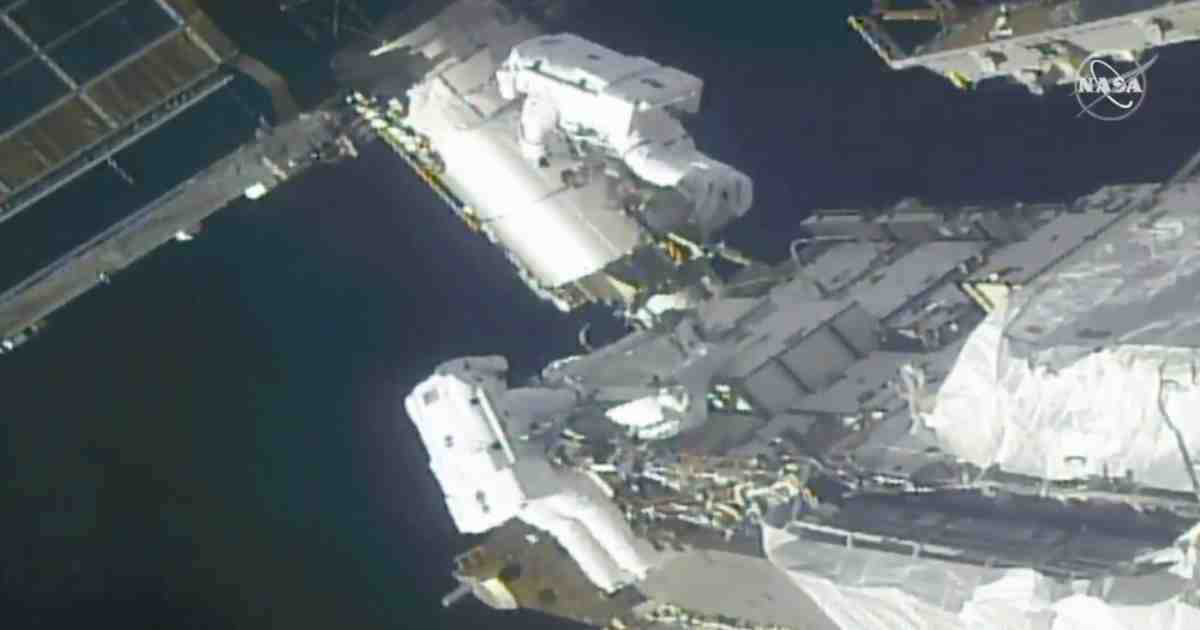
Spacewalking astronauts prep station for new solar wings
Spacewalking astronauts ventured out Sunday to install support frames for new, high-efficiency solar panels arriving at the International Space Station later this year.
5 years ago
.jpg)
NASA releases Mars landing video: 'Stuff of our dreams'
NASA on Monday released the first high-quality video of a spacecraft landing on Mars, a three-minute trailer showing the enormous orange and white parachute hurtling open and the red dust kicking up as rocket engines lowered the rover to the surface.
5 years ago

Bone cancer survivor to join billionaire on SpaceX flight
After beating bone cancer, Hayley Arceneaux figures rocketing into orbit on SpaceX’s first private flight should be a piece of cosmic cake.
5 years ago

Mars landing team 'awestruck' by photo of descending rover
The world got its first close-up look at a Mars landing on Friday, as NASA released a stunning picture of its newest rover being lowered onto the dusty red surface.
5 years ago
.jpg)
Chinese space scientists use water heat to charge mobile phone
What if you could charge your mobile phone without conventional electricity, but with a bottle of hot water instead? Space thermoelectric technology could soon make this sustainable solution a reality.
5 years ago

SUST team's genomic data on Sylhet Coronavirus strains published by GISAID
Scientists at Shahjalal University of Science & Technology (SUST) have sequenced the genome of the Novel Coronavirus found in 2 districts of Sylhet division, Vice Chancellor Farid Uddin Ahmed disclosed at a press briefing Tuesday.
5 years ago