Arts-&-Culture

Cultural show marking Chinese New Year held in Dhaka
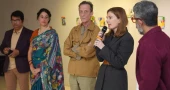
Bangladesh Shilpakala Academy (BSA) and the Embassy of China in Dhaka jointly organised a cultural event marking the Chinese New Year celebration in Dhaka.
The event titled "Happy Chinese New Year Wu Opera" was held at the National Theatre Hall auditorium on Tuesday night.
Cultural Affairs Adviser Mostofa Sarwar Farooki, Chinese Ambassador to Dhaka Yao Wen, along with his spouse Li Yu, Bangladesh Shilpakala Academy Director General Dr Syed Jamil Ahmed, and BNP Standing Committee Member oDr Abdul Moyeen Khan attended the event and delivered speeches.
Around 800 attendees, including key figures from the Bangladesh government and various sectors, the Chinese community, representatives of China-funded enterprises, Confucius Institutes, international students, and media outlets from both China and Bangladesh, watched the performance live.
‘Nalini’: artist and printmaker Julia Lebrao Sendra’s solo exhibition begins at AFD
In his speech, Adviser Farooki extended Chinese New Year greetings to the people of both nations and spoke highly of the event for injecting new vitality into Bangladesh's cultural communities, effectively promoting cultural exchange and mutual understanding between China and Bangladesh.
“We know that Bangladesh has entered a new era. I would like to thank the Chinese government and the embassy and hope that through cultural exchanges, Bangladesh-China relations will reach a unique height in the coming days, bringing benefits to both countries culturally and economically,” said Farooki.
In his speech, Ambassador Yao highlighted the historical ties and geographical proximity between China and Bangladesh, which have fostered friendly exchanges for thousands of years. He noted that the Spring Festival is the most important traditional festival for the Chinese people and has been recognised by UNESCO as part of the Representative List of the Intangible Cultural Heritage of Humanity.
Wu Opera, as a treasure of China's intangible cultural heritage, represents an important facet of Chinese traditional cultural art. Ambassador Yao expressed hope that more Bangladeshi friends would experience the profound heritage and unique charm of Chinese culture, making cultural exchanges between China and Bangladesh even more vibrant.
Yao also called for closer collaboration across various sectors in both countries to strengthen the bonds of friendship, contribute to regional and global peace and prosperity, and better build a community with a shared future for mankind.
23rd DIFF concludes; ‘Priyo Maloti’ wins Best Film for Bangladesh
1 year ago
‘Nalini’: artist and printmaker Julia Lebrao Sendra’s solo exhibition begins at AFD
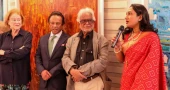
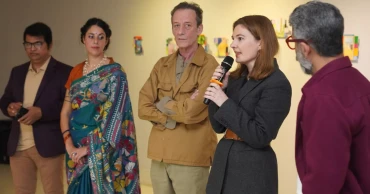
Franco-Brazilian printmaker Julia Lebrao Sendra’s solo exhibition ‘Nalini’ began at La Galerie, Alliance Française de Dhaka (AFD), Dhanmondi on Tuesday.
Alliance Française de Dhaka and Brihatta Art Foundation jointly organised the exhibition.
The inaugural ceremony of this exhibition was joined by Amandine Roggeman, Cultural Attachée of the French Institute in India as the special guest. Brihatta co-founder and renowned Bangladeshi artist Bishwajit Goswami and Dhaka University Faculty of Fine Art Professor Anisuzzaman Anis were also present at the ceremony, along with the Director of Alliance Francaise Francois Grosjean.
Read: 23rd DIFF concludes; ‘Priyo Maloti’ wins Best Film for Bangladesh
The exhibition is an outcome of a three-month residency programme held in partnership between Villa Swagatam, Institut Français in Delhi, the French Embassy in Bangladesh, Alliance Française de Dhaka, and Brihatta Art Foundation.
Villa Swagatam, launched in 2023, supports a wide range of artistic disciplines, with a strong emphasis on literature, arts, and crafts. In 2024-2025, the program will expand with collaborations with nearly 30 renowned residencies across France, India, and Bangladesh, creating a unique platform for creativity, fostering mutual understanding, and promoting cross-disciplinary dialogue.
Brihatta Art Foundation, based in Dhaka, is a research-driven, artist-run platform aimed at enhancing the accessibility and visibility of art through community engagement. It serves as a dynamic bridge between artists, craftsmen, local and expat communities, and global practitioners, facilitating workshops, residencies, and art talks to achieve shared artistic goals.
Read: Arka Fashion Week’s third edition concludes in style
The main focus of the work is the relationship between riverbank communities and their natural environment, the Buriganga River. The exhibition focuses on the relationship between riverbank communities and the Buriganga River, exploring themes of identity, water, and textiles.
Julia Lebrao Sendra’s work, initially aimed at understanding local healing rituals, shifted after she discovered a deeper issue: a broken connection between the people and the river, symbolizing the concept of ‘Solastalgia’. Coined by philosopher Glenn Albrecht, ‘Solastalgia’ describes people's emotional distress when they can no longer connect to the natural environments they once knew due to climate change and human activities.
This sense of loss is evident in Dhaka, where the relationship with the Buriganga reflects global concerns. Julia's work aims to foster reflection and dialogue as a step toward healing, using symbols, patterns, and colors from her daily life in Dhaka to offer fresh perspectives on the issue.
The exhibition will be open to visitors at AFD till Monday, January 27, every day from 3 pm to 9 pm.
1 year ago
23rd DIFF concludes; ‘Priyo Maloti’ wins Best Film for Bangladesh
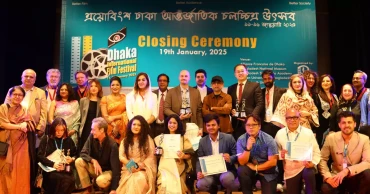
The 23rd Dhaka International Film Festival (DIFF) concluded on Sunday, awarding Shankha Dasgupta-directed and Mehazabien Chowdhury-starrer film ‘Priyo Maloti’ the FIPRESCI Award for Best Full-Length Feature Film under the Bangladesh Panorama section.
Organised for nine days in five venues across the capital, the festival showcased 203 films from 75 countries in 10 different categories.
On Sunday, the festival concluded with its closing ceremony at the main auditorium of the Bangladesh National Museum in the capital, with the Bangladeshi premier of Iqbal Hossain Chowdhury-directed film ‘Boli’.
Cultural Affairs Adviser Mostofa Sarwar Farooki joined the ceremony as the chief guest, who mentioned several future steps for the Bangladesh film industry and the future editions of the Dhaka International Film Festival. He promised a permanent arrangement for well-equipped venues, a fixed budget and year-round activities, and also shared aspirations for the continuation of these types of works.
“30 years ago, I was a volunteer at this festival; and I joined as a volunteer so that I could watch movies for free. However, this is unfortunate that our flagship Bangladeshi film festival lacks a permanent venue, advanced projection technology, and a proper sound system,” Farooki said at the event.
1 year ago
Gallery Chitrak launches Syed Azizul Huq's book on art maestro Rafiqun Nabi
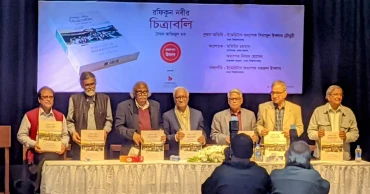
The publication ceremony of the book "Rafiqun Nabi'r Chitrabali" (Paintings of Rafiqun Nabi) was held on Sunday at Chhayanaut Sanskriti Bhaban in the capital’s Dhanmondi, featuring the paintings of the eminent Bangladeshi painter and Dhaka University Drawing and Painting Department Professor Emeritus Rafiqun Nabi.
Hosted by Gallery Chitrak, the event, chaired by Dhaka University Professor Emeritus Dr Nazrul Islam, was joined by cultural luminaries from the society including the chief guest and the country’s prolific academician, critic, historian and DU Professor Emeritus Serajul Islam Choudhury; alongside eminent journalist and the daily Prothom Alo Editor Matiur Rahman; author of the book Dr Syed Azizul Huq, prominent art maestro and former dean of DU Faculty of Fine Art Nisar Hossain, and renowned academician and English translator of the book Dr Fakrul Alam, as the speakers.
Gallery Chitrak Managing Director and artist Md Moniruzzaman delivered the welcome address. After the musical performance of Chhaya Karmakar, who performed the songs of Rajinikanth Sen and Rabindranath Tagore, the speakers shared their remarks about the book.
Addressing the chief guest at the event, DU Professor Emeritus Serajul Islam Choudhury said, "This book provides a detailed picture of Rafiqun Nabi's work, covering all of the mediums he worked with. The unified body of Rafiqun Nabi’s artworks is a picture of Bangladesh through its vibrant representation of the nation's people, society and thriving folk culture.”
Syed Azizul Huq, the author of the book 'Rafiqun Nabi's Chitrabali' said, "Rafiqun Nabi has worked in various fields of the country’s art industry. A total of 160 of his paintings are discussed individually in the book.” Besides sharing the experience of writing for Rafiqun Nabi in this book, Syed Azizul Huq also shared his experience of writing books discussing the works of Shilpacharya Zainul Abedin, and the late eminent artist Shafiuddin Ahmed.
1 year ago
‘Power of Pain and Pathos 2’: Embassy of the Netherlands hosts solo exhibition of Priti Ali
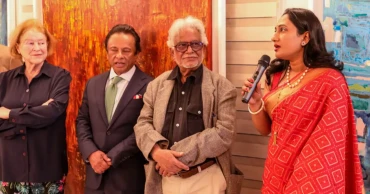
The Embassy of the Netherlands has organized a special, month-long solo exhibition of the renowned Bangladeshi artist Priti Ali titled ‘Power of Pain and Pathos 2’ at the embassy's Gallery Residence in the city's Gulshan 2.
Inaugurated on January 17, the exhibition is featuring 40 paintings of Priti Ali.
The inauguration ceremony was joined by several prominent personalities and delegates, including the Dutch Ambassador to Bangladesh Andre Carstens, eminent Bangladeshi-Spanish artist Monirul Islam, and CEO of WildTeam Dr Anwarul Islam.Born in 1986, Priti Ali spontaneously paints in the abstract expressionist style. Her artwork depicts various manifestations of human emotions and feelings, exploring the meaning of life amid good and evil while surrendering to nature.
An ardent follower of pure abstract expressionism, Priti Ali specifies that her paintings are very much connected to humans’ affection, ecstasy, anguish and isolation. An emotionally charged painter, she draws what she feels from the core of her soul.
Read: Artist Kalidas Karmakar's 79th birth anniversary observed in Faridpur
Her paintings can be explained in many ways where one can find the touch of mysticism; some can get the taste of harmony, melancholy or despair. In her paintings, one feels the lament of a lonely soul, an underlying sorrow or a feeling of bareness.
1 year ago
Artist Kalidas Karmakar's 79th birth anniversary observed in Faridpur
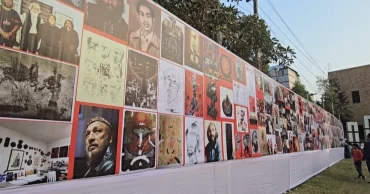
Friday marked the 79th birth anniversary of the late eminent Bangladeshi printmaker Kalidas Karmakar. To commemorate the Faridpur-born and internationally renowned artist's birth anniversary, a grand event took place at Ambika Maidan in Faridpur city.
Born on January 10, 1946 in Faridpur to a family of goldsmiths and artisans, the internationally renowned maestro cemented his legacy as one of the most respected artists of Bangladesh.
On Friday afternoon, guests inaugurated the program with releasing balloons and lighting lamps, which was followed by a drawing competition for children and a cultural program, under the patronage of the artist's family.
Over a hundred children from various schools in the city participate in the drawing competition. Additionally, local artists showcased musical performances, and the celebration was complemented with a cake cutting ceremony.
Members of Kalidas Karmakar’s family, leaders of the cultural organization, and distinguished individuals were present at the event.
Regarding the event, Kalidas Karmakar’s younger brother Proshanta Karmakar Buddha said, "Today is the 79th birth anniversary of the eminent artist, my elder brother Kalidas Karmakar; and to enlighten our next generation of artists about his life and works, we organised the event from the family."
AR-VR exhibition featuring July uprising posters opens at BSA
"Throughout his entire life, Kalidas Karmakar worked to elevate the country's art to the world; he was a globetrotter throughout his life and had many options to settle abroad, but he always chose his motherland and became an internationally acclaimed artist. The art competition we have arranged today will not have any top place holder, rather we want them to draw as they wish and flourish their artistic talent, just like Kalidas Karmakar," he added.
Rezaul Karim, a visitor, said, "The Ekushey Padak-winning artist Kalidas Karmakar is the pride of our Faridpur. We are extremely happy that today we are being able to celebrate his birth anniversary with this special event at his birthplace."
"Artist Kalidas Karmakar is a globally acclaimed artist, but we were unable to properly celebrate his eventful life and works," stated Shipra Goswami, a local women's leader. "In order for the next generation to learn about our great artist, it is the duty of both the government and the people of our local community to plan and organize such events."
At the ceremony, Kalidas Karmakar's younger brother Proshanta Karmakar Buddha informed that an archive in Faridpur is being established to preserve the eminent artist's work. An art college, in honor of the 'alluvial' artist, is also planned to be established in Faridpur, Prashanta Karmakar Buddha stated.
A maestro of printmaking especially viscosity printing, Kalidas Karmakar’s diverse artworks featuring metallic and other objects, handmade paper, and oil on canvas prints have been widely exhibited throughout South Asia, the Middle East, Europe, the United States and many other places across the world.
Shilpacharya Zainul Abedin’s 110th birth anniversary being observed
Known as the ‘Alluvial Man’ in the country's art sphere, Kalidas began his career in paintings through assembling metal objects in the 1970s and with prints, he began to explore mythical images in the ‘80s, opening up new possibilities for etching and aquatint. His maiden solo art exhibition was held at Bangladesh Shilpakala Academy on August 7, 1976; and more than 50 of his exhibitions were held in 70 countries across the world.
Throughout his illustrious career, he received multiple prestigious scholarships and fellowships, including the Polish Government Scholarship in Graphic Art at the Warsaw Academy of Fine Art, Warsaw University; the French Government Superior Scholarship in Fine Arts for research in multicolour etching at Atelier-17, in Paris; Japan Foundation Fellowship on Japanese Woodblock Printing at Tokyo National University of Fine Arts and Music; ICCR Special Scholarship for research in Contemporary Modern Sculpture, West Bengal Lalit Kala Academy Studio; and Asian Cultural Council New York, Fellowship with Artist Residency program in the US, to name a few.
He was one of the advisers of Gallery Cosmos and the modern state-of-the-art printmaking studio Atelier71 at the gallery venue in Cosmos Centre, Malibagh in the capital, for which he had always shown great dedication. He was engaged with the gallery till his death on October 18, 2019, following a heart attack.
For his remarkable contribution to the Bangladeshi fine arts, Kalidas Karmakar was awarded the Shilpakala Padak in 2016 and the Ekushey Padak in 2018.
1 year ago
AR-VR exhibition featuring July uprising posters opens at BSA
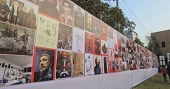
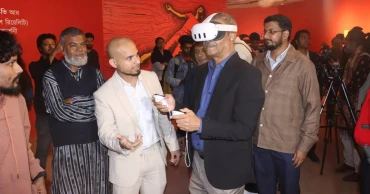
Bangladesh Shilpakla Academy (BSA) launched an exclusive live and AR-VR (augmented-virtual reality) interactive exhibition titled ‘July Uprising on Posters’ featuring artist Debashish Chakrabarty's July Uprising artworks at the National Art Gallery in the capital.
BSA’s Production Department organised the exhibition with an opening ceremony at the National Art Gallery Auditorium on Tuesday, January 7.
Dr Asif Nazrul, adviser to the Ministry of Law, Justice and Parliamentary Affairs and the Ministry of Expatriate Welfare and Foreign Employment, joined the ceremony as the chief guest. Director General of Bangladesh Shilpakala Academy Dr Syed Jamil Ahmed presided over the event.
Eminent photographer, curator, activist and managing director of Drik Picture Library, Dr Shahidul Alam; writer, journalist, and managing director of Bangladesh News Agency (BSS), Mahabub Morshed; and director of the Fine Arts Department of Bangladesh Shilpakala Academy, Mustafa Zaman, were also present as the special guests at the opening ceremony.
‘Remembering Monsoon Revolution’: 8 directors selected to make films on July uprising
Writer and researcher Parvez Alam joined live from Amsterdam, Netherlands’, and artist Debashish Chakrabarty joined live from the US. Abdul Halim Chanchal, Director of the Production Department of Bangladesh Shilpakala Academy delivered the welcome speech on the occasion.
Dr Asif Nazrul said, "The fascist government's use of filthy narrative-making tactics has been demonstrated to us over the past 15 years; several claims of development advancement have been made through those tactics. A minimal poster can make a significant impact on developing an intriguing narrative, and it has also contributed to the July Uprising that we have seen through Debashish’s excellent works.”
"Graffiti can be a powerful medium that we have not seen in the political context of the last 15 years," the adviser stated in reference to the July movement art graffiti. “Graffiti might not be around in the future, but if it is documented properly, it will be sustained—thus the Bangladesh Shilpakala Academy's endeavour is commendable from that perspective.”
Dr Syed Jamil Ahmed, Director General of the Bangladesh Shilpakala Academy, stated, "Artist Debashish Chakrabarty has enviably demonstrated how art can be both a political tool and a work of art at the same time. The artist deserves appreciation for his ability to maintain his artistic integrity in the face of the revolution and widespread unrest.”
1 year ago
Oprah Winfrey opens 2025 with an encore. 'A New Earth' is her book club pick for a second time
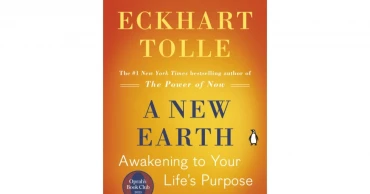
Oprah Winfrey is beginning 2025 with an old favorite. She has selected Eckhart Tolle's “A New Earth: Awakening to Your Life Purpose” for her book club, marking the first time she has chosen a publication twice.
Winfrey, who launched her club in 1996, also picked “A New Earth” in 2008 and featured it in a series of webinars she hosted with Tolle. “A New Earth” was originally released in 2005 and has sold millions of copies.
“As we welcome a new year, I wanted to revisit the book that had more effect on me than any other book by a living author has had on my perception of how I understand my connection to the world,” Winfrey said in a statement Tuesday. “As Eckhart’s work continues to speak to people from all generations, this podcast conversation is an offering to hear about his groundbreaking work ‘A New Earth’ and allow us all to experience brand new a-ha’s.”
A Winfrey-Tolle video podcast discussion, held recently at a Starbucks Reserve in the Empire State Building, can be seen on Winfrey's YouTube channel and other outlets. Last month, Winfrey launched “The Oprah Podcast,” a weekly series that will include book club authors. The interviews are presented in partnership with Starbucks.
Read: Michelle Obama, Oprah Winfrey headline arena like rock stars
“I am deeply grateful to Oprah for having made spirituality accessible to a mainstream audience,” Tolle said in a statement. "Now, for the second time, she has chosen ‘A New Earth’ for her Book Club, thus bringing it to a new generation of readers at a time of increasing collective challenges. As there is no awakening and no gain in consciousness without challenges, we live in truly auspicious times!”
1 year ago
‘Remembering Monsoon Revolution’: 8 directors selected to make films on July uprising
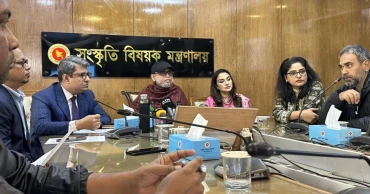
The Ministry of Cultural Affairs has selected eight directors to make films on the July uprising under its “Remembering Monsoon Revolution” programme.
These directors will lead workshops in eight divisions of the country and produce medium-length films with the trained personnel.
Cultural Affairs Ministry unveils seven priority projects to inspire youth after July Revolution
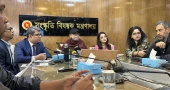
Suman Rahman, a member of the search committee, announced the names of the directors on Tuesday at a press conference held at the Secretariat. Cultural Affairs Adviser Mostofa Sarwar Farooki was present at the press conference.
Rahman said that the search committee aimed to select filmmakers who will conduct workshops in eight divisional cities of Bangladesh in 2025 and create eight films with participants trained during the workshops.
The selected directors are: Anom Biswas, Humayra Bilkis, Shankha Dasgupta, Shaheen Dil Riaz, Robiul Alam Robi, Tasmiya Afrin Mou, and Mohammad Tawkir Islam.
Shilpacharya Zainul Abedin’s 110th birth anniversary being observed
While outlining the initiative's objectives, Rahman said, “Firstly, the aim is to establish communication between young people interested in film production, both inside and outside Dhaka, and to provide opportunities for them to develop their skills and talents. Second, to directly apply the knowledge and skills acquired through the training by participating in film production with the same trainers.”
He added, “There is no fixed framework for these workshops and film productions. This will allow artists to implement their own work methods and creativity to the fullest, and they will be more comfortable creating artistic, politically charged, revolutionary, and youth-oriented languages.”
Rahman also expressed hope that the films would reflect the experiences of Bangladeshis, particularly following the long period of struggles and the blood-soaked July-August revolution. "We hope to see an artistic representation of that in these films," he said.
Cultural Affairs Adviser Mostofa Sarwar Farooki said, “In selecting these film directors, we didn’t look at whether they had done 50 films; what mattered more was whether they had done a work that we could refer to. We tried to see if they had the spark.”
He also assured that the selected directors have complete freedom to create their films. “We have given them complete freedom regarding what they will create. We don’t want this to become another failed government project. We want these eight films to be engaging. We want these films to show the way forward for the future of filmmaking. These elements will certainly be present in their stories.”
Curtain rises on 6th National Sculpture Exhibition at BSA
The government will provide full financial support for the films' creation. The directors, along with the search committee, will determine the budget. Farooki said that the production work for these films must be completed by June.
The ministry will create a Google form for each division’s workshop, allowing interested individuals to apply. The directors of the respective divisions will select the candidates, according to Rahman.
1 year ago
Shilpacharya Zainul Abedin’s 110th birth anniversary being observed
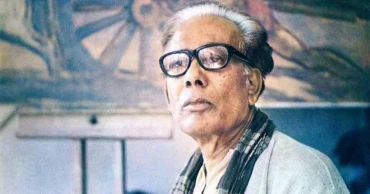
Sunday marks the 110th Birth Anniversary of the master painter and pioneering art maestro Zainul Abedin, widely revered as the 'Shilpacharya' (great master of fine arts).
Shilpacharya Zainul Abedin was born on December 29, 1914, in Kishoreganj in then-British India, and was a key figure in the establishment of the Dhaka University Faculty of Fine Art (FFA) and the Folk Art Museum in Sonargaon, Narayanganj.
The artist community is celebrating the 110th birth anniversary of the Shilpacharya with a variety of celebrations, most notably the traditional three-day ‘Zainul Utshab’ on December 27, 28 and 29 by Dhaka University's Faculty of Fine Art and Bangladesh Folk Art & Crafts Foundation, every day from 10 am to 8 pm.
The festival commenced with an inaugural ceremony on Friday (27 December) at 10 am, at the courtyard of the DU Faculty of Fine Art. DU Treasurer Professor M Jahangir Alam Chowdhury inaugurated the event.
The event was also joined by Dhaka University Proctor and Associate Professor Saifuddin Ahmed, Dean of the Faculty of Fine Art Professor Dr Azharul Islam Sheikh, Emeritus Professor Abul Hashem Khan, art maestro Professor Dr Md Abdus Sattar, Shilpacharya’s youngest son Engineer Mainul Abedin, Director of the Bangladesh Folk and Craft Foundation Kazi Mahbubul Alam, CEO of Berger Paints Bangladesh Limited Md Mohsin Habib Chowdhury, and fashion house Bishwa Rong founder-owner Biplab Saha, among others. After the inaugural ceremony, the exhibition of artworks created by various artists commenced.
On the second day of the festival, Professor Abdus Sattar delivered a commemorative lecture on Saturday at 3:30 pm. On Sunday, the concluding day of the festival, the Faculty of Fine Art and other art organisations placed floral wreaths on the grave of the Shilpacharya at 9 am.
This year, the prestigious ‘Zainul Award 2024' award was presented to Professor Mizanur Rahim and Professor Rafiqul Alam.
Bishwajit Roy's solo sculpture exhibition 'Haat Katali' opens at AFD
Zainul Abedin earned global respect for his 1943 illustrations of the Bengal famine. He visited Palestinian camps in Syria and Jordan in 1970 and made 60–70 paintings of the refugees there, adding another example of his calibre as a modern, international artist.
During childhood, he discovered his love of art while a young child frolicking by the Brahmaputra river.
His motherland, Bangladesh (then East Pakistan), welcomed him back after he graduated from the Government Art School in Kolkata in 1932. However, shortly after the Indian subcontinent was divided in 1947, he permanently departed Kolkata and returned to his motherland in Bangladesh.
The Dhaka Art Institute was subsequently founded with active help from Zainul Abedin, who was appointed as the institute's principal in 1949. The institute later developed into Dhaka University's Faculty of Fine Art.
The institute became the hub of fine arts practices in then East Pakistan and actively participated in historical foundation events of independent Bangladesh such as the 1952 Language Movement and the 1971 Liberation War under the_ artistic leadership of Zainul.
He retired from the Dhaka Art Institute in 1967 and was conferred the honorary title of Shilpacharya (great master of fine arts) by the institute.
Before taking the mantle of Shilpacharya, Zainul Abedin received two years of training from the Slade School of Fine Art in London and developed a new style of art called the 'Bengali style' featuring folk art forms with their geometric shapes including the usage of semi-abstract representation and primary colours.
However, he lacked the sense of perspective, realised the limitations of folk art, and went back to nature, rural life and the daily struggles of people to make art that would be realistic but modern in appearance, thus being the pioneer of modern artistic style in the subcontinent.
Known for the simple yet majestic projection of natural and social hazards, Zainul painted the 1970 Bhola cyclone that devastated then East Pakistan, portraying the effect of the cyclone through his painting ‘Monpura’.
As a fond lover of folk arts, Zainul formed Charu O Karu Shilpi Sangram Parishad and also collected a large number of traditional crafts, ceramic works, and nakshi kanthas in his lifetime which he preserved through founding the Folk Art Museum at Sonargaon, Narayanganj in 1975.
He also founded the Zainul Abedin Sangrahashala, a gallery of his works at the Shaheeb Quarter Park on the bank of his nostalgia-infused Brahmaputra River in Mymensingh in the same year.
In 1973, Zainul received an honorary D.Litt from Delhi University. He was declared the National Professor of Bangladesh in 1975. NASA honoured the iconic artist by naming a crater on the planet Mercury after the painter, called the 'Abedin Crater' in 2009.
The revered artist passed away in Dhaka on May 28, 1976, after losing his battle with lung cancer. He was buried beside the Dhaka University Central Mosque.
1 year ago