others
Acting President begins official duties at Bangabhaban
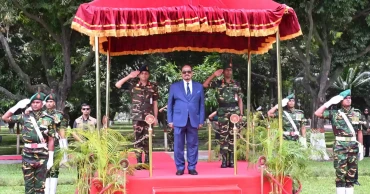
Acting President Hafiz Uddin Ahmad on Tuesday began his official duties at Bangabhaban.
He arrived at Bangabhaban at around 11:10 am where a horse-mounted contingent of the President Guard Regiment (PGR) welcomed him at Main Gate No. 2 and escorted him to the Guard of Honour venue.
A smartly turned-out contingent of the PGR presented the Guard of Honour, while a combined military band comprising members of the Bangladesh Army, Navy and Air Force played a welcome tune.
Following the ceremony, President's Military Secretary Major General A S M Bahauddin, Public Division Secretary Khan Md Nurul Amin and Press Secretary Md Sarwar Alam greeted the Acting President with bouquets at the Octagonal of Bangabhaban.
The Acting President later went to his office, where he exchanged greetings with senior officials.
The Military Secretary and the Public Division Secretary subsequently briefed him on matters relating to Bangabhaban, marking the beginning of his official engagements.
Before leaving Bangabhaban, the Acting President inspected the Toshakhana at around 1.40pm.
6 days ago
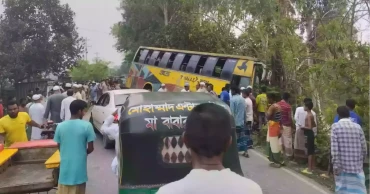
Over 7,300 students killed in road crashes in 7.5 years in Bangladesh
Road crashes continue to claim the lives of a staggering number of students in Bangladesh, with 7,364 students killed between 2019 and June 2026, accounting for 15.11 percent of all road fatalities during the period.
These findings come from a report by the Road Safety Foundation (RSF) which was released on Tuesday.
Data analysis shows that 48,713 people were killed in road crashes across the country during the same period.
Among the student victims, 3,328 (45.19 percent) were school and madrasa students aged between five and 17 years, while 4,036 (54.80 percent) were college and university students aged between 18 and 25 years.
Younger children remain vulnerable as pedestrians, motorcycle crashes have become the single biggest cause of death among teenagers and young adults, it said .
Motorcycles account for more than half of student deaths
Of the total student fatalities, 3,841 (52.15 percent) were either motorcycle riders or pillion passengers.
Besides,519 students (7.04 percent) were killed while riding bicycles or travelling by rickshaw. Another 154 students (2.09 percent) died after scarves or clothing became entangled in the wheels of auto-rickshaws.
Road-wise analysis shows that the highest number of student deaths occurred on regional roads, where 2,149 students (29.18 percent) lost their lives.
The analysis shows that children aged between five and 12 were mostly killed while walking to or from school or while playing near their homes after being struck by auto-rickshaws, motorcycles and goods vehicles. Such crashes were more common on rural roads.
Student deaths peaked in 2022
The annual death toll shows a sharp rise over the years.
A total of 693 students were killed in road crashes in 2019, followed by 719 in 2020 and 936 in 2021.The number reached its highest level in 2022, when 1,385 students lost their lives.
The figure later declined to 1,153 in 2023, 1,073 in 2024 and 1,014 in 2025. During the first six months of 2026 alone, another 391 students were killed.
During the same period, another 1,237 students died after being hit by trains while crossing railway tracks carelessly or walking along railway lines while using headphones, according to the analysis.
Major causes identified
The study identifies several factors behind the alarming number of student deaths, including defective roads and unsafe vehicles, inadequate awareness about road safety, the absence of structured road safety education in educational institutions, insufficient public awareness campaigns, reckless motorcycle riding among young people, poor compliance with traffic laws, and weak governance in the transport sector.
Recommendations
To reduce student fatalities, RSF recommended organising annual road safety campaigns in educational institutions, providing government-supported training for teachers, incorporating road safety questions into school examinations, launching sustained awareness campaigns through mainstream and social media, removing unsafe vehicles from roads, improving safety around schools and colleges, and strictly enforcing laws to prevent underage motorcycle riding alongside greater parental awareness.
Eight years after the Safe Roads Movement
RSF recalled the nationwide student movement for safe roads that followed the deaths of two students of Shaheed Ramiz Uddin Cantonment College, who were killed by a speeding bus of Jabal-e-Noor Paribahan on Airport Road in Dhaka on July 29, 2018.
It notes that despite the passage of eight years, the country’s road transport sector has failed to establish lasting discipline or significantly reduce road crashes.
The absence of a long-term and coordinated road safety strategy, weak enforcement of the Road Transport Act and the influence of vested interests have prevented meaningful reforms, it added.
Although committees are frequently formed and recommendations prepared, implementation remains limited, leaving road safety largely unchanged.
6 days ago

Deep depression over Northwest Bay moves west-northwestwards, weakens gradually
The deep depression over Northwest Bay and adjoining West Bengal coast moved west northwestwards and crossed West Bengal-North Odisha coasts at 06 am on Tuesday.
It is now lies over north Odisha and adjoining Gangetic West Bengal coast, said a Met office bulletin.
It is likely to move west-northwestwards and weakened gradually. Steep pressure gradient persists over North Bay and adjoining area.
Squally weather may affect the Maritime Ports, North Bay and adjoining coastal areas of Bangladesh.
Maritime ports of Chattogram, Cox's Bazar, Mongla and Payra have been advised to keep hoisted local cautionary signal No 3.
All fishing boats and trawlers over North Bay have been advised to remain close to the coast and proceed with caution till further notice.
6 days ago
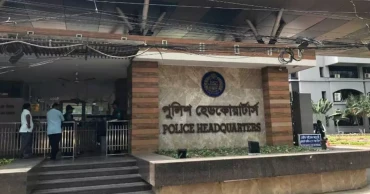
Nearly 40,000 arrested in special police drive since May 1
Bangladesh Police arrested 39,267 people across the country during a special operation conducted from May 1 to July 27, said a statement issued by police headquarters on Tuesday.
Besides those arrested in the special drive, another 102,722 people were arrested in various cases and other operations during the period.
This brings the total number of arrests under the special drive and other cases to 141,989, said the statement.
During the operations, police recovered 325 firearms, 2,802 rounds of bullets and cartridges, 103 magazines, 46 cocktails, 2.25 kg of gunpowder, 638 locally made weapons, 18 firearm components, 17 pieces of weapons- and bomb-making equipment, and 10,300 chocolate firecrackers.
The recovered firearms included 101 pistols, 35 shooter guns, 38 LGs, 19 revolvers, 92 guns, 15 pipe guns, seven shotguns, three rifles, two submachine guns, 12 air guns and one pen gun.
Police also seized 9,122,996 yaba tablets, 9,080 packets of heroin, 4,095 bottles of phensedyl, 8,211 bottles of foreign liquor, 423 bottles of locally made liquor, 8,552 packets of cannabis and other narcotics.
A total of 17,066 cases were filed in connection with the recovery of the drugs, while 24,821 people were arrested in those cases, according to the police headquarters.
6 days ago
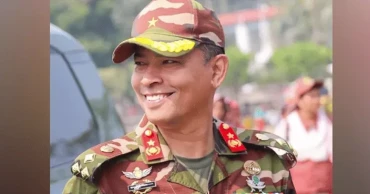
Army takes Brig Gen Miftah Uddin into custody over Ekramul murder case at ICT
The Bangladesh Army has taken Brigadier General Miftah Uddin Ahmed into military custody in connection with a crimes against humanity case over the 2018 killing of former Teknaf municipality Ward councillor Ekramul Haque.
Confirming the development, an official of the Inter Services Public Relations (ISPR), speaking on condition of anonymity, told UNB that Brig Gen Miftah Uddin Ahmed, a serving senior officer of the Bangladesh Army, has been taken into military custody on Monday.
"The next course of action against him is being taken in accordance with the law," the ISPR official said.
The development came a day after the prosecution submitted a formal charge before the International Crimes Tribunal (ICT) in the crimes against humanity case on Sunday last over the killing of Ward Councilor Ekramul Haque.
The prosecution on Sunday named 11 accused in the case, including ousted Prime Minister Sheikh Hasina.
Brig Gen Miftah Uddin Ahmed, who was serving as the commanding officer of RAB-7 in Chattogram as a lieutenant colonel at the time of the incident, was also named as an accused in the formal charge. At the time, Cox's Bazar was under the jurisdiction of RAB-7.
Ekramul Haque, a Ward councillor in Teknaf and then president of the upazila unit of Juba League, youth wing of Awami League, was killed in what was described as a "gunfight" in Teknaf, Cox's Bazar, on May 26, 2018.
6 days ago

EC ready to hold Presidential election: CEC
Chief Election Commissioner (CEC) AMM Nasir Uddin on Tuesday said the Election Commission (EC) is fully prepared to conduct the Presidential election.
“We are prepared to conduct the presidential election. Only preliminary discussions have taken place. The date has not been decided yet. You will be informed at the appropriate time,” the CEC told reporters after a meeting with Acting Speaker Kayser Kamal at the Jatiya Sangsad Bhaban.
Nasir Uddin said all discussions at the meeting were related to the presidential election.
“If an election is held, it will take place here. If there is only one candidate, he or she will be elected unopposed,” he added.
Nasir Uddin said the Election Commission would announce the election schedule and all relevant details through an official gazette.
Responding to a question, the CEC said no discussion was held during the meeting regarding the status of expelled Jamaat-e-Islami MP from Satkhira-4 Gazi Nazrul Islam.
“If the matter is referred to us, we will examine it,” he said.
The CEC said the issue of the Satkhira-4 lawmaker was not part of the meeting’s agenda with Acting Speaker Kayser Kamal.
Election commissioners Abdur Rahmanel Masud, Tahmida Ahmad and Md Anwarul Islam Sarker and EC Senior Secretary Akhtar Ahmed also joined the meeting.
As per the Presidential Election Act, 1991, the Election Commission needs to consult the Speaker before fixing the schedule for the presidential election.
If Parliament is in session, the Commission is required to issue the election notification at least seven days before the polling date.
If Parliament is not in session, the Commission, in consultation with the Speaker, must convene a meeting of Members of Parliament at least seven days before the election.
As part of the process, the Jatiya Sangsad Secretariat will send the list of MPs to the EC, which will prepare and publish the electoral roll for the presidential election before announcing the schedule.
According to Article 123(2) of the Constitution, an election to fill the vacant office of the President must be held within 90 days of the post becoming vacant due to resignation.
Chief Election Commissioner AMM Nasir Uddin will act as the Returning Officer for the presidential election which will be held with direct votes of Members of Parliament.
As per the Presidential Election Act, a candidate's nomination paper must be proposed by one MP and seconded by another.
The candidate securing the highest number of votes will be declared elected by the CEC. In the event of a tie, the result will be determined by a lottery, and the CEC's declaration of the result will be final.
On July 24 last, Mohammed Shahabuddin resigned as the president from office and Speaker Hafiz Uddin Ahmad took the charge as the acting president.
6 days ago
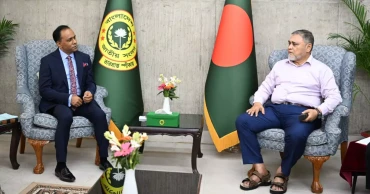
Presidential Election: EC meets acting Speaker ahead of schedule announcement
The Election Commission led by Chief Election Commissioner (CEC) AMM Nasir Uddin has sat in a meeting with acting Speaker Barrister Kayser Kamal on Tuesday morning ahead of the announcement of schedule for the Presidential election.
The meeting began at 11am at the Jatiya Sangsad Bhaban.
Election commissioners Abdur Rahmanel Masud, Tahmida Ahmad and Md Anwarul Islam Sarker and EC Senior Secretary Akhtar Ahmed also joined the meeting.
As per the Presidential Election Act, 1991, the Election Commission needs to consult the Speaker before fixing the schedule for the presidential election.
If Parliament is in session, the Commission is required to issue the election notification at least seven days before the polling date.
If Parliament is not in session, the Commission, in consultation with the Speaker, must convene a meeting of Members of Parliament at least seven days before the election.
As part of the process, the Jatiya Sangsad Secretariat will send the list of MPs to the EC, which will prepare and publish the electoral roll for the presidential election before announcing the schedule.
According to Article 123(2) of the Constitution, an election to fill the vacant office of the President must be held within 90 days of the post becoming vacant due to resignation.
6 days ago

HSC student shot in capital’s Manikdi 'in critical condition'
An HSC student was shot by unidentified assailants in the Manikdi under Cantonment Police Station in the capital early Tuesday.
The injured student was identified as Md Karim, 18, a second-year HSC student at Mirpur Bangla College.
The incident occurred around 12:15am, after which Karim was taken to the emergency department of Dhaka Medical College Hospital (DMCH) in critical condition.
Karim’s father, Rafiqul Islam, said around 12:15am he had sent his son to a nearby shop to buy mosquito coils.
After buying the coils, Karim spent some time chatting with a friend named Tuhin before heading home. As he was passing in front of a building locally known as “32 Malik’s Building” in the Amtala area, unidentified assailants opened fire indiscriminately from the darkness, leaving him with bullet injuries to both legs.
Locals rescued Karim and initially took him to a private hospital in Kurmitola. He was later shifted to DMCH in the early hours.
Doctors performed surgery during the night and removed a bullet from his right leg. The bullet that struck his left leg reportedly came out at the scene of the incident.
Inspector Md Faruk, in-charge of the DMCH police outpost, said Cantonment police have been informed about the incident and are investigating it.
6 days ago
Hidden disease, hidden losses: How brucellosis is ravaging dairy farms in stealth
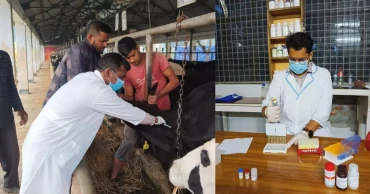
Dairy farmers in Bangladesh may be losing a significant amount of income every year without even realising it, as brucellosis, a largely overlooked livestock disease, silently reduces milk production in infected cows.
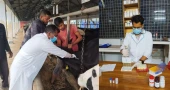
A two-year study by a team of researchers from Bangladesh Agricultural University (BAU) has found that a cow suffering from active brucellosis produces, on average, about one litre less milk a day than a healthy cow, while even cows carrying the disease without showing visible symptoms produce around half a litre less.
The researchers estimate that brucellosis could cause annual economic losses of around Tk 2.41 crore on average at large commercial dairy farms, with reduced milk production accounting for most of the losses.
The findings are particularly significant for Bangladesh, where ensuring adequate and nutritious food for a growing population remains a major challenge and milk plays an important role in meeting the nutritional needs of children, women and people of all ages.
Although the country’s dairy and dairy-products sector has been gradually moving towards self-sufficiency, brucellosis has emerged as a major obstacle to the sector’s growth, the researchers said.
The study was conducted on 2,696 lactating cows at 17 large commercial dairy farms in the country’s major milk-producing areas between January 2023 and December 2024.
The findings were recently published in the international research journal Animal Diseases.
Farmers generally suspect brucellosis when a cow suffers a miscarriage. But the researchers found that the disease can remain hidden in many cows without producing any obvious external signs.
“Our study found that a cow with active brucellosis produces an average of 1.01 litres less milk per day than a healthy cow. Even a cow with a hidden or latent infection, despite showing no external symptoms, produces 0.53 litres less milk daily,” said lead researcher Professor Dr AKM Anisur Rahman of BAU’s Department of Medicine.
Speaking to UNB, the research team said farmers often fail to recognise these hidden losses because the decline in milk production is gradual and the animals may otherwise appear healthy.
In active infections, the reduction in milk production can be one litre or more per cow per day, they said.
As a result, farmers may suffer substantial financial losses every day without knowing that brucellosis is responsible.
The researchers advised farmers to consult veterinarians and arrange testing without delay if they notice repeated miscarriages, retained placenta, failure to come into heat or repeated breeding failures among their cows.
Zeroing in on latency
Professor Anisur Rahman said cows are generally classified simply as either healthy or infected when studying brucellosis.
The BAU study, however, specifically identified latent infections as a separate category, allowing researchers to assess the economic impact of animals that appear healthy but are carrying the disease.
“Brucellosis cannot always be identified from external symptoms. In many cows, the disease remains hidden or latent. Although they may appear healthy, their milk production declines and the infection can later become active,” he said.
For the study, researchers collected information and milk samples from the nearly 2700 lactating cows, spread across 17 large commercial dairy farms.
Using modern laboratory tests and an advanced statistical approach known as Bayesian mixed-effects multinomial regression, the cows were classified into three groups- healthy, latently infected and actively infected.
Two experts from the University of Thessaly in Greece, Lefteris Meletis and Polychronis Kostoulas, worked jointly with the BAU research team on the advanced mathematical methods used to identify the disease.
The economic analysis found that brucellosis could cause average annual losses of about Tk 2.41 crore at large dairy farms, with reduced milk production making up the largest share of the losses.
Based on the research findings, the researchers estimated that dairy farmers in Bangladesh may unknowingly face losses amounting to around Tk 2.5 crore annually from the disease.
The study also assessed the costs and benefits of different measures that could be adopted to control brucellosis.
Professor Anisur Rahman said planned mass vaccination emerged as the most economically viable control measure.
“Our economic analysis shows that planned mass vaccination is the most profitable measure. For every Tk 1 invested in this approach, an average of Tk 8.14 in losses can be avoided,” he said.
On the other hand, identifying infected cows and removing them from farms can be costly for ordinary farmers, particularly in the absence of a government compensation scheme, he said.
Risk to human health
Brucellosis is not only an economic threat to the dairy sector but also a potentially dangerous zoonotic disease that can spread from animals to humans.
Dr Md Shafiul Alam, a member of the research team and a district livestock officer under the Ministry of Fisheries and Livestock, said people can become infected by drinking raw milk from infected cows or coming into contact with infected animals.
“Brucellosis is also a dangerous zoonotic disease for humans,” he told UNB.
He stressed the need for early identification of high-risk cows, regular disease surveillance and stronger reproductive health management to control brucellosis in Bangladesh.
He also called for wider research into the disease at small dairy farms across the country, saying studies should not remain limited to large commercial farms.
The research was conducted with funding from the government’s Livestock and Dairy Development Project (LDDP) and support from field-level officials of the Department of Livestock Services.
The research team was led by Professor Dr AKM Anisur Rahman of BAU’s Laboratory of Epidemiology and Preventive Medicine under the Department of Medicine.
Other members included BAU professors Dr Md Siddiqur Rahman and Dr M. Ariful Islam; district livestock officer and PhD student Dr Md Shafiul Alam; master’s students Md Nazmul Islam Lijan, Biswo Jyoti Adhikari, Shanta Islam and R.S. Mahmud Hasan; and Milk Vita veterinary officer and PhD student Muhammad Akhtaruzzaman.
The researchers said the findings highlight the need for a more systematic approach to controlling brucellosis, particularly as Bangladesh seeks to strengthen domestic milk production and improve food and nutrition security.
For dairy farmers, they said, the message is straightforward: a cow does not necessarily have to show obvious signs of illness for brucellosis to cause financial damage.
A seemingly healthy cow producing slightly less milk every day may already be costing a farm money — and, in some cases, the hidden losses can continue until the disease is detected.
6 days ago
32 ex-DCs linked to 'controversial' 2018 polls sent into compulsory retirement
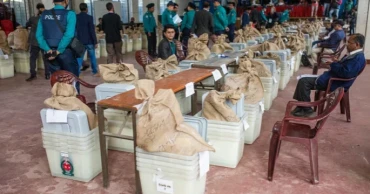
The government has sent 32 former deputy commissioners (DCs) who served as returning officers during the controversial 2018 parliamentary elections during the Awami League retime, into compulsory retirement.
The Ministry of Public Administration issued a gazette notification on Monday in this regard.
According to the notification, the officials, who were serving as officers on special duty (OSDs) at the rank of joint secretary, have completed 25 years of service and sent into retirement under Section 45 of the Government Service Act, 2018 in the public interest.
They will be entitled to retirement benefits in accordance with the existing rules, it said.
Those sent into compulsory retirement include former DCs Md Majedur Rahman Khan (Chandpur), Md Abul Fazal Mir (Cumilla), Md Aslam Hossain (Kushtia), Moinul Islam (Netrokona), Mohammad Daudul Islam (Bandarban), Md Shahriar (Natore), Kazi Abu Taher (Shariatpur), AZM Nurul Haque (Chapainawabganj), Md Mizanur Rahman (Mymensingh), Mohammad Elias Hossain (Chattogram), Anjan Chandra Pal (Lakshmipur), AKM Mamunur Rashid (Rangamati), Md Kamal Hossain (Cox's Bazar), Md Abdul Ahad (Sunamganj), Md Jasim Uddin (Pabna), Saroj Kumar Nath (Jhenaidah), Md Shahidul Islam (Khagrachhari), Md Wahiduzzaman (Feni), SM Azior Rahman (Barishal), Mohammad Masud Alam Siddique (Bhola), Md Matiul Islam Chowdhury (Patuakhali), Nazia Shirin (Nilphamari), SM Abdul Quader (Rajshahi), Md Ali Akbar (Magura), Mahmudul Kabir Murad (Habiganj), Md Sarwar Murshed Chowdhury (Kishoreganj), Syeda Farhana Kawnain (Narsingdi), Mohammad Helal Hossain (Khulna), Anar Kali Mahbub (Sherpur), Mosammat Sultana Parvin (Kurigram), SM Ferdous (Manikganj) and Gopal Chandra Das (Chuadanga).
On February 20 last year, the then interim government made 33 former DCs who had served as returning officers in the 2018 parliamentary election OSDs. Since then, they had been serving as joint secretaries in different ministries and departments.
The 11th parliamentary election was held on December 30, 2018, in which the Awami League-led alliance secured an overwhelming majority to form the government.
The election, however, was marred by widespread allegations of irregularities, ballot stuffing and vote rigging before and during polling.
According to an enquiry commission constituted by the then interim government on June 26, 2025, the three national elections held in 2014, 2018 and 2024 were orchestrated at the highest levels of the state, with segments of the administration, police, Election Commission, and intelligence agencies mobilised to implement the plans.
The National Election Investigation Commission submitted its report to then Chief Adviser Prof Muhammad Yunus on January 12 this year.
According the commission, the 2018 polls saw overnight ballot stamping in 80 percent of voting centres to secure the Awami League’s victory.
“Within the administration, there was a form of dishonest competition to ensure the party’s win, resulting in voter turnout figures exceeding 100 percent in some centres,” it had said.
The commission also noted that during those elections, control of the electoral process moved away from the EC to the administration.
7 days ago