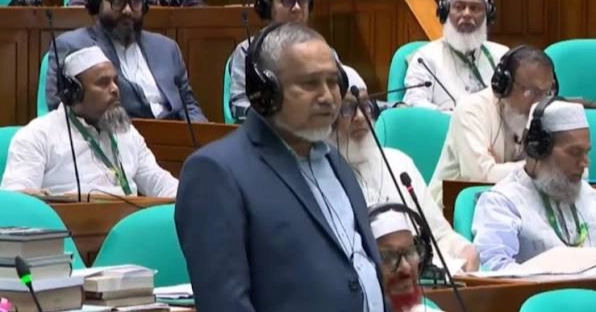
Opposition Deputy Leader Syed Mohammad Abdullah Mohammad Taher on Wednesday demanded that the opposition be given chairmanship of parliamentary standing committees in proportion to its representation in parliament, accusing the ruling party of ignoring its legitimate rights.
Speaking on a point of order in Parliament, he said the opposition earlier raised the issue of committee formation and later held discussions with the ruling party over the allocation of committee positions.
Parliament sees debate over reports on human rights, enforced disappearance bills
Taher said an understanding was reached that the opposition would get around 26 percent of the committee memberships based on its strength in Parliament, and the ruling party agreed to maintain that proportion.
“We expect that it is also our right to get 26 percent of the chairmanships. That is normal,” he said.
The Bangladesh Jamaat-e-Islami lawmaker noted that neither the Rules of Procedure nor the parliamentary privileges provisions specify any particular ratio for distributing committee chairmanships between the government and opposition.
He said the opposition was also told at one stage that it would be given 10 chairmanships and that the ruling side sought a list of preferred committees from them. “We submitted the list accordingly,” he said.
The opposition deputy leader alleged that the ruling party has become somewhat “reckless” because of its two-thirds majority in parliament and is seeking to impose decisions unilaterally.
“It is very indecent when the government says, ‘Come to this committee and you will be given this.’ We are not children who can be shown a lollipop and then dealt with differently elsewhere,” he said.
Taher said the opposition is demanding committee chairmanships as a matter of right and accused the government of ignoring that right.
“They cannot decide that they will take 100 percent of the chairmanships. Where is it written? Is it in the Constitution?” he asked.
The opposition lawmaker warned that allowing the will of the majority party to become the law and the decision of Parliament will amount to authoritarianism.
“We do not want to see this Parliament that way,” he said, urging the ruling party not to create discrimination inside or outside Parliament in the interest of democracy and national interests.
Taher also criticised the government for not allocating any chairmanship to the opposition and demanded that the decision be reconsidered.
Responding to Taher, Home Minister Salahuddin Ahmed said there is no provision requiring parliamentary committee chairmanships to be distributed among opposition members according to their numerical strength.
“There is no such provision, nor is there any obligation. There is no such precedent in history either,” he said.
Salahuddin also rejected Taher’s claim that there was an agreement to give the opposition 10 committee chairmanships, saying no formal discussion took place on the matter.
He, however, said the government remains committed to the principle agreed upon in the July National Charter.
The minister said the charter, which was signed as a political consensus document, contains a commitment that opposition members will get chairmanships of ministry-related parliamentary committees in proportion to their representation in Parliament. “We are still committed to that pledge,” he said.
He said the committees will be reconstituted after implementation of the July National Charter and the consequent constitutional amendments. “At that time, the opposition will get chairmanships in proportion to its strength,” he said.
Salahuddin, however, accused the opposition of not cooperating in the implementation of the July National Charter.
He urged opposition lawmakers to return to Parliament and participate in discussions instead of pursuing politics outside the House.
“If you are more comfortable calling constitutional amendment ‘reform’, then call it reform. But, in parliamentary language, the amendment has to be adopted as an amendment,” he said.