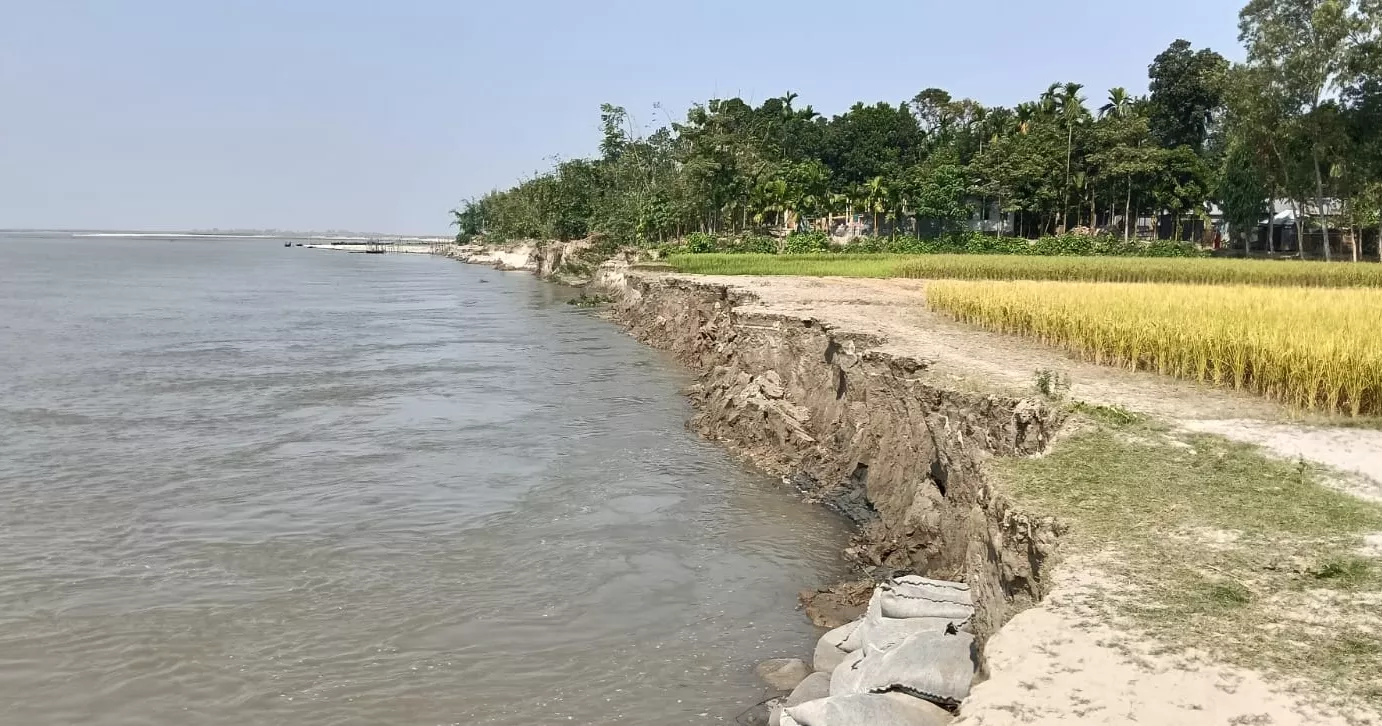
Intensifying climate change impacts are accelerating the Brahmaputra’s relentless erosion in Kurigram, deepening a decades-long crisis that has displaced thousands, wiped out vast stretches of land and pushed vulnerable communities into chronic uncertainty.
For decades, the river has been steadily eating into its banks across the northern district, drastically altering its landscape and displacing hundreds of thousands of people, many of whom have rebuilt their homes multiple times only to lose them again.
Originating in India’s Assam, the Brahmaputra enters Bangladesh through Narayanpur union of Nageshwari upazila and flows through Kurigram Sadar, Ulipur, Chilmari, Roumari and Char Rajibpur before reaching Bahadurabad in Jamalpur, where it becomes known as the Jamuna.
A roughly 70-kilometre stretch from Narayanpur to Rajibpur has been experiencing continuous erosion since the 1950s, said locals.
Large parts in unions in Nageshwari, Kurigram Sadar, Ulipur, Chilmari, Roumari and Rajibpur have been partially or completely eroded, displacing several lakh people and reshaping the district’s geography.
The loss of agricultural land, educational institutions, religious establishments and other assets has dealt a severe blow to the local economy and social structure.
To address the crisis, the Bangladesh Water Development Board (BWDB) has proposed a riverbank protection project worth around Tk 850 crore to protect the left bank of the Brahmaputra.
The project aims to safeguard about 16.305 kilometres of vulnerable riverbanks across Ulipur, Roumari and Rajibpur upazilas.
Planned for implementation from January 2026 to June 2029, it will cover areas including Saheber Alga, Habiganj Bazar, Namajer Char, Sonapur, Ghughumari and Sukher Bati in Ulipur; Phulua Charghat in Roumari; and Kodalkati, Hajipara and Char Neoyaji in Rajibpur.
BWDB officials said the proposal has been sent to the Ministry of Water Resources after completing necessary surveys.
It was forwarded to the Planning Commission on March 2 but is yet to receive final approval.
Residents in erosion-hit areas say they are living in extreme hardship after losing their homes repeatedly.
“I have built my house five times in my life, and each time it was taken by the river. I don’t know where to go now,” said Sharafat Ali, 56, from Saheber Alga in Ulipur.
“The river has taken everything from me. I now live on someone else’s land with my children, and I fear the monsoon every year,” said Rahila Khatun from the same area.
Zaidul Islam, a farmer from Phulua Char in Roumari, said he now works as a day labourer after losing 10 bighas of farmland to the river.
“It is becoming impossible to survive after losing our homes again and again. If immediate steps are not taken, we will become completely homeless,” said Zarina Khatun from Char Rajibpur.
Local representatives have urged the government to take urgent action, warning of a looming humanitarian disaster.
“People have had to relocate five to six times. Without a sustainable embankment, a major humanitarian crisis is inevitable,” said Mozzaffar Hossain, chairman of Saheber Alga union in Ulipur.
Representatives from Roumari and Rajibpur echoed similar concerns, stressing the need for immediate intervention to control erosion.
Experts say the Brahmaputra’s unstable nature is a key factor behind the worsening situation.
“The Brahmaputra is an extremely dynamic river. On average, it erodes about 50 metres of its banks each year, destroying homes, farmland and infrastructure. Over time, this is intensifying poverty and humanitarian challenges,” said Prof Shafiqul Islam Bebu, president of Kurigram District Char Development and Implementation Organisation.
He also emphasised the need for regular dredging alongside embankment protection to maintain the river’s navigability.
BWDB Executive Engineer Rakibul Hasan said a project proposal has been prepared after identifying vulnerable areas and that work would begin once approval is secured.
Residents now hope the project will be approved and implemented without delay, offering protection from the relentless erosion and restoring some stability to life in the char areas.
Although Bangladesh is responsible for less than 0.5 percent of global carbon emissions, it faces some of the gravest impacts of climate change.
According to the World Bank, climate-related disasters could displace one in seven people in the country by 2050.