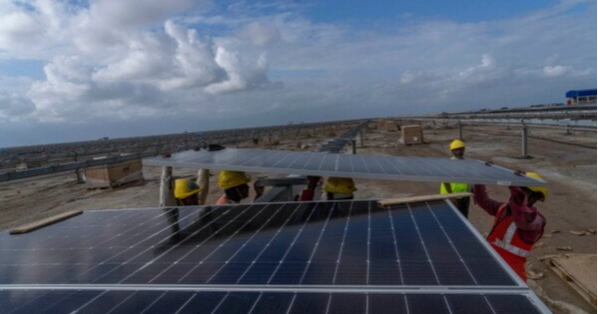
India is rapidly expanding its renewable energy capacity, but a growing amount of solar power is going unused because the country's electricity grid and storage systems are struggling to keep pace.
Over the past 15 months, India curtailed nearly 11 terawatt-hours of solar power — enough electricity to supply around 10 million homes — according to government data and research by energy think tank Ember.
The unused solar power comes at a time when India's electricity demand is rising sharply, driven by extreme heat, increased use of air conditioners, irrigation needs and the growing electrification of transport and other sectors.
India now has more than 300 gigawatts of clean energy capacity, accounting for over half of its total installed electricity capacity. However, coal still generates most of the country's electricity.
One major problem is known as curtailment, which happens when solar or wind farms are forced to reduce or stop generating electricity because the grid cannot safely absorb the available power.
Solar generation usually peaks in the afternoon, but coal-fired power plants cannot always reduce their output quickly enough to make room for renewable electricity.
“We're in a stage where some of the biggest hurdles in renewables are starting to hit us,” said Neshwin Rodrigues, an energy analyst at Ember.
Another challenge is the concentration of solar projects in western India. Gujarat and Rajasthan together account for nearly half of the country's solar capacity, putting heavy pressure on transmission lines in the region.
Experts say India needs to expand its power transmission network, develop more battery storage and make its electricity system more flexible.
“Without enough storage, India risks keeping coal plants running even when cheap renewable power is available,” said Vibhuti Garg, South Asia director at the Institute for Energy Economics and Financial Analysis.
Building new solar and wind projects can take around two years, but major transmission lines often require at least three years to complete. India has achieved about 80% of its annual transmission construction targets over the past five years, according to Ember.
India aims to reach 500 gigawatts of clean electricity capacity by 2030 and expects non-fossil sources to account for nearly 70% of its installed power capacity by 2036.
Energy experts say battery storage could help address the problem by storing excess solar power generated during the day and supplying it during the evening, when electricity demand remains high.
India currently has about 3 gigawatts of battery storage and 7.4 gigawatts of operational pumped-storage capacity. The government expects the country's storage requirement to reach around 74 gigawatts by 2032.
“If we try to increase the solar installations without solving for energy storage, it is only going to lead to curtailment,” said Ankit Mittal, CEO of battery storage company Ingro Energy.
Industry experts say the rapid growth in electricity demand has caught many by surprise as transport, industries and other sectors increasingly shift to electricity and more data centres are built.
The challenge for India now is not only to add more renewable energy projects, but also to build the transmission and storage systems needed to ensure that clean electricity can be used when and where it is needed.