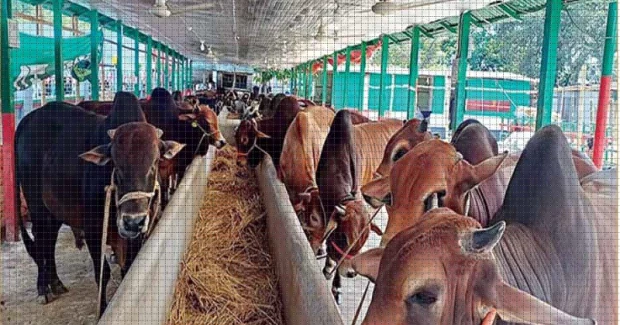
Cattle markets in Chandpur are bustling with activity ahead of Eid-ul-Azha as farmers prepare more than 66,000 sacrificial animals for sale, hoping to secure fair prices during the peak trading season.
Despite strong preparations, many farmers remain concerned about market volatility and the possible influx of cattle from a neighboring country, which they fear could affect prices.
According to the Department of Livestock Services, Chandpur district currently has 66,098 sacrificial animals ready for sale against an estimated demand of around 75,000, leaving a shortfall of about 9,000
animals.
Officials, however, said the gap would likely be filled by small-scale seasonal traders and farmers from remote char areas and neighboring districts.
District Livestock Officer Dr Jyotirmoy Bhowmik said there would be no shortage of sacrificial animals this year.
“We have sufficient local production and the remaining demand will be met by marginal farmers and seasonal traders. We expect a smooth supply during Eid,” he told UNB.
The ready animals include 27,346 bulls, 8,366 oxen, 10,571 cows, 23 buffaloes, 19,346 goats and 446 sheep.
Visits to major cattle markets including Sofarmali, Bagadi Chourasta, Puranbazar and Bakila in Haziganj revealed that cattle trade have already gained momentum.
Buyers said cattle prices this year are slightly higher than last year.
“Prices have increased compared to previous years, especially for healthy local bulls,” said Abu Sayeed, a cattle buyer in Chandpur town.
Traders were seen bringing truckloads of cattle from Faridpur and northern districts to local markets, although buyers appeared to prefer locally raised cattle.
According to livestock officials, around 4,155 entrepreneurs — mostly young farmers — are involved in raising sacrificial animals across Chandpur’s eight upazilas. Nearly 300 temporary and permanent cattle markets have been set up in the district ahead of Eid.
Many farmers said they purchased young bulls several months ago and raised them using locally produced feed such as grass, straw, oil cake and bran.
While small and medium-sized cattle are mainly sold in local markets, larger bulls are increasingly marketed online.
During a visit at several farms, workers were seen caring for cattle that are expected to be sold within the next week.
Despite their preparations, many farmers expressed anxiety over market prices.
“If Indian cattle do not enter the market in large numbers, we hope to get good prices this year,” said farmer Khaled Khan from Nanupur village in Sadar upazila.
Khaled, who has been involved in cattle farming for two decades, said he has prepared several bulls for Eid, with prices ranging between Tk 90,000 and Tk 1.2 lakh.
Another farmer, Ahmed Ali from Ghashipur village, said he has 32 cattle in his farm including seven bulls raised entirely on local feed.
Some farmers are targeting high-end buyers with premium bulls.
Nargis Begum of Hamankardi village in Maishadi union has prepared three large bulls aged between three and five years.
Among them is a bull named “Raja Babu,” for which she is seeking Tk 12 lakh. Another bull, “Hamankardi King,” is priced at Tk 10 lakh, while the smallest one is expected to sell for around Tk 5 lakh.
Farm worker Md Moslem said the animals were raised naturally without artificial fattening methods.
“We fed them local grass, straw and bran. We are taking special care of them every day,” he said.
Many buyers expressed more interest in locally farmed cattle, citing concerns about chemical fattening practices sometimes used by outside traders.
“People in the city now prefer cattle raised by local farmers because they trust the quality more,” said Abdul Barek, a resident of Chandpur town.
To ensure smooth trading during Eid, the livestock department officials said mobile teams, including veterinary surgeons, will monitor cattle markets, resolve disputes and check counterfeit currency during
transactions.