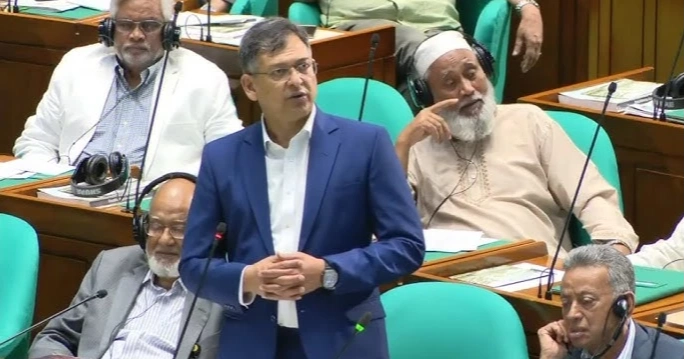
Home Minister Salahuddin Ahmed on Tuesday characterized the July National Charter (Constitution Reform) Implementation Order as an invalid legal document, labeling it a manifestation of "infinite deception" by the interim government.
“This order is a document of infinite deception by the interim government. I reiterate this again today,” he said, joining the two-hour discussion on a motion placed by the opposition leader in Parliament for summoning the session of the Constitution Reform Council.
Bangladesh Jamaat-e-Islami Ameer Dr Shafiqur Rahman placed adjournment motion in the House under the Section 62 of the Rules of Procedure, seeking the adjournment of the business of the House for the discussing summon of the session of the Constitution Reform Council as per the July National Charter (Constitution Reform) Implementation Order, 2025.
Speaker Hafiz Uddin Ahmad, Bir Bikram, moved the motion for two-hour discussion as the last agenda for Tuesday’s business in the House.
The Home Minister argued that the order holds no legal standing as it is categorized as neither a law nor an ordinance.
He, however, said they (the government) hold on to every single word of the July National Charter which was signed by the political parties as a historic document.
Salahuddin Ahmed pointed out the President had the jurisdiction to issue such orders only between March 1971 and April 1973, and that authority ceased following the formation of the first parliament in 1973.
He said 133 ordinances issued during the interim government have been introduced in parliament but the July Charter Implementation Order was not among them as it lacks legislative legitimacy.
He further questioned the President's authority to convene a session of the constitution reform council, citing the absence of constitutional provisions for such a body or its accompanying oath of office.
The Minister dismissed claims that the BNP opposes reform or the July Charter itself, asserting that the party upholds the spirit of the historic document.
“All the issues that were agreed upon in July National Charter 2025 with notes of dissent…. But where are the notes of dissent here (in the Order)?” he said.
"No order of the President can reduce the sovereignty of the parliament," Ahmed stated, citing Article 93 of the Constitution, which prohibits the President from issuing ordinances that change constitutional provisions.
Reaffirming the BNP's commitment to the July Charter, the Home Minister emphasized that the party intends to pursue democratic constitutional amendments through inclusive dialogue.
On behalf of the Leader of the House, he proposed the formation of a special parliamentary committee—including all represented parties and independent lawmakers—to draft a constitutional amendment bill based on broad consensus.
Later, Leader of the Opposition Dr Shafiqur Rahman suggested forming a parliamentary committee to take a decision on the implementation of the referendum results.
PM seeks steps to reduce school-time gridlock
“We want a solution. We want it on the basis of justice. After discussing this issue, if you think it is good, you can form a committee. However, we will call for the committee to be formed with an equal number of members from two sides,” he said.
He said if the committee is formed with majority from the ruling side, it will bring no good result. “We’ve raised our desire. Now the decision is yours,” he said.
Referring to the remark that the order is a document of endless fraud, he said the interim government and the President did this together on November 13, 2025 but the referendum was held on February 12, 2026. BNP officially congratulated the government for holding the parliamentary election and the referendum on the same day due to their demand. “So, the referendum was also their demand.”
"We will sincerely appeal to the government party - the people have accepted the referendum. If we also respect the people by accepting it, then this parliament will be respected. Let the public desire be reflected through this with our joint initiative,” said Dr Shafiqur Rahman.
Law Minister Md. Asaduzzaman said that all reform initiatives must be implemented within the framework of the Constitution, stressing that the constitution remains the supreme legal foundation of the state and parliament.
He said the July Charter is the central focus of current political discourse and that it represents the public mandate following the July 24 mass uprising. “The people have given us the mandate to conduct all activities under the constitution and bring necessary reforms through parliament,” he said.
The law minister explained that the July Charter outlines reform measures that must be adopted through parliamentary processes rather than through extra-constitutional means.
He emphasized that parliament is sovereign in law-making and cannot be compelled by unauthorized orders.
“The July Charter should guide reforms, but all actions must be taken through constitutional and parliamentary procedures,” he said, adding that national unity and democratic consensus are essential for sustainable constitutional reform.
Joining the discussion, BJP chairman Andaleeve Rahman (Partho) asked the NCP leaders not to turn into the Jamaat generation while representing Gen Z.
“You are our heroes. Those who fought (in the July uprising) are here (in Parliament). I would like to tell them that you represent Gen Z. You should not become Jamaat generation,” he said, pointing at the NCP leaders.
He said there is a tendency among some political actors to push them (BNP-led alliance) against the spirit of the July uprising for political advantage, which could harm national unity.
“We are seeing an attempt to push us against the spirit of July,” he said, adding that such “tagging politics” was also seen during the Awami League regime.
Questioning the formation of the Constitution Reform Council, the BJP chief said they wanted to remain within the constitutional process through which amendments are made.
He claimed that although around 70 percent of people voted “yes” in the referendum, 51 percent supported the BNP-led alliance (in the 13th parliamentary election) in favour of constitutional changes.
Focusing on the roles of different political parties and actors in the 2024 July movement, the BJP chief said, “You scored 12 runs from six balls. But we scored 300 runs before.”
Stressing the need for political unity over the spirit of July movement, he said, “We must respect the Constitution and at the same time we must respect the spirit of July.”
Earlier, NCP Member Secretary Akhter Hossen said BNP chairman Tarique Rahman on January 30 last had urged people to vote “yes” in the referendum during a pre-election rally in Rangpur, the birthplace of July martyred Abu Sayeed, but now BNP is showing reluctant to accept the referendum results.
“We want to ask the Prime Minister (Tarique Rahman) why you don't want to accept the verdict of the referendum after asking (the people) to vote 'yes' in the referendum," said the NCP leader.
Noting that the people had given their verdict in favour of implementing the July National Charter, he said terming the public verdict as unconstitutional is audacity and stigmatization of Parliament.
“Whether the Referendum Order is approved by Parliament or not, there is no chance of making the referendum illegal,” he said.
Besides, Jamaat lawmakers Md. Rafiqul Islam Khan (Sirajganj-4), Muhammad Nazibur Rahman (Pabna-1), Md Saiful Alam (Dhaka-12), Md. Shafiqul Islam (Patuakhali-2) and Md Nurul Islam (Chapainawabganj-3), and NCP lawmaker Md Abul Hasnat, who is widely known as Hasnat Abdullah (Cumilla-4), joined the discussion.