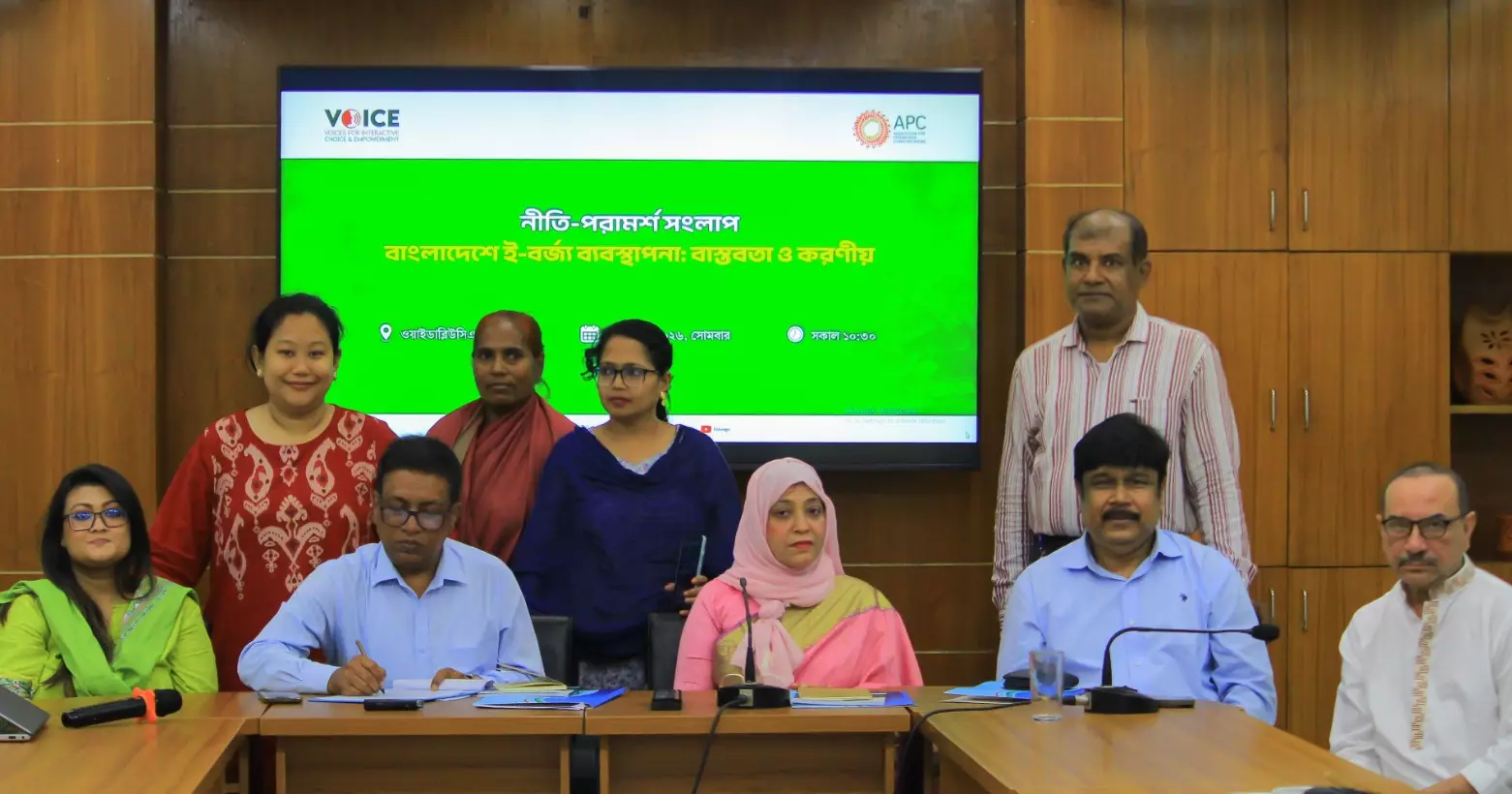
Weak enforcement of existing regulations, the absence of an effective collection system and poor coordination among stakeholders are preventing Bangladesh from tackling its rapidly growing electronic waste (e-waste) problem, speakers said at a policy dialogue in Dhaka on Monday.
They warned that though Bangladesh has the Hazardous Waste (E-Waste) Management Rules, 2021, implementation remains inadequate, allowing millions of tonnes of electronic waste to be discarded without proper recycling or resource recovery.
The dialogue, titled "Electronic Waste Management in Bangladesh: Reality and Way Forward," was organised by rights-based advocacy organisation VOICE with support from the Association for Progressive Communications (APC) at the YWCA auditorium.
According to VOICE's latest assessment on the enforcement mechanism, Bangladesh generates around 30 lakh tonnes of e-waste every year, but less than 10 percent is formally recycled.
The assessment also found serious shortcomings in compliance with the 2021 rules. Although all surveyed entities were registered with the Department of Environment (DoE), none collected end-of-life electronic products during the last fiscal year, exposing major gaps in implementation.
Presenting an overview of the global e-waste situation, VOICE Deputy Director (Programmes) Musharrat Mahera said the world generated around 6.2 crore tonnes of e-waste in 2022, while Bangladesh alone produces about 30 lakh tonnes annually.
She said e-waste contains valuable materials that could be recovered, estimating that resources worth US$ 200-221 million could potentially be extracted from discarded electronic products each year.
Prof Dr Rowshan Mamtaz of Bangladesh University of Engineering and Technology (BUET) said city corporations' waste management systems need to become more strategic and efficient.
She also stressed that committees formed under the Department of Environment should assign responsibilities according to members' expertise and ensure effective implementation.
Founding Managing Director and Chief Executive of Change Initiative Zakir Hossain Khan said Bangladesh lacks a robust monitoring and tracking system for electronic products, making it difficult to determine the actual volume of e-waste generated.
He also urged the private sector to adopt circular economy approaches and develop market-based solutions for e-waste management.
Consultant (Medical Waste Management) at the Directorate General of Health Services (DGHS) Tarit Kanti Biswas emphasised the importance of social responsibility and evidence-based policymaking.
He said greater reliance on primary data, rather than secondary information, and stronger collaboration among all stakeholders are essential to develop a comprehensive strategy that can transform e-waste into a valuable resource.
Concluding the dialogue, VOICE Executive Director Ahmed Swapan Mahmud called on the government to issue an official circular establishing a clearer framework for e-waste management and ensuring proper utilisation of discarded electronic products.
Representatives from Citizens' Initiative, Arannayk Foundation, Work for a Better Bangladesh (WBB) Trust, recycling companies and media organisations attended the dialogue.
The participants stressed that without stronger commitment from government agencies, better enforcement of existing regulations and coordinated action among regulators, industry, civil society and the media, Bangladesh's e-waste problem will continue to pose serious environmental and public health risks.