
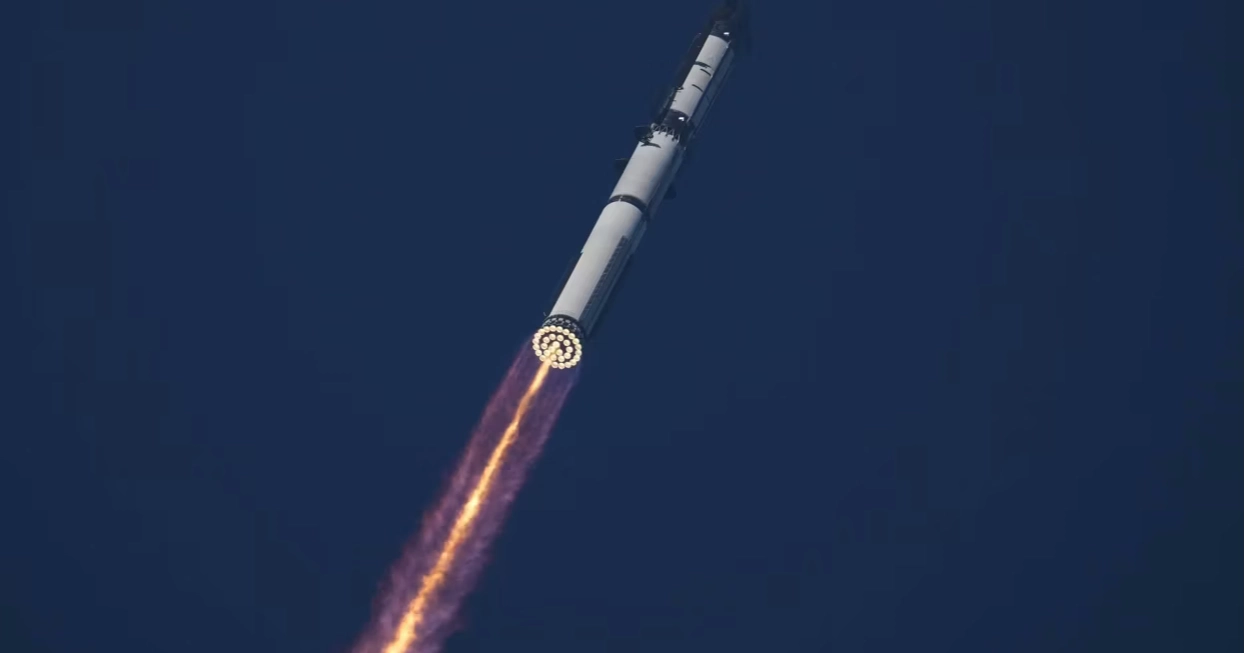
SpaceX successfully launched its massive Starship rocket on Friday during its 13th test flight, marking another milestone in the development of the world's largest launch vehicle. The mission also deployed 20 of the company's most advanced Starlink satellites into orbit.
Standing 407 feet (124 meters) tall, Starship lifted off from SpaceX's Starbase facility in southern Texas. The mission, closely watched by NASA, is an important step toward qualifying the spacecraft for future lunar missions under the Artemis program.
The hourlong flight concluded with a controlled splashdown in the Indian Ocean, where the spacecraft remained afloat after touchdown, prompting celebrations among SpaceX employees.
The launch followed a last-minute abort earlier in the week caused by engine issues. SpaceX replaced six of the booster’s 33 engines before Friday’s successful liftoff. While all engines performed during launch, several failed to restart during the booster’s descent, causing it to crash into the Gulf of Mexico instead of making a controlled return.
Meanwhile, the upper-stage spacecraft continued its planned trajectory, releasing the 20 Starlink satellites individually at an altitude of about 124 miles (200 kilometers) before reentering Earth's atmosphere.
The mission was the second flight this year of Starship's upgraded Version 3 design. As with the previous demonstration, neither the booster nor the spacecraft was intended for recovery, although the spacecraft achieved its smoothest reentry to date and landed upright in the Indian Ocean more than 10,000 miles (16,000 kilometers) from the launch site.
According to SpaceX, the spacecraft remained largely intact after reentry, unlike previous tests that ended in explosions or structural failures. SpaceX engineer Kate Tice described the mission as "lucky flight 13" and praised the successful performance.
The newly launched Starlink satellites completed their objectives before reentry, including establishing laser communications with existing Starlink satellites in orbit. SpaceX now operates a constellation of more than 10,000 satellites providing global internet service.
Six of the satellites also carried cameras that captured high-resolution images of Starship's heat shield during reentry. Engineers tested the shield using pressure sensors and by painting some thermal protection tiles white to simulate missing tiles, helping evaluate the system's durability under extreme conditions.
Elon Musk later said on X that the mission collected all the heat shield data SpaceX had hoped for and more. NASA Administrator Jared Isaacman also congratulated the company, saying he looked forward to the insights gained from the test.
SpaceX aims to perfect Starship's heat shield before attempting to return the spacecraft directly to the launch site, where giant mechanical arms have already demonstrated the ability to catch returning boosters. The long-term goal is to make both stages of Starship fully reusable.
NASA is relying on Starship for its Artemis III mission, with astronauts expected to practice docking with the spacecraft ahead of a planned lunar landing. Beyond lunar exploration, Musk envisions Starship as the primary vehicle for future missions to Mars and has also proposed commercial trips to both the Moon and the Red Planet.
The latest mission had been delayed twice—first because of the July 16 launch abort and later due to poor weather associated with Tropical Storm Bertha.