foreign-affairs
Hasina will be arrested whenever she comes to Bangladesh: Shama Obaed
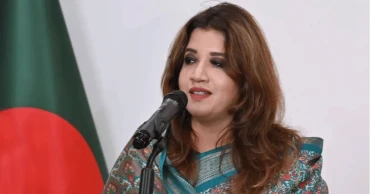
State Minister for Foreign Affairs Shama Obaed Islam on Thursday said former Prime Minister Sheikh Hasina, currently staying in India, would be arrested whenever she comes to Bangladesh.
"Since she has been convicted, there is no scope for surrender. Whenever she comes to Bangladesh, she will be arrested. It will be done in accordance with the law," she told reporters at the Ministry of Foreign Affairs, noting that efforts are continuing to secure her extradition to Bangladesh.
Hasina will have to go to jail if surrenders, says Shama Obaed
The State Minister said the people of Bangladesh want court orders to be implemented against those living abroad. She said the Law Adviser and the Home Adviser had already explained the legal aspects.
"If she surrenders, the existing law will be followed. She will have to go to jail. The law will take its own course," Shama Obaed told reporters on Monday at the Ministry of Foreign Affairs.
She said Hasina's recent remarks from abroad appeared intended to encourage Awami League leaders and activists who have either gone into hiding or fled the country. "I see no other reason," she said.
Bangladesh has formally requested India to extradite Hasina under the bilateral extradition treaty.
Bangladesh is making sustained diplomatic efforts to bring Hasina back to face trial, while acknowledging that the extradition process takes time.
Three ministries, including the Ministry of Foreign Affairs, have been pursuing the matter since the new government assumed office in February, building on efforts initiated under the interim government.
The government believes the people of Bangladesh want Hasina to be extradited.
On April 8, Bangladesh renewed its request for the extradition of Hasina and former Home Minister Asaduzzaman Khan Kamal, both of whom have been sentenced to death by the International Crimes Tribunal.
"We will continue to seek her extradition through a transparent judicial process. It has been discussed and will be dealt with through a transparent judicial process," Prime Minister's Foreign Affairs Adviser Humaiun Kobir told reporters in Dhaka.
18 days ago
Bangladesh to buy both Boeing, Airbus jets to expand Biman fleet
Bangladesh has decided to purchase both Boeing and Airbus aircraft for Biman Bangladesh Airlines as part of fleet expansion with mixed aircraft, keeping national interests protected.
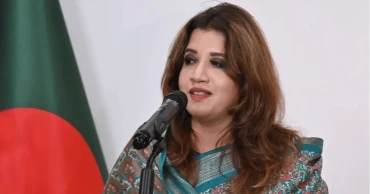
“We have to take country's civil aviation sector to new heights. We have to purchase whatever we need. We need Boeing, we need Airbus (aircraft), too. We will purchase both,” State Minister for Foreign Affairs Shama Obaed Islam told reporters at the Ministry of Foreign Affairs on Thursday.
She said the government is committed to strengthening the country’s civil aviation sector while pursuing prudent economic management.
“The Prime Minister inherited a fragile economy from the previous governments. To put the economy on a stronger footing, we need to exercise austerity on the one hand, while also purchasing what the country requires. We need both Boeing and Airbus. We will buy both,” the state minister said.
She said Bangladesh does not give preferential treatment to any particular country. “Absolutely not,” she said when asked whether any country was receiving greater preference.
“The interests of Bangladesh are always given top priority when it comes to investment,” Shama Obaed added.
Bangladesh has reportedly expressed its interest in procuring Airbus aircraft to develop a sustainable mixed fleet for the national flag carrier while protecting the country’s strategic interests.
The issue was also discussed between Civil Aviation and Tourism Minister Afroza Khanam, State Minister M Rashiduzzaman Millat, and ambassadors and senior diplomats representing France, the United Kingdom, Spain, Germany and the European Union at the Ministry of Civil Aviation and Tourism on Wednesday.
The meeting was attended by French Ambassador Jean-Marc Séré-Charlet, British High Commissioner Sarah Cooke, Spanish Ambassador Gabriel Sistiaga, German Chargé d’Affaires Anja Tersten and Deputy Head of the Delegation of the European Union to Bangladesh Baiba Zerin.
The French ambassador has recently underlined the importance of ensuring a fair and level playing field to encourage greater engagement by European companies in Bangladesh's aviation sector.
He emphasised the commitment of European aerospace leader Airbus to supporting the growth of Bangladesh's aviation industry.
The issues were discussed when he met Chairman of Biman Bangladesh Airlines Rumee A Hossain last week to discuss opportunities for strengthening cooperation in the civil aviation sector.
18 days ago
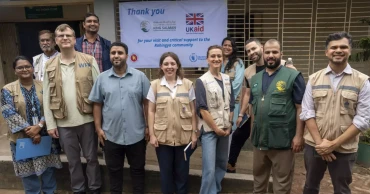
Rohingyas: UK, Saudi Arabia reaffirm humanitarian partnership through joint visit
Representatives from the King Salman Humanitarian Aid and Relief Center (KSrelief) and the British High Commission in Dhaka have concluded their first joint visit to Cox’s Bazar, highlighting the impact of Saudi Arabia and UK’s growing humanitarian partnership in support of the Rohingya refugees.
British High Commissioner to Bangladesh Sarah Cooke on Thursday said the United Kingdom is proud to partner with KSrelief to deliver life-saving assistance for Rohingya refugees, host communities and other vulnerable populations around the world.
"This visit marks our deepening humanitarian partnership and our shared commitment to helping those in need," she said.
The visit demonstrated the shared commitment of Saudi Arabia and the United Kingdom to delivering effective, principled humanitarian assistance and supporting some of the world's most vulnerable communities, said the British High Commission in Dhaka.
The King Salman Humanitarian Aid and Relief Center (KSrelief) Assistant Supervisor General for Operations and Programs Eng. Ahmed bin Ali Al-Baiz said they value their partnership with FCDO as they work together to continue empowering vulnerable communities.
"Our partnership with the UK enhances our ability to deliver life-saving support to Rohingya refugees and their hosts, reaffirming our shared dedication to alleviating suffering and fostering resilience through effective and compassionate humanitarian action."
During the visit, the delegation met humanitarian partners and community members and observed programmes providing food security assistance and water, sanitation and hygiene (WASH) services for Rohingya refugees and host communities.
$7.8 million is being provided jointly by KSrelief and the UK Government through partners including the World Food Programme (WFP), the International Organization for Migration (IOM) and Integrated Social Development Effort (ISDE) Bangladesh, as announced in December 2025 at the UK-KSA Strategic Aid Dialogue, said the British High Commission in Dhaka.
It follows the signing of a joint statement between KSrelief and the UK Government in London in December 2025, committing both sides to humanitarian actions in Bangladesh and Yemen.
The delegation heard directly from humanitarian partners and community members about how these programmes are helping families access essential services, improve living conditions, and strengthen resilience in the face of ongoing challenges.
18 days ago
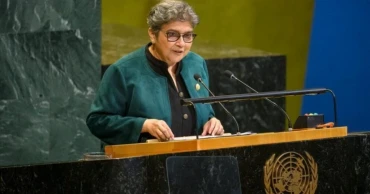
Bangladesh’s Rabab Fatima named UN Special Representative for Afghanistan
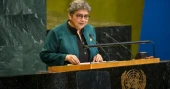
United Nations Secretary-General António Guterres has appointed Rabab Fatima of Bangladesh as his new Special Representative for Afghanistan and Head of the United Nations Assistance Mission in Afghanistan (UNAMA).
As a career diplomat, Fatima served as Ambassador of Bangladesh to Japan (2016-2019), as Director-General of the Ministry of Foreign Affairs in Bangladesh (2015-2016), and in Bangladesh missions in New York, Geneva, Beijing and Kolkata, and in the Ministry of Foreign Affairs, in different capacities.
Fatima succeeded Roza Otunbayeva, former President and Foreign Minister of Kyrgyzstan, to whom the Secretary-General expressed his gratitude for her dedicated service.
He also thanks Georgette Gagnon of Canada, Deputy Special Representative of UNAMA, who currently serves as Officer-in-Charge of the Mission, according to an official announcement made by the UN Headquarters on July 15.
Fatima brings to the position over 30 years of experience in national and international civil service, encompassing bilateral and multilateral diplomacy, policymaking, advocacy, programme planning, and implementation.
She currently serves as Under-Secretary-General and High Representative for the Least Developed Countries, Landlocked Developing Countries, and Small Island Developing States (UN-OHRLLS).
Prior to this, she was the Ambassador and Permanent Representative of Bangladesh to the United Nations in New York (2019-2022).
In that capacity, she served as the President of the Executive Boards of UNICEF (2020) and UN-Women (2022), as well as Vice-President of the UNDP/UNFPA/UNOPS Executive Board (2021).
She was the first woman to be elected as the Chair of the Peacebuilding Commission in 2022.
She also served as a Vice-President of the 77th session of the United Nations General Assembly.
Fatima also served in the International Organization for Migration (IOM) as Regional Adviser for South and South-West Asia and Regional Adviser for Climate Change and Migration (2012-2015), and as Regional Representative for South Asia (2007-2011).
She was also the Head of Human Rights at the Commonwealth Secretariat in London (2006-2007).
Fatima holds a master’s degree in international relations and diplomacy from the Fletcher School of Law and Diplomacy, Tufts University, United States, and a bachelor’s degree in social science from the University of Canberra, Australia.
In addition to her native Bangla, she speaks English and has working knowledge of Hindi and Urdu.
18 days ago

Right to Freedom to host memorial celebration of life honoring Ambassador William B. Milam
Right to Freedom, a nonprofit organization dedicated to advancing democracy and human rights worldwide, will host a memorial celebration of life honouring its Founding President, Ambassador William B. Milam, on Friday at the National Press Club in Washington, D.C.
The event will also be streamed live and recorded for those unable to attend in person.
Ambassador Milam, who passed away earlier this year at the age of 89, dedicated seven decades to public service, scholarship, and the advancement of democratic values around the world. Born in Bisbee, Arizona, in 1936, he graduated from Stanford University in 1959 before beginning a distinguished career as a U.S. Foreign Service Officer.
Over the course of his career, Ambassador Milam served in postings across Africa, Europe, and South Asia and was appointed U.S. Ambassador to Bangladesh in 1990 and later to Pakistan, where he served until his retirement in 2001.
He led the U.S. delegation that negotiated the 1994 Desertification Treaty and worked extensively on issues of nuclear nonproliferation, economic development, and free and fair elections.
Following the events of September 11, 2001, he was recalled to public service to help establish an economic reconstruction program for Afghanistan.
In retirement, Ambassador Milam continued to write and research as a Senior Scholar at the Woodrow Wilson Center, and in 2010 published Bangladesh & Pakistan: Flirting with Failure in South Asia with Oxford University Press.
He founded Right to Freedom, with Ambassador Mushfiqul Fazal Ansarey, an organization created to give voice to those who could not be heard in their own countries.
"It is with hearts full of both grief and gratitude that we invite the public to join us in celebrating the extraordinary life of Ambassador William B. Milam," said Jon Danilowicz, President of Right to Freedom’s Board of Directors.
"He was, to so many of us, more than a distinguished diplomat; he was a steady friend, a generous mentor, and a believer in the enduring power of freedom and dignity for all people."
The memorial will bring together family, friends, colleagues, and admirers from around the world to share memories and reflect on Ambassador Milam's remarkable life and legacy, said a media release on Thursday.
18 days ago
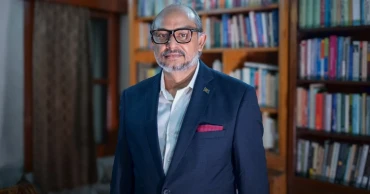
Titumir seeks stronger UN Women support to protect women, girls amid global crises
Prime Minister’s Finance and Planning Adviser Dr Rashed Al Mahmud Titumir has called for stronger cooperation from UN Women to protect and empower women and girls in Bangladesh amid the growing challenges posed by global conflicts, economic instability, energy insecurity and supply chain disruptions.
During a meeting with UN Assistant Secretary-General and UN Women Deputy Executive Director Nyaradzayi Gumbonzvanda in New York, he said Bangladesh continues to host more than 1.2 million Rohingya refugees on humanitarian grounds placing significant economic, environmental and security pressures on the country.
Titumir called for greater UN Women engagement to support the early repatriation of the Rohingya to Myanmar and to help ensure that, upon their return, women and girls can live in safety and dignity, enjoy their rights and access sustainable livelihood opportunities.
He noted that the multidimensional impacts of the ongoing global crises have significantly constrained Bangladesh's fiscal space, while stricter lending conditions imposed by international financial institutions have limited access to grants and concessional financing.
The adviser underscored the need for expanded UN Women support to strengthen the protection and empowerment of women and girls and reinforce inclusive social protection programmes.
Highlighting the government's women-centred development agenda under the leadership of Prime Minister Tarique Rahman, he outlined key initiatives, including the Family Card issued in the name of the female head of household, free education for girls up to the postgraduate level, expanded reproductive and mental health services and the planned universal life-cycle-based social protection system.
ASG Gumbonzvanda commended Bangladesh's progress in advancing gender equality and described the Family Card initiative as an innovative women-centred social protection programme.
Recalling her visit to Cox's Bazar, she praised Bangladesh's humanitarian commitment and reaffirmed UN Women's continued partnership in promoting gender equality, women's economic empowerment, social protection, the Women,
Peace and Security agenda and efforts to address the Rohingya crisis.
19 days ago
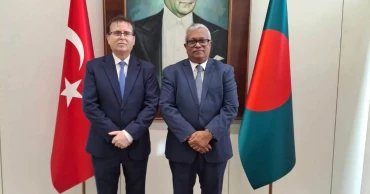
Turkish envoy pays tribute to democracy martyrs on failed coup bid anniversary
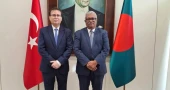
Turkish Ambassador to Bangladesh Ramis Şen on Wednesday paid tribute to the martyrs who defended democracy during the failed coup attempt in Türkiye on July 15, 2016.
The Embassy of Türkiye in Dhaka hosted an event marking the 10th Democracy and National Unity Day in Türkiye to commemorate with respect their heroes and martyrs who protected democracy during the heinous coup attempt.
Foreign Secretary Asad Alam Siam, among others, joined the event.
Bangladesh, Turkey discuss ways to boost cooperation in key sectors
The Turkish ambassador said July 15 is observed as the Democracy and National Unity Day in Türkiye in remembrance of those who sacrificed their lives to defeat the failed coup attempt orchestrated by the Fethullahist Terrorist Organization (FETO).
"On the 10th anniversary of this day, I pay tribute to our martyrs who defended democracy against the terrorist organisation FETO and express my gratitude to the veterans," he said in a statement.
19 days ago
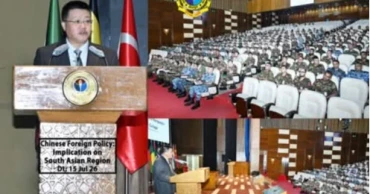
China champions equal and orderly multipolar world: Ambassador Yao Wen
Chinese Ambassador to Bangladesh Yao Wen on Wednesday said China is committed to working with the international community, including Bangladesh, to champion an equal and orderly multi-polar world and a universally beneficial and inclusive economic globalization.
He said China is also committed to advancing the Global Development Initiative, the Global Security Initiative and the Global Civilization Initiative and the Global Governance Initiative, and striving toward building a community with a shared future for humanity.
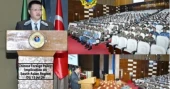
The Ambassador made the remarks while delivering a lecture upon invitation at the Defence Services Command and Staff College of Bangladesh.
Acting commandant Md Asaduzzaman, together with more than 300 officers of Bangladeshi Armed Forces and representatives of foreign militaries were present at the lecture.
Ambassador Yao said Prime Minister Tarique Rahman's recent visit to China has yielded fruitful results.
The two countries agreed to upgrade the China-Bangladesh Comprehensive Strategic Cooperative Partnership to build a China-Bangladesh community with a shared future in the new era, he said.
As President Xi Jinping said, the Ambassador said China has always attached great importance to developing relations with Bangladesh, and will always be Bangladesh’s trustworthy good friend, good neighbor and good partner.
"China is willing to strengthen exchanges and cooperation with all sectors of Bangladesh, to help Bangladesh achieve better development," he said.
The Ambassador said China has consistently pursued an independent foreign policy of peace. "Hegemony, expansion or spheres of influence find no place in Chinese dictionary."
At the end of the lecture, Ambassador Yao had friendly interactions with the audience on issues such as Rohingya.
19 days ago
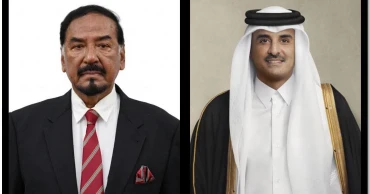
Speaker Hafiz Uddin hands PM's condolence message to Qatar Emir over father's death
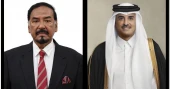
Bangladesh Parliament Speaker Hafiz Uddin Ahmed Bir Bikram on Tuesday handed over Prime Minister Tarique Rahman's message of condolence to Qatar's Emir Sheikh Tamim bin Hamad Al Thani following the death of his father and former Emir Sheikh Hamad bin Khalifa Al Thani.
The condolence message was delivered during an official state condolence reception held at Lusail Emiri Palace on July 14.
PM orders naming Dhaka road after ex-Qatari Emir Sheikh Hamad bin Khalifa Al Thani
On behalf of the government and people of Bangladesh, the Speaker conveyed heartfelt sympathy to the Emir and the bereaved members of the Qatari royal family and prayed for the eternal peace of the late former Emir.
19 days ago
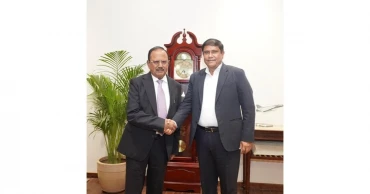
PM's defense adviser holds meeting with Indian NSA on sidelines of BIMSTEC meet
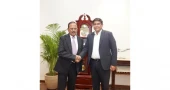
Indian National Security Adviser (NSA) Ajit Doval on Wednesday met Brigadier General ( Retd.) Dr. AKM Shamsul Islam, Defence Adviser to Prime Minister Tarique Rahman, on the sidelines of the BIMSTEC NSAs meeting.
Bangladesh, the current chair of the Bay of Bengal Initiative for Multi-Sectoral Technical and Economic Cooperation (BIMSTEC), is participating in the BIMSTEC National Security Advisers' meeting in New Delhi.
Prime Minister’s Defence Adviser Brig. Gen. (Retd.) Dr AKM Shamsul Islam is representing Bangladesh at the meeting.
The fifth BIMSTEC National Security Advisers' Meeting is being hosted by India and is scheduled to take place in New Delhi on July 16, a senior official told UNB.
BIMSTEC Secretary General Indra Mani Pandey is also visiting New Delhi, India, from July 15-17.
He will participate at the 5th meeting of the BIMSTEC National Security Chiefs and hold bilateral meetings.
The BIMSTEC leaders at the Goa Retreat held on 16 October 2016, recognised the need for urgent measures to counter and prevent the spread of terrorism, violent extremism and radicalization, an official told UNB.
The leaders expressed determination to take concrete measures to step up cooperation and coordination among law enforcement, intelligence and security organisations of the BIMSTEC Member States.
The leaders in the Goa Retreat agreed to convene “Annual Meeting of National Security Chiefs of Member States on Information and Intelligence Sharing”.
The BIMSTEC National Security Chiefs initiated the following subsidiary mechanisms of security cooperation: expert groups on maritime security cooperation, cyber security cooperation and space security cooperation.
19 days ago