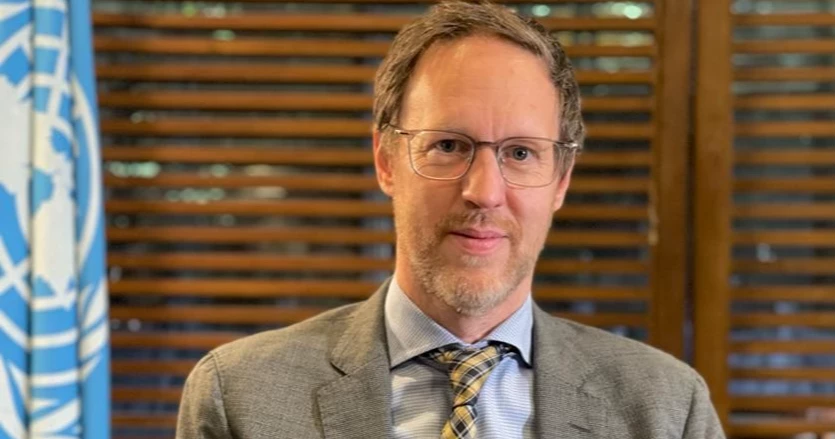
Noting that Bangladesh is at a very important moment, UNDP’s outgoing Resident Representative in Bangladesh Stefan Liller has said utimately, the interests of the Bangladeshi people are best served when political actors can compete, disagree, and still work within shared democratic rules.
"Political differences are natural in any democracy. The strength of democratic culture lies not in avoiding disagreement, but in creating institutions where disagreement can be expressed peacefully, responsibly and constructively," he told UNB in an exclusive interview.
The UN official, who is set to end his four-year tenure in Bangladesh soon, said accepting different voices and views is not a weakness; it is part of how democratic institutions become stronger.
In Bangladesh, as in many countries emerging from a period of intense political contestation, building a culture of restraint, inclusion and consensus will be essential for lasting stability and growth, he said, highlighting the importance of dialogue and democratic culture.
He said the political transition, the election, and the formation of a new government have created both renewed hope and significant public expectations.
At the request of national counterparts, UNDP supported the Bangladesh Election Commission through technical and institutional assistance for the recent national election.
"But elections are not the end of a democratic process. Their value is also tested in what follows: whether institutions are strengthened, whether citizens feel heard, and whether public trust is rebuilt through visible and credible change," said Stefan Liller.
He is a Swedish development worker with over 20 years of experience in serving the United Nations (UNDP and UNODC) at headquarters, regional and country office levels in Asia, Latin America, Europe and CIS and Africa.
Talking about institutional trust, Liller said citizens need to see that institutions are independent, fair, responsive and accountable.
"This includes electoral institutions, the judiciary, Parliament, oversight public administration, local government and security institutions. Reform is not a technical undertaking," he said .
Over time, it must be felt by people in their everyday lives and livelihoods, and in a stronger, fairer relationship between citizens and the state, Liller said.
A second priority is inclusion, especially the meaningful participation and leadership of women, he said.
He said women represent half of Bangladesh’s population, and the country cannot reach its full potential if women’s voices, leadership and economic participation are not fully reflected in national life.
"This means supporting women’s leadership from communities to courts, from local government to the private sector, and from Parliament to Cabinet," Liller said, noting that Bangladesh has a proud history of women’s leadership at all levels, and it is important that progress does not move backwards - women’s participation must deepen.
Finally, the UN official said, reforms must deliver. "Given the nature of the current transition, expectations are understandably high."
He said people will judge this moment not only by announcements, but by whether they see improvements in justice, services, jobs, social protection, safety, accountability and dignity.
The UN official said Bangladesh has the capacity to make this transition meaningful and the key will be to sustain reform developments with patience, openness, and a focus on all citizens.
"I sincerely hope the present government will be able to continue progressing this forward in a way that strengthens institutions, builds trust and serves the people of Bangladesh," he said.
Since 1972, UNDP has stood alongside #Bangladesh as a "trusted" development partner, evolving its work with the development priorities of successive governments and the aspirations of its people.