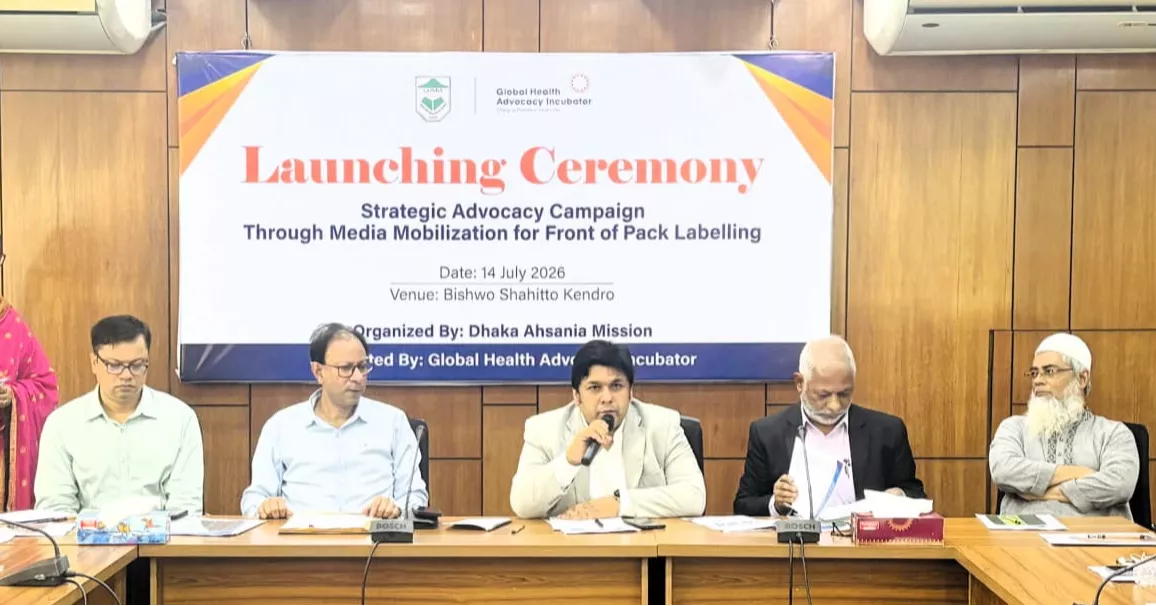
Public health experts, legal professionals and media representatives have called for the prompt formulation and implementation of Front-of-Pack Labelling (FOPL) policy in Bangladesh to protect public health, ensure consumer’s right, prevent non-communicable diseases (NCDs), and promote healthier food choices.
The call came at a Media Advocacy Workshop on Front-of-Pack Labelling (FOPL) in Bangladesh, organized by Dhaka Ahsania Mission (DAM) on Tuesday at the Bishwo Shahitto Kendro in the capital, says a press release.
In his welcome remarks, Iqbal Masud, Director of the Health and Nutrition Sector at Dhaka Ahsania Mission, said that the nutrition information currently displayed on packaged foods is often difficult for consumers to understand. As a result, many people unknowingly consume foods high in sugar, salt and unhealthy fats.
He noted that simple and clear warning labels on the front of food packages would enable consumers to make informed purchasing decisions and contribute significantly to improving public health in the long run.
Muhammad Ruhul Quddus, Bangladesh Country Lead of the Global Health Advocacy Incubator (GHAI), presented the objectives of the FOPL advocacy campaign, highlighted global progress in implementing front-of-pack labelling, and outlined future activities planned for Bangladesh.
He said that many countries have already adopted effective FOPL policies and that now is the right time for Bangladesh to introduce similar measures in the interest of public health.
Speaking at the workshop, Barrister Md. Mahfuzur Rahman Milon, Senior Advocate of the Supreme Court of Bangladesh, emphasized that access to accurate and easy-to-understand food information is a fundamental consumer right.
He said that an effective FOPL system would help realize this right, strengthen the enforcement of existing consumer protection laws, and contribute to building a safer food environment.
Dr. Ahmad Khairul Abrar, Assistant Scientist at the National Heart Foundation Hospital & Research Institute, highlighted international evidence demonstrating that front-of-pack labelling encourages consumers to choose healthier foods while motivating food manufacturers to reformulate products with healthier ingredients.
He noted that such measures could significantly reduce the long-term burden of non-communicable diseases.
Abu Rushd Md. Ruhul Amin, Senior News Editor at Bangla Vision, stressed that the media's responsibility extends beyond simply reporting information. Through evidence-based reporting, investigative journalism, informed public discussion, and sustained media coverage, the media can play a pivotal role in raising public awareness about FOPL and creating a supportive environment for evidence-based policymaking.
The workshop brought together journalists from print, television and online media, public health experts, legal professionals, youth representatives and members of civil society.
During the open discussion, Mahbuba Rahman, Project Coordinator of Dhaka Ahsania Mission, informed participants that the draft Front-of-Pack Labelling (FOPL) Regulations is currently under review by the Food Ministry.
She emphasized that at this critical stage of policy development, evidence-based media advocacy and coordinated engagement among all stakeholders can help build positive public opinion and accelerate policy progress.