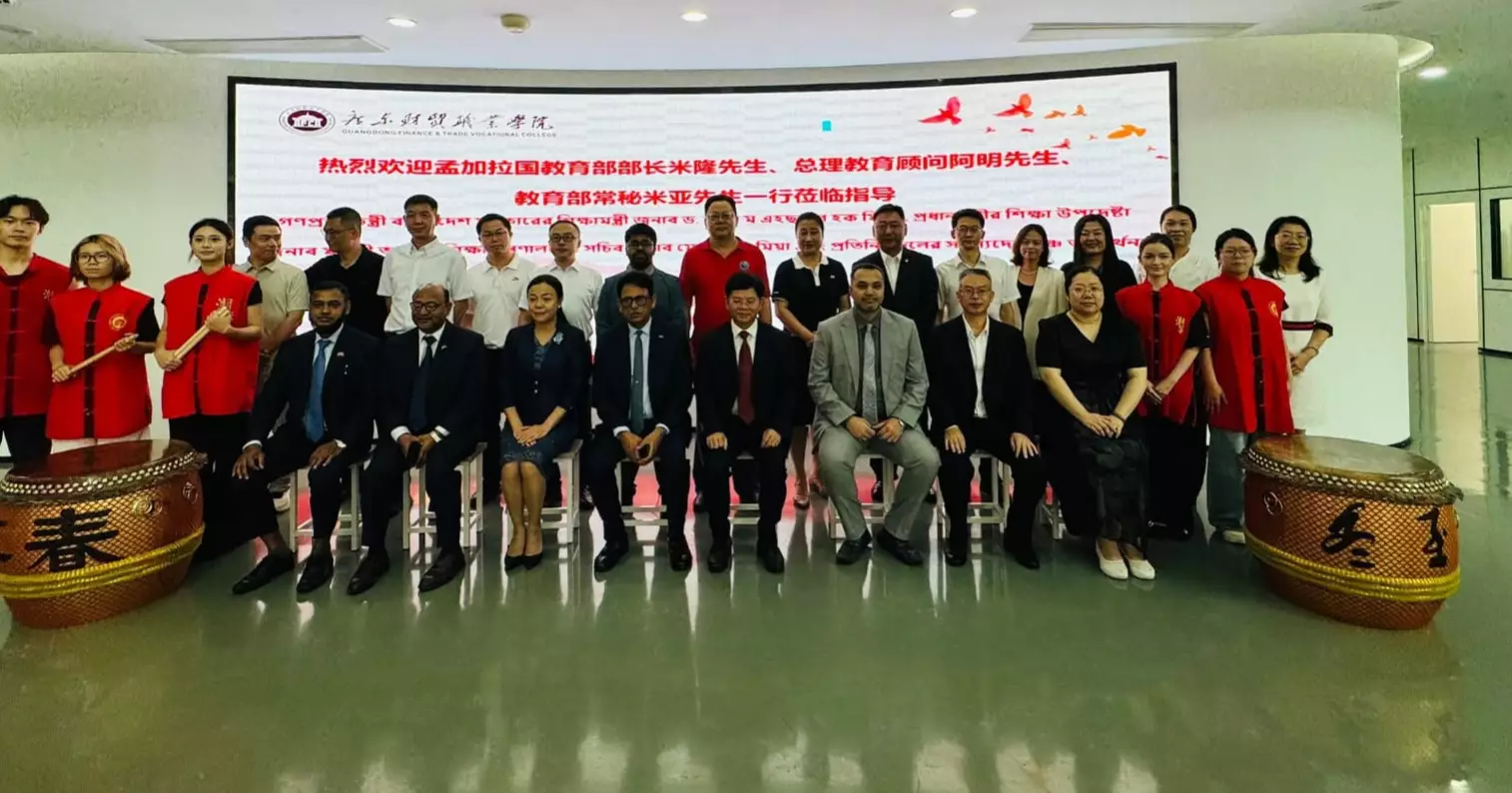
Education ties between Bangladesh and China will strengthen bilateral partnership while creating more employment and career opportunities, Prime Minister’s Education and Primary and Mass Education Adviser Mahdi Amin said Thursday.
“Our plan is to make technical and vocational education compulsory for all to connect theoretical classroom learning with the practical needs of the workplace,” he said.
Mahdi Amin made the remarks at a symposium titled “Technical Education Bridging and China-Bangladesh Economic-Trade Talent Development” held in Guangdong, China, Thursday morning.
He said the government under the visionary leadership of Prime Minister Tarique Rahman has made education its highest priority as part of its commitment to taking effective and visible steps to meet people’s expectations and implement its election manifesto.
He also said the government has taken effective steps to make third-language education compulsory, giving priority to Mandarin or Chinese, to help Bangladesh’s large young generation stay ahead in global trade and the international arena.
The symposium was organised to promote cooperation in technical education, technological training, skills development, and the integration of technology and industry with education.
The adviser said stronger bilateral educational exchanges, including teacher cooperation, student scholarships, curriculum development and institutional partnerships, could play an important role in deepening connectivity between Bangladesh and China.
Such cooperation could create employment opportunities, enhance skills and help build a more sustainable and mutually beneficial partnership between the two countries, he said.
Mahdi Amin stressed the importance of bilateral educational connectivity and direct cooperation with reputed Chinese educational institutions for sustainable transformation.
“Developing a skilled generation is essential to sustain the growing economic and trade partnership between Bangladesh and China,” he said.
He said the government’s key objective is to develop human resources proficient in international trade, cross-border e-commerce, supply chain management, financial technology and modern logistics.
“Our plan is to use the experience of reputed Chinese educational institutions to develop a modern and skilled generation capable of directly leading Bangladesh-China bilateral trade, investment and industrial sectors,” he said.
The adviser stressed strengthening institutional ties between teachers and researchers of the two countries.
He said regular faculty collaboration and exchange programmes could help Bangladeshi teachers enhance their capabilities by gaining exposure to China’s modern trade and technological expertise.
The government also plans to significantly increase scholarships and higher education opportunities for Bangladesh’s large young population at leading Chinese universities and technical institutions, he said.
Mahdi Amin said the government has specific plans to redesign technical curricula in line with the practical needs of China’s reputed educational institutions and modern industries, develop internationally recognised courses and ensure joint certification.
It also aims to establish direct institutional partnerships between Bangladeshi polytechnic and technical education institutions and leading Chinese industries and industry partners, he said.
He said the government wants to incorporate the practical needs of Chinese industries into curricula and establish a modern employment exchange network between the two countries.
The objective is to ensure that students can access internships, skills development and decent employment opportunities in domestic and international Chinese industrial zones immediately after completing their studies, he said.
He also outlined a long-term plan to establish modern laboratories and practical training workshops in Bangladesh in areas such as artificial intelligence, robotics, smart manufacturing and emerging technologies.
“Our goal is to build an inclusive education ecosystem where students will not be limited to competition for conventional professions. Instead, they should be able to develop the highest level of skills in the trades they are interested in,” Mahdi Amin said.
He said the government plans to ensure all necessary opportunities and facilities through joint initiatives so that Bangladesh’s large young generation does not face financial barriers in this transformation.
The adviser also called on Chinese industries and educational institutions to make joint investments to expand technical education and strengthen economic ties between the two countries.
He said the government’s ultimate goal is to develop a sustainable framework for future cooperation between Bangladeshi educational institutions and Chinese technical institutions and industry partners.
Under the framework, the government plans to identify specific partners and quickly launch joint projects, modern training and academic programmes, he said.
Mahdi Amin urged reputed Chinese industries and educational institutions to come to Bangladesh and invest in modern laboratories and skills development.
He expressed hope that new investment and educational cooperation with China would help transform Bangladesh’s large and promising young population into a world-class workforce.
Education Minister Dr ANM Ehsanul Haque Milon and Secretary of the Technical and Madrasa Education Division of the Ministry of Education Md Daud Mia were also part of the Bangladesh delegation.
Presidents and representatives of several reputed Chinese educational institutions, prominent teachers and researchers, students and leading Chinese industrial entrepreneurs attended the event.
The Education Minister said Bangladesh has a strong interest in learning from China’s experience in modernising technical education.
Bangladesh’s large young population represents enormous potential, and high-quality technical and vocational education can play a crucial role in turning this potential into a skilled and productive workforce, he said.
He called for greater cooperation between Bangladeshi and Chinese institutions in technical education, modern skills training, curriculum development, institutional partnerships and employment-oriented education.
One of the major highlights of the event was the launch of the Guangdong “Chinese + Vocational Skills” Industry-Education Integration Alliance to promote technical education globally.
The alliance has created a new platform for cooperation in technical education, language education, skills development and industry-education integration.