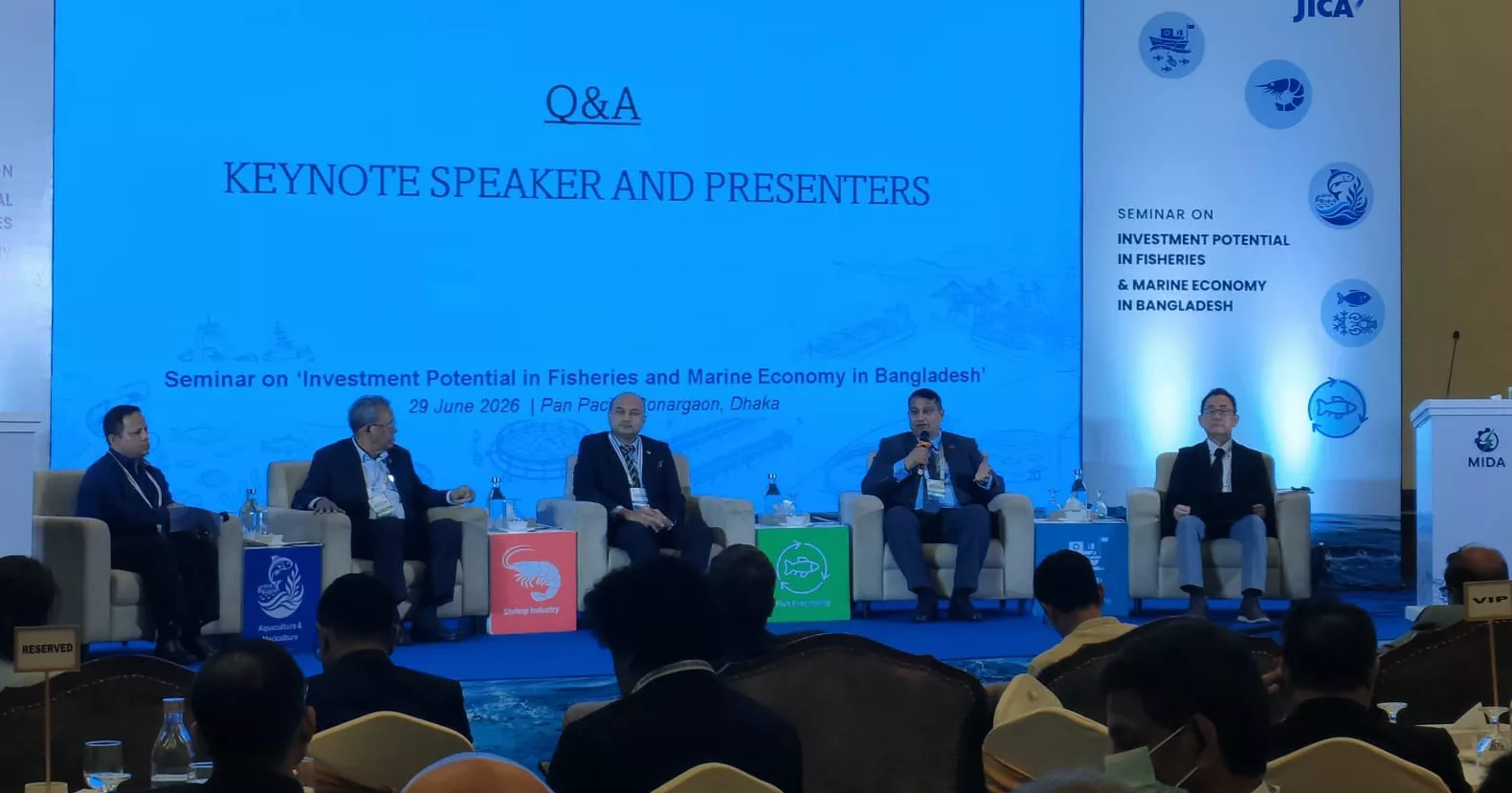
Executive Chairman of Bangladesh Investment Development Authority (BIDA) Chowdhury Ashik Mahmud Bin Harun on Monday said Bangladesh is prioritising foreign direct investment (FDI) and joint ventures to tap its massive, unutilised deep-sea marine resources centring on the Matarbari strategic business hub.
He made the remarks while addressing a seminar titled "Investment Potential in Fisheries and Marine Economy in Bangladesh" organised by the Moheshkhali Integrated Development Authority (MIDA) in cooperation with the Japan International Cooperation Agency (JICA) at a city hotel.
Due to a lack of industrial capacity, hundreds of kilometres in the country's deep-sea areas remain out of economic activity. In the absence of Bangladeshi entrepreneurs, neighbouring nations are harvesting valuable tuna and other high-value fish from the Bay of Bengal.
Speaking as the chief guest at the seminar, the BIDA executive chairman said as local entrepreneurs currently lack the capacity for deep-sea fishing, the government is prioritising foreign direct investment in collaboration with local businesses.
He revealed that a Japanese company has already applied for permission to conduct fishing and economic activities in these deep-sea zones, opening up immense opportunities to earn foreign currency through marine exports.
Minister at the Embassy of Japan in Dhaka Takahashi Naoki and Chief Representative of JICA Bangladesh Takahashi Junko made special remarks at the event.
Naoki emphasised that Japan, through JICA, is actively promoting public and private sector investments in Bangladesh's marine economy, including a flagship support programme at the Matarbari deep-sea port to assist the coastal fishing communities in Cox's Bazar.
Former Secretary of the Maritime Affairs Unit Rear Admiral (retd) Md Khurshed Alam noted that MIDA is a visionary government programme designed to transform Moheshkhali and Matarbari into a multi-dimensional business hub for energy, supply chains, aquaculture, seafood processing, mariculture, and deep-sea fishing.
The seminar highlighted four crucial sectors primed for scalable investment to unlock Bangladesh’s marine potential.
Deep-Sea Fishing
The country’s offshore waters contain vast fish resources, including commercial Yellowfin and Skipjack tuna. Capitalising on this requires deployment of industrial longliner fleets, deep-sea port facilities, and an enabling regulatory framework.
Mariculture and Seaweed
Bangladesh’s coastal ecology is highly suitable for commercial seaweed, finfish, and shellfish farming. Transitioning from traditional methods to scalable farming systems can target rapidly rising regional demand.
Aquaculture and Shrimp Industry
As the country's second-largest export commodity, the shrimp sector needs species diversification and strict certification compliance to successfully shift from volume-driven output to premium global markets.
Seafood Processing
To minimise value-chain gaps, major investment is required to establish modern processing plants, integrated cold chains, and preservation technologies that meet strict international market standards.
According to technical presentations, establishing a standard commercial fleet of 10 modern longliner vessels requires an estimated investment of Tk 150 crore per vessel, but yields a lucrative 37 percent net profit margin and a five-year payback period.
Sector visions project that deploying 25 to 50 vessels could generate millions of dollars annually in seafood exports by 2035.
Fisheries and Livestock Secretary Delwar Hossain stated that the ministry is fully committed to transforming the Matarbari corridor into a flourishing marine economy hub by establishing direct trade connections with premium global markets.
The seminar featured several specialised keynote presentations by JICA Fisheries Expert Dr Echigo Manabu, MIDA Member (Marine Affairs) Commodore Tanzim Faruq, ACI Agrolink Business Director Syed M Istiak and Department of Fisheries Researcher Dr Tanvir Hossain Chowdhury.