Bangladesh has sought stronger Korean investment in artificial intelligence (AI), infrastructure, advanced manufacturing and digital technologies, aiming to take bilateral economic cooperation beyond traditional concessional development financing.
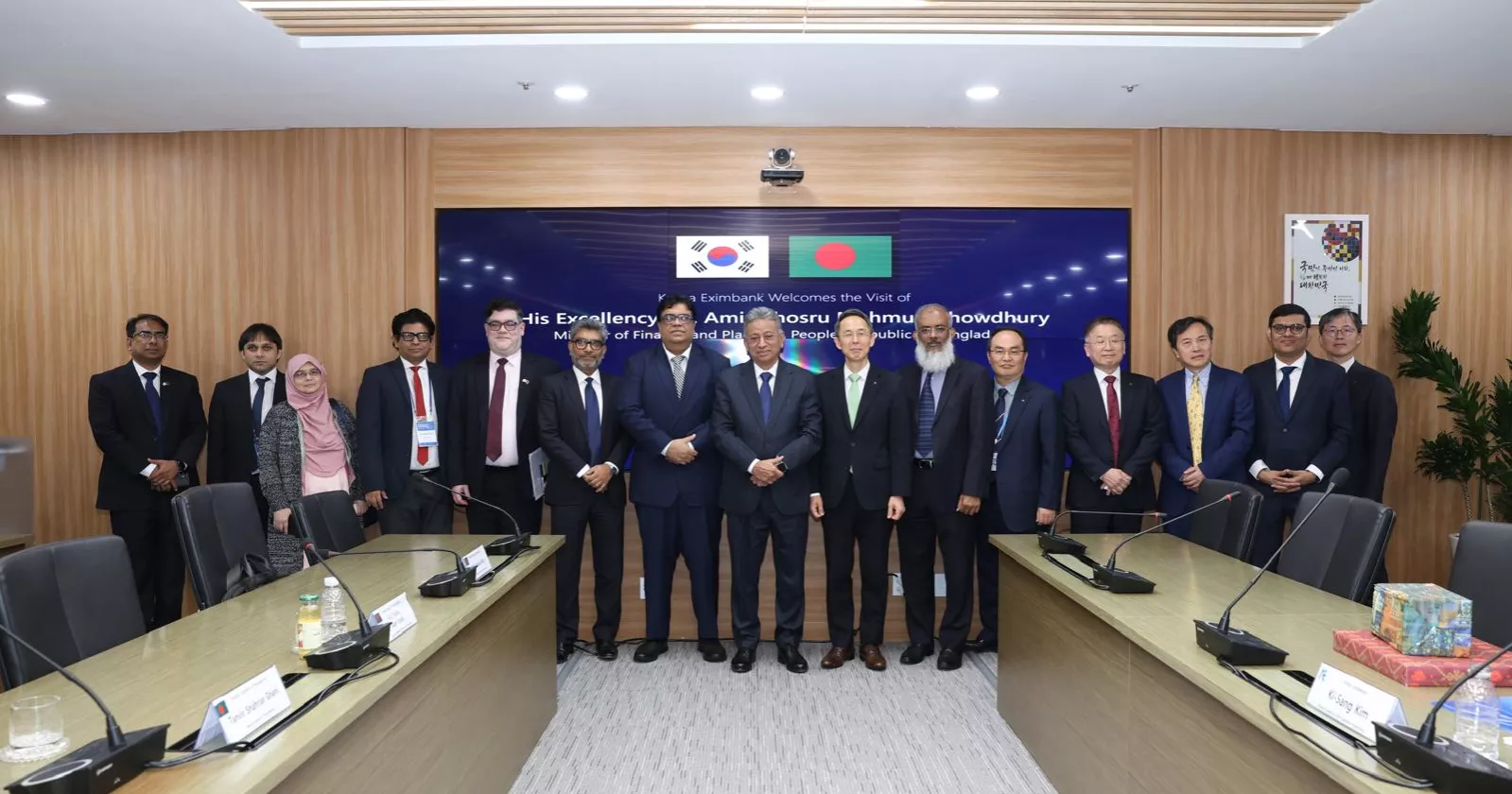
The issue was discussed during a series of meetings between a Bangladesh delegation, led by Finance and Planning Minister Amir Khosru Mahmud Chowdhury, and senior South Korean government officials, financial institutions, technology companies and business representatives in Seoul on Tuesday.
The discussions focused on mobilising Korean institutional capital, attracting private-sector investment, developing AI capabilities and accelerating priority infrastructure projects in Bangladesh, according to a press release issued from Finance Ministry on Wednesday.
At a meeting with Hwang Kiyeon, Chairman and CEO of the Export-Import Bank of Korea (KEXIM), the two sides reviewed the US$3 billion Economic Development Cooperation Fund (EDCF) Framework Arrangement for 2023–2027.
They discussed several priority projects including the southern route of Dhaka Metro Rail Line-5, the Matlab Uttar-Gazaria Bridge and the procurement of 260 broad-gauge passenger carriages.
KEXIM said EDCF priorities were under review and that project proposals would be considered in consultation with the relevant Korean authorities.
Bangladesh proposed a clear roadmap for utilising the remaining EDCF resources and sought cooperation in emerging areas such as AI, digital transformation, smart infrastructure and resilient supply chains.
In a separate meeting with Chang Huh, the second Vice Minister of South Korea’s Ministry of Finance and Economy, Amir Khosru called for elevating bilateral relations to a broader strategic level.
Bangladesh highlighted investment opportunities in advanced manufacturing, energy, shipbuilding and digital technologies.
The minister also encouraged South Korea to expand its engagement in the Asian Development Bank-supported Integrated Growth and Development (IGND) initiative, including its financing and implementation.
The Korean side expressed readiness to continue discussions on AI, digital transformation, alternative financing, future EDCF cooperation and wider participation in the initiative.
Mobilising Korean institutional investment was another key focus of the visit.
During discussions with the Korea Investment Corporation (KIC), the delegation explored investment opportunities in infrastructure, renewable energy and digital infrastructure.
The proposed Bangladesh Sovereign Fund, with a potential size of US$1–2 billion, was discussed as a possible investment vehicle.
The two sides also explored the possibility of combining KIC equity investment with KEXIM financing, including through Korean fund managers.
AI and digital transformation emerged as new areas of potential cooperation.
During discussions with LG AI Research, the delegation explored the development of a Bangladeshi large language model (LLM) suited to the country’s culture and languages, along with AI applications in education, healthcare, manufacturing and public services.
Bangladesh also outlined its ambition to develop as a regional AI and data centre hub.
Separate discussions with FuriosaAI focused on strengthening the country’s higher-value AI ecosystem, while KEXIM expressed interest in exploring infrastructure projects incorporating AI.
The delegation also held discussions with major Korean companies on investment in energy, liquefied natural gas (LNG), renewable energy, shipbuilding, advanced manufacturing and urban development.
At a meeting with Samsung C&T, Bangladesh explored potential cooperation in infrastructure, renewable energy, tourism and public-private partnership (PPP) projects, including rooftop and utility-scale solar power.
Samsung C&T expressed interest in expanding its engagement beyond engineering, procurement and construction (EPC) contracting towards long-term investment.
At an investment business roundtable organised by Youngone, Bangladesh highlighted opportunities in light engineering and component manufacturing, encouraging Korean companies to pursue joint ventures, technology transfer and the integration of Bangladeshi suppliers into Korean supply chains.
The discussions on the second working day of the official visit reflected Bangladesh’s efforts to attract more Korean private investment and technology partnerships alongside development financing.
Both sides agreed to continue consultations to translate the discussions into concrete projects and investment partnerships.