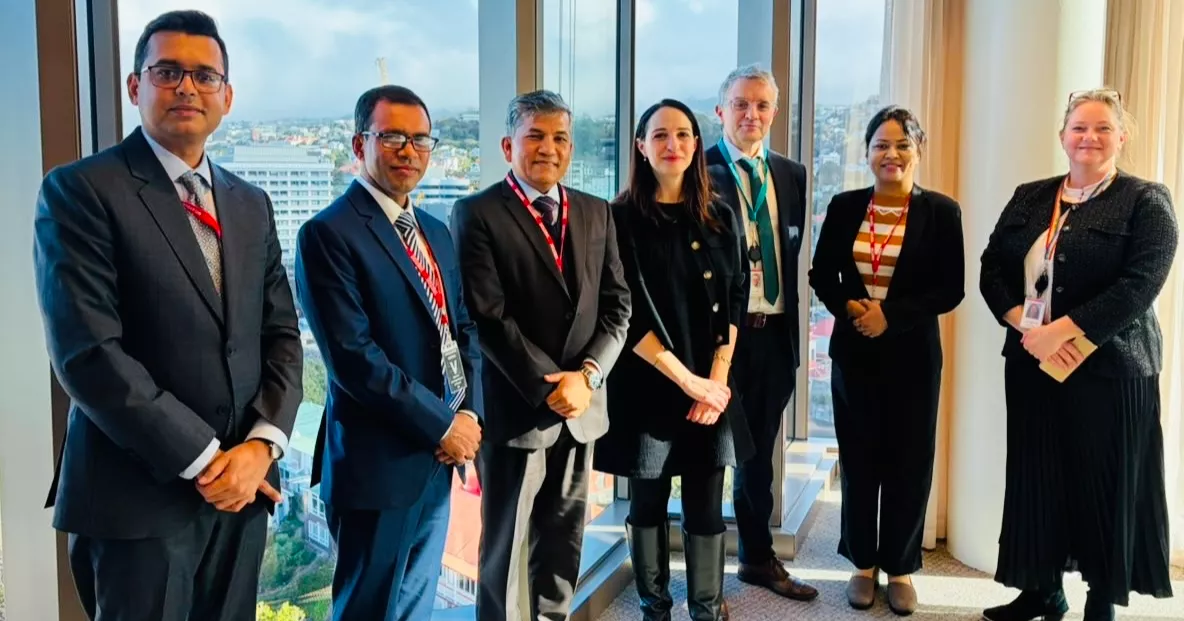
Bangladesh has sought New Zealand's active support for its membership in the Regional Comprehensive Economic Partnership (RCEP), a three-year extension of its LDC graduation preparation period until November 2029 and the signing of a comprehensive bilateral free trade agreement (FTA).
The proposals were made at a high-level policy meeting held at the headquarters of New Zealand's Ministry of Foreign Affairs and Trade (MFAT) in Wellington on Tuesday, as Bangladesh seeks to strengthen and diversify its trade and diplomatic relations with New Zealand, according to the Ministry of Commerce.
The New Zealand delegation was led by Sarah Meymand, divisional manager of the Trade Negotiations and Policy Division, and Jonas Holland, unit manager.
The Bangladesh delegation was led by Commerce Secretary Md Ataur Rahman Khan and included officials concerned with the Foreign Trade Agreement (FTA) Wing and Counselor of the Bangladesh High Commission in Wellington Ishtiaque Ahmed.
The delegation presented a specific roadmap for transforming the existing commercial ties between the two countries into a more effective and long-term partnership.
Bangladesh sought New Zealand's support for joining the RCEP, saying it has submitted the required questionnaire and is pursuing reforms to meet the agreement's trade standards.
The reforms include reducing tariffs on industrial raw materials and high-tech machinery, opening telecommunications, financial and logistics sectors, and modernizing laws on competition, patents, copyrights and data protection.
Bangladesh also proposed 15-20 years of phased tariff flexibility for sensitive products and industries, similar to provisions for ASEAN's LDC members.
The Bangladesh delegation also explained the need for additional time in its LDC graduation process.
Bangladesh has applied to the UN General Assembly to extend its graduation preparation period until November 2029 instead of the currently scheduled 2026 timeline. The delegation sought New Zealand's support for the request, citing both global and domestic circumstances.
It said the Russia-Ukraine war, ongoing conflicts in the Middle East, rising global energy prices and inflation have placed considerable pressure on developing economies and countries undergoing the graduation process.
Bangladesh-ASEAN partnership poised for stronger cooperation: Envoy
Bangladesh also highlighted its ongoing socioeconomic transformation following the 2024 student-led mass uprising, efforts to stabilize foreign exchange reserves and the need for administrative and institutional reforms.
The possibility of signing a comprehensive bilateral FTA between Bangladesh and New Zealand also received significant attention during the meeting.
Bangladesh informed the meeting of its decision to formally initiate FTA negotiations, following discussions between the commerce ministers of the two countries ahead of the World Trade Organization's 14th Ministerial Conference (MC14).
Bangladesh said an FTA could provide New Zealand with greater access to Bangladesh's market of nearly 170 million people, particularly for dairy products, agricultural machinery and metal products.
Bangladesh proposed three measures to strengthen future trade cooperation: establishing an annual Bilateral Trade Policy Consultative Group to review post-LDC market access and RCEP interests; forming a joint working group to initiate FTA negotiations; and enhancing diplomatic coordination in New York to secure New Zealand’s support for Bangladesh’s request for additional time for LDC graduation.
The Bangladesh delegation also invited a New Zealand policy-level delegation to visit Bangladesh soon. New Zealand authorities responded positively to the invitation.