Bangladesh has sought policy and technical support from the World Bank to simplify business operations, move government services fully online and build new export sectors beyond readymade garments (RMG).
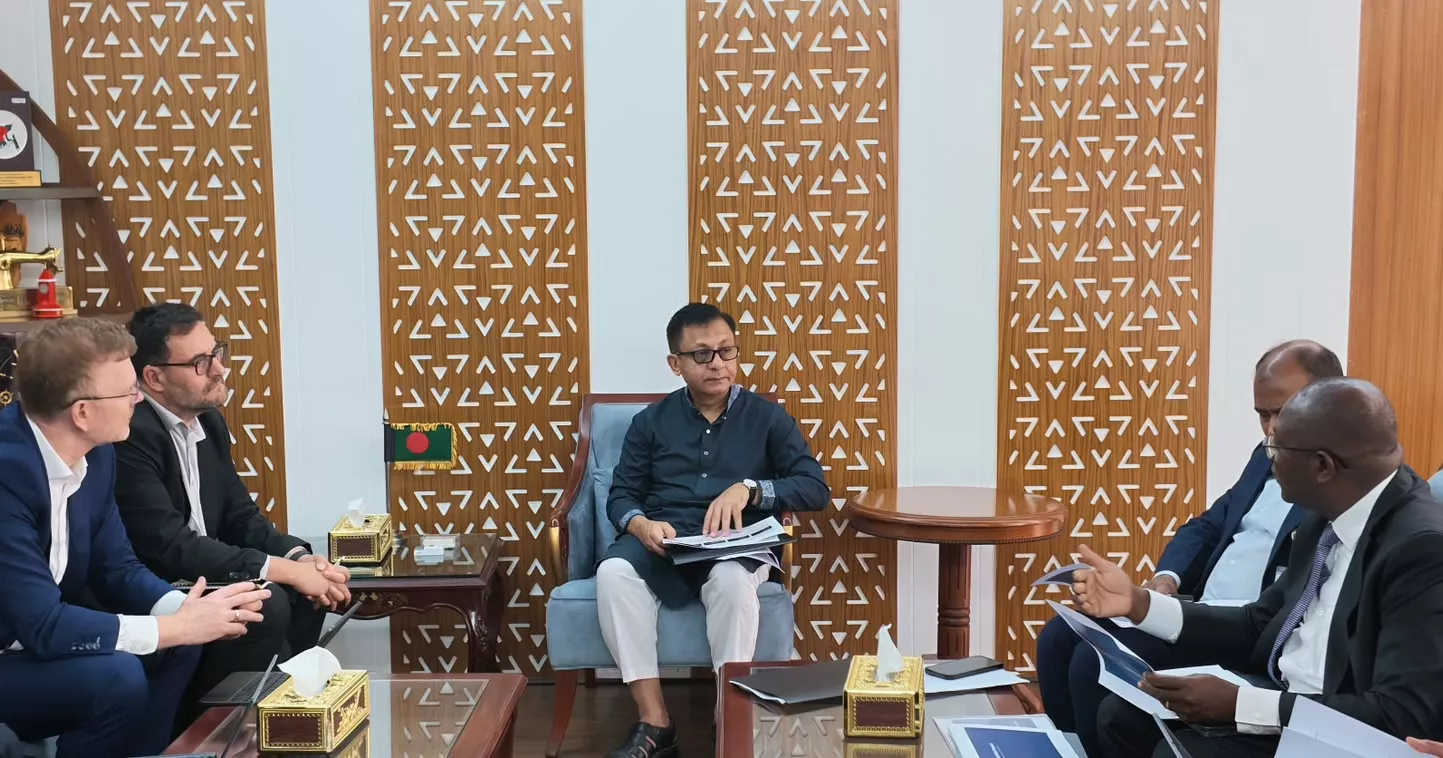
Commerce Minister Khandakar Abdul Muktadir sought the cooperation on Tuesday morning during a meeting at the Commerce Ministry with an eight-member World Bank delegation led by Jean Pesme, Division Director for Bangladesh and Bhutan.
The minister said a specific three-year action plan is being drawn up ahead of Bangladesh's graduation from the least developed country (LDC) category.
“Under the plan, citizen and business services of different ministries and government offices will be delivered online through Invest Bangladesh's one-stop service, the National Single Window portal,” he said.
"Currently, businesspeople have to visit multiple offices to obtain trade licences, environmental and fire safety clearances and import registration certificates (IRCs), he said. The government aims to remove these delays through digitalisation and complete the entire process within 14 days," he added.
Terming export diversification one of the economy's top priorities, the minister said special emphasis is being given to leather and leather goods, non-leather footwear, shipbuilding, ship recycling and light engineering, alongside RMG.
He also spoke of plans to set up a new central effluent treatment plant (CETP) at the Savar Leather Industrial City to ensure environmental standards and international compliance, and to obtain Leather Working Group (LWG) certification.
He added that the government is determined to bring the gold industry out of the informal sector and into an institutional framework, aiming to turn it into an export-ready jewellery industry within the next few years.
To expand Bangladesh's participation in global trade, the minister said talks on economic partnerships and free trade agreements are moving forward.
"Negotiations are underway on economic partnership agreements (EPAs) with Japan and South Korea, and on free trade agreements (FTAs) with the United Arab Emirates, Malaysia, Singapore and the European Union. In-principle approval has also been secured for Bangladesh to join the Regional Comprehensive Economic Partnership (RCEP)," the minister said.
Moreover, steps have been taken to prevent duplication and lack of coordination among ministries' projects under the Annual Development Programme (ADP) and to build the skills of project directors, he added.
As part of this, the minister informed the delegation of a plan to turn the Bangladesh Foreign Trade Institute into a specialised institution.
At the meeting, Jean Pesme assured policy and technical support in trade facilitation, implementation of the National Single Window, skills development in the leather and light engineering sectors, and FTA-related research.
He said the World Bank Group and the International Finance Corporation (IFC) are keen to work jointly to strengthen the capacity of Bangladesh's private sector and manufacturers.
Alongside structural economic reforms, he stressed financing and technical capacity building for agro-processing and high-value-added manufacturing.
Sebastian Eckardt, the World Bank's Regional Practice Director for Prosperity, said the next three to four years will be critical for Bangladesh ahead of LDC graduation.
If the country makes good use of this period to reform trade policy, remove tariff and non-tariff barriers and integrate into global value chains, it will see significant growth in foreign direct investment (FDI) and employment, he said.
He added that the World Bank is ready to provide training and the necessary technical assistance to strengthen the negotiating capacity of Bangladeshi officials in FTA talks.
Citing recent research, World Bank Lead Economist Souleymane Coulibaly said reforming the para-tariff structure could play an important role in improving the efficiency of the economy and export competitiveness.
He also said that, drawing on Vietnam's experience, trade reforms and better logistics infrastructure would significantly increase Bangladesh's actual export earnings and employment.