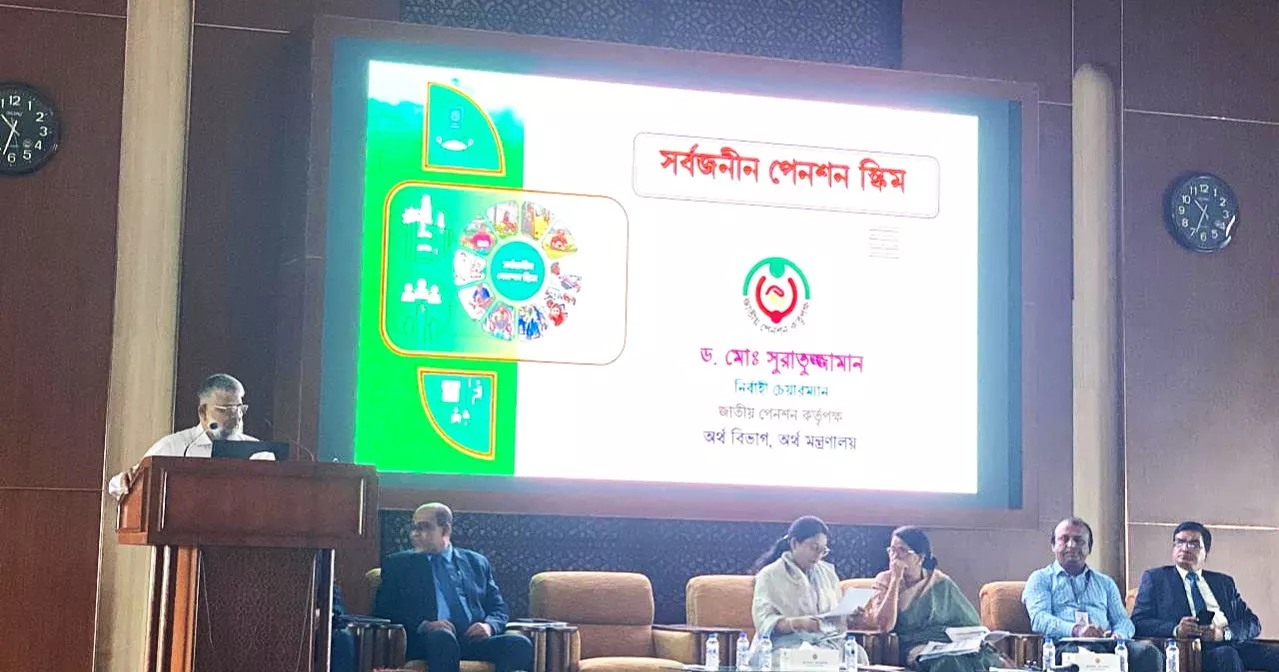
The government has urged scheduled banks to take necessary measures to bring their officers and employees under the “Progoti Scheme” of the Universal Pension Scheme as part of efforts to expand pension coverage among private-sector workers.
The call came at a review meeting held at the Ministry of Finance’s Multipurpose Hall at the Bangladesh Secretariat on Wednesday to accelerate participation of bank employees in the pension scheme.
The meeting was chaired by Nazma Mobarek, Secretary of the Financial Institutions Division, and attended by representatives of Bangladesh Bank and managing directors of all scheduled banks.
Presenting the keynote paper, Dr Md Suratul Jaman, Executive Chairman of the National Pension Authority, highlighted the progress of the Universal Pension Scheme, the features of the Progoti Scheme and its significance for private-sector employees.
He noted that a large proportion of the country’s approximately 18 million registered workers and employees in the private sector remain outside any form of post-retirement financial security. While government employees are covered by state pension arrangements, no comparable institutional mechanism exists for most private-sector workers.
To address this gap, the Progoti Scheme, introduced under the Universal Pension Scheme in 2023, has emerged as an effective and sustainable solution for private-sector employees, he said.
The meeting was informed of several initiatives aimed at making the scheme more attractive, including the introduction of a Shariah-based pension scheme, consideration of lifetime pension benefits for nominees and the inclusion of outsourced employees under the Progoti Scheme.
According to the presentation, the Universal Pension Scheme represents a landmark step towards providing organised retirement benefits for employees in the country’s large private sector.
The initiative also aligns with the government’s 2026 election manifesto commitment to establish a pension fund ensuring financial security for private-sector workers in old age.
Under the Progoti Scheme, designed specifically for owners and employees of private organisations, both employers and employees contribute equally, with each paying 50 percent of the monthly subscription.
Subscribers can contribute between Tk1,000 and Tk15,000 per month and receive a lifelong monthly pension after retirement. Contributions are eligible for income tax rebates, while pension income is exempt from tax. Pensioners will also be entitled to withdraw up to 30 percent of their accumulated corpus as a lump-sum gratuity after reaching the age of 60. Investments under the scheme carry a state guarantee.
The meeting was informed that, as of May 30, 2026, a total of 377,930 people had registered under the four pension schemes, with total deposits approaching Tk260 crore. Total investments have reached Tk286 crore.
Officials also said the National Pension Authority has signed memorandums of understanding with 48 banks and financial institutions, while 24 banks are actively receiving and processing pension contributions.
The meeting unanimously decided that Bangladesh Bank representatives and managing directors of all scheduled banks would take the necessary steps to enrol their officers and employees in the Progoti Scheme.
Participants were also reminded of the government’s target to bring at least one member from each of the country’s nearly 40 million families under one of the pension schemes by 2030, with bankers expected to play a key role in achieving the goal.
In her concluding remarks, Secretary Nazma Mobarek directed bank managing directors to establish dedicated pension service desks and display promotional banners at all branches in line with existing agreements with the National Pension Authority.
She also instructed banks to incorporate promotion of the Universal Pension Scheme into their regular marketing activities and take initiatives to bring all employees of private banks under the Progoti Scheme.
The meeting was moderated by Ayesha Haque, Assistant General Manager of the National Pension Authority.