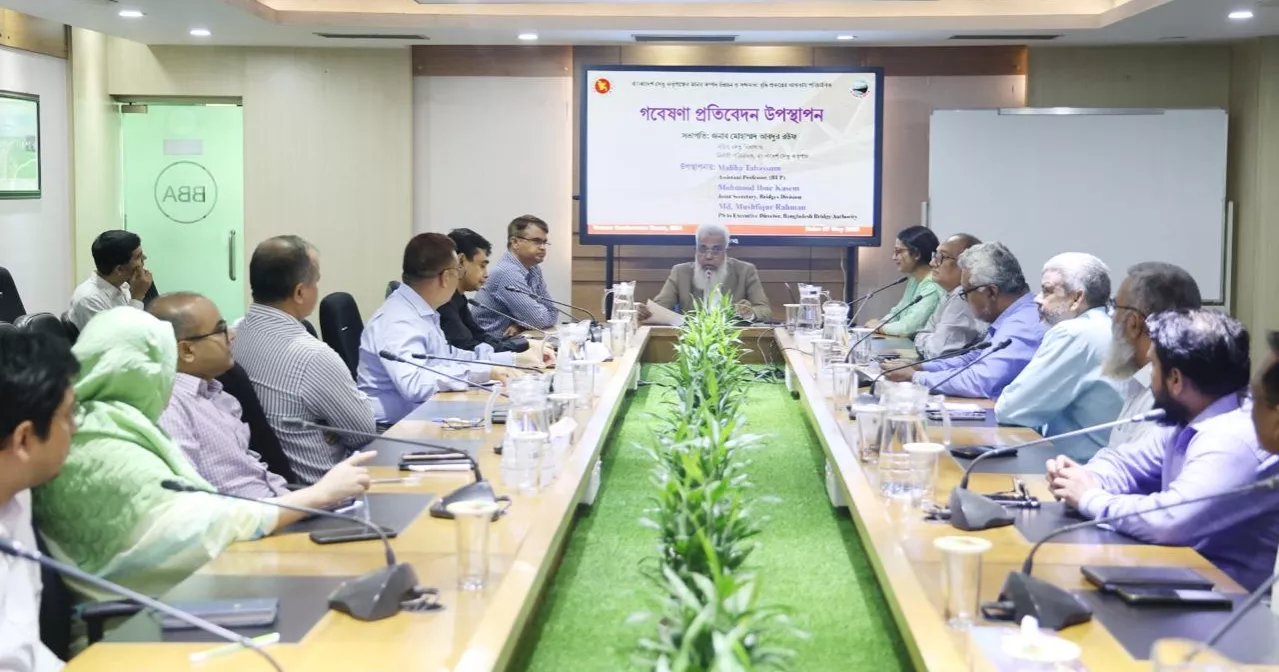
Bangladesh Bridge Authority (BBA) on Thursday presented three research papers aimed at accelerating the rollout of Electronic Toll Collection (ETC) systems across its installations as part of broader efforts to make toll management cashless, faster, and more transparent.
The presentations were held under BBA's Human Resource Development and Capacity Building Project, with BBA Executive Director and Bridges Division Secretary Mohammad Abdur Rouf in the chair.
Dispute over toll collection halts bus services across Chapainawabganj routes
As part of building a self-reliant Bangladesh, we are committed to ensuring cashless and automated toll systems at all BBA installations at the earliest possible time, Rouf said. “The findings of today's research will serve as a roadmap for our future planning and help us address existing challenges.”
He added that the recommendations would be reviewed and swiftly moved to field-level implementation, so that commuters can pay tolls seamlessly without any interruption.
The first paper, titled “Developing an Effective Communication Protocol for Emergency and Traffic Disruptions in Bridge and Toll Operations,” was presented by Maliha Tabassum, Assistant Professor of Mass Communication and Journalism at Bangladesh University of Professionals (BUP).
The study identified critical communication gaps in current bridge and toll operations and recommended several structural reforms, including posting a dedicated communication officer at each bridge, adding a live traffic tab to BBA's website for real-time updates on fog or accident-related disruptions, and simplifying the ETC registration process from five steps to two, with registration available both at toll plazas and online, eliminating the need for users to visit the Mawa office in person.
The second paper, “Adoption of Electronic Toll Management of Padma Bridge: A Study Based on the Stakeholders' Perspective for Implementation,” was presented by Bridges Division Joint Secretary Mahmood Ibne Kasem.
The research captured the views and challenges of users, drivers, and other stakeholders regarding the full rollout of ETC at the Padma Bridge.
It recommended establishing an integrated data-sharing system among BRTA, mobile financial service (MFS) providers, and BBA to enable automatic vehicle verification and payment processing.
The study also called for broad awareness campaigns on ETC benefits, digital literacy support for users, and targeted training for marginal-level drivers and transport owners. It further urged ensuring the accuracy of RFID readers and sensors at toll plazas to prevent technical faults from worsening traffic congestion.
The third paper, “Efficiency of MFS-Based Electronic Toll Collection (ETC) System as a Part of Toll Management in Bangladesh: Case Studies,” was presented by Md Mushfiqur Rahman, Personal Secretary to BBA's Executive Director.
The study explored the current state and future potential of MFS-based toll collection through case studies on popular mobile banking platforms.
It recommended direct integration between MFS wallets and the ETC system to enable real-time balance checking and automatic toll deduction with low-balance notifications.
The research also called for regular training of toll operators on digital systems and, as a long-term goal, the introduction of a multi-lane free-flow system, where vehicles would not need to stop at toll plazas, with tolls collected automatically through sensors while vehicles remain in motion.
Senior officials of the Bridges Division and BBA attended the event in person, while field office officers joined via Zoom.