
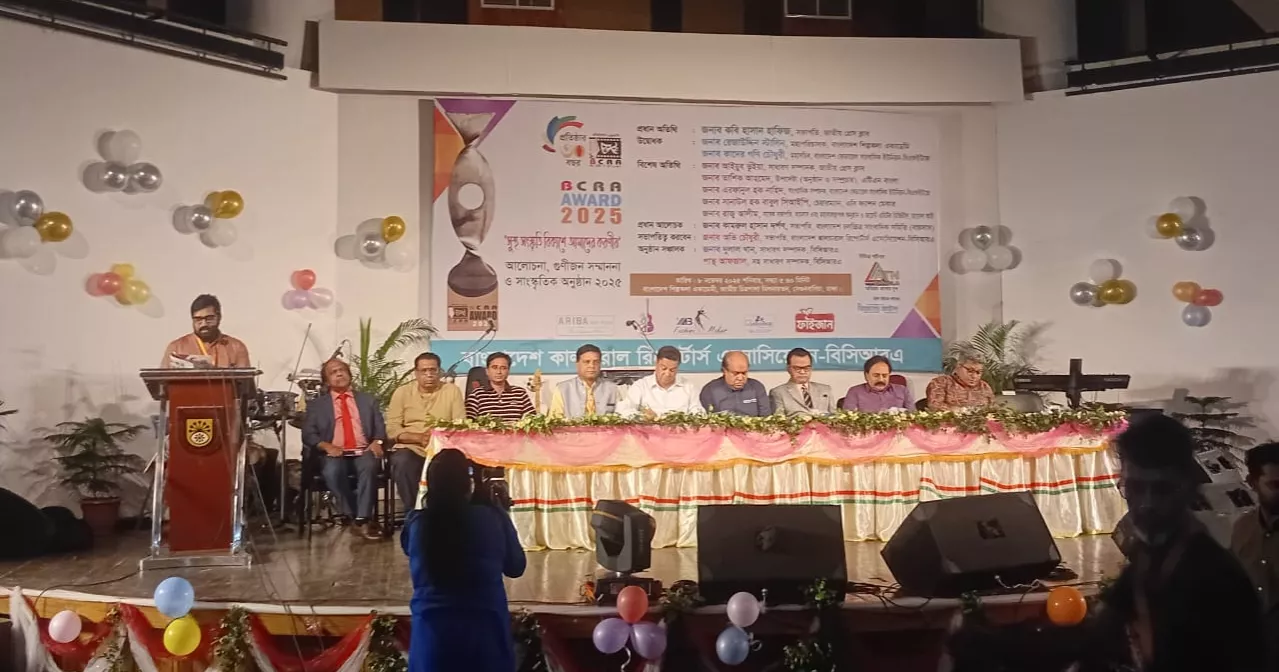
Secretary General of the Bangladesh Federal Union of Journalists (BFUJ) Kader Gani Chowdhury on Saturday said that subculture is strangling national values and driving the youth towards destruction.
“Young people are being drawn to subculture because it offers glamour, excitement, and momentary pleasure — it has an allure,” he said. “But we must remember, the future of any nation lies in its youth.”
He added, “Subculture alienates people from love for their mother, their land, and their country. Its glitter is like a mirage — dazzling but hollow — turning people into beings devoid of conscience.”
Kader Gani made these remarks while inaugurating the 30th anniversary celebration of the Bangladesh Cultural Reporters Association (BCURA) at the National Art Gallery Auditorium of the Bangladesh Shilpakala Academy.
The event was presided over by BCURA President Abhi Chowdhury with Hasan Hafiz, President of the National Press Club and Editor of Kaler Kantho, as the chief guest.
Among others who spoke were Poet Rezauddin Stalin, Director General of the Shilpakala Academy; world-renowned magician Jewel Aich; Tashik Ahmed, Ziaul Kabir Suman, Erfanul Haque Nahid, Raju Alim, Kamrul Hasan Darpan, and Rimon Mahfuz. The programme was conducted by secretary generalbof the AssociationnDulal Khan.
Kader Gani warned that the country’s youth, if trapped by the venom of subculture, will push the nation’s future into darkness.
“Culture shows the path of beauty, while subculture leads to ugliness and darkness. Subculture strangles national values and knocks at the door of conscience,” he said.
He blamed flashy Western influencesbfor eroding the roots of Bangladesh’s age-old cultural heritage:
“We are losing our cultural uniqueness and drifting toward spiritual poverty. In this era of globalization, cultural aggression is inevitable — consumerism turns every cultural element into a commodity. Foreign films and songs will appear on social media, but that doesn’t mean we should close our eyes and ears.”
To protect native culture, he emphasized strengthening rural traditions while ensuring modern amenities for villages.
“We must not confine villagers to the digital cages of city living. Let’s restore open green fields, rivers, canals, and boat races. Folk dance, jari, sari, baul, murshidi, bhatiali, bhawaiya, and songs of Lalon, Nazrul, Tagore, and Hasan Raja must not be allowed to disappear.”
He urged turning children away from the blinding rays of mobile screens and helping them rediscover the moonlit nights, autumn skies, and the magic of rural art and music.
On the link between education and culture, he said, “Education and culture go hand in hand. They complement each other. To build an enlightened generation, we must nurture a healthy cultural environment. Remember, one of the best ways to resist evil forces is through cultural practice.”
Kader Gani further stated, “If the education we receive doesn’t teach us to love our country, to make life more humane and compassionate, then it is miseducation. And from miseducation, subculture takes root.”
He recalled how Bangladesh’s cultural backbone has faced attacks time and again — from attempts to impose Urdu as a national language by Jinnah to efforts by past governments to suppress free speech — but the people have always resisted.
“Language and freedom of expression can never be taken from us. Culture has its own strength — we saw that in 1952, 1969, 1970, 1971, 1990, and even in 2024. Why are we forgetting that heritage?”
He lamented that many young people today are forgetting the Bengali language and culture. “Through this contradictory cultural practice, can we really progress far? One day we must seek our roots — because culture is the mirror of life. It must be lived, practiced, and nurtured constantly. Words alone won’t sustain it — we must embody it in our actions.”