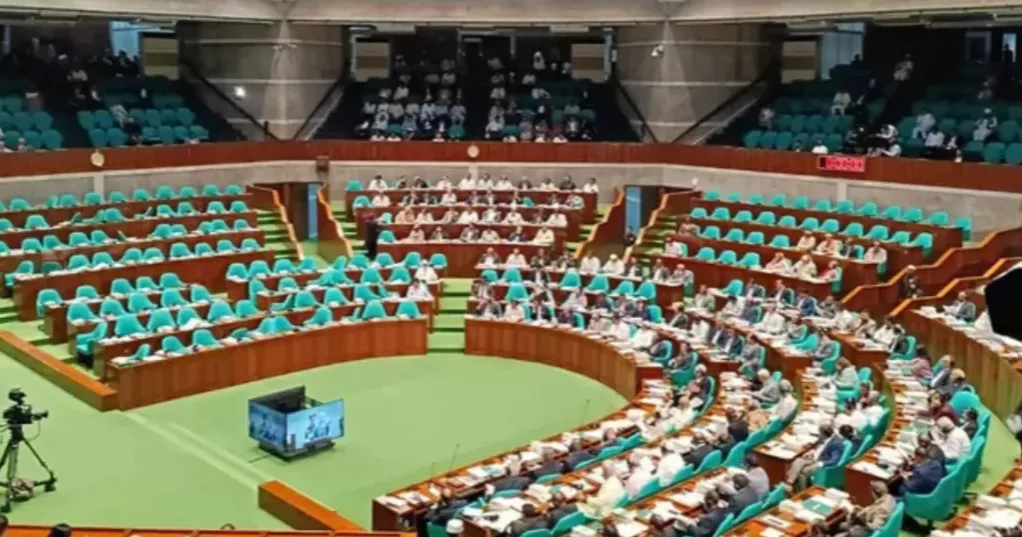
The Special Solar Power Installation Bill, 2026 was placed in Parliament on Tuesday, seeking to expedite the expansion of solar power installations across the country through special procurement and implementation arrangements.
Power, Energy and Mineral Resources Minister Iqbal Hassan Mahmood placed the bill, which was sent to the parliamentary standing committee concerned for scrutiny and submission of a report within three working days.
The bill seeks to replace the Special Solar Power Installation Ordinance, 2026, promulgated on October 19.
The ordinance was placed before Parliament on Monday before the government moved to enact it into law.
Under the proposed law, special solar power systems will be installed at suitable locations on a priority basis under the OPEX (Operational Expenditure) model.
Institutions with their own funds or regular income will also be allowed to install solar power systems under the CAPEX (Capital Expenditure) model, considering their future financial viability.
A tripartite agreement will have to be signed among the consumer, service provider and competent authority for the installation and operation of such systems.
The bill also proposes special procurement arrangements. Under the CAPEX model, the financial ceiling for purchasing goods and related services through a limited tendering method will be Tk 5 crore.
It also states that the use of the Electronic Government Procurement (e-GP) system will not be mandatory for the relevant procurement processes, aiming to speed up the implementation of solar power projects.
A National Policy Council will be formed to provide policy guidance for the programme, while district-level technical and coordination committees will oversee activities at the local level.
The proposed law stipulates a maximum of three years’ imprisonment, a fine of Tk 50,000, or both for stealing electricity generated by a special solar power system or any of its components.
In his statement explaining the objectives and reasons for the bill, the power minister said the government had formulated the National Renewable Energy Development Strategy Paper 2026-2030 to meet rising electricity demand, reduce dependence on imported fossil fuels, ensure energy security and achieve national renewable energy targets.
He said the government had also announced incentives for purchasing surplus electricity supplied to the national grid from rooftop solar systems by February 28 next year.
Hassan Mahmood said existing laws and regulations did not provide adequate scope for installing solar power systems on rooftops, courtyards and other suitable spaces of government, semi-government, autonomous and local government institutions, state-owned companies and residential buildings.
The ordinance introduced provisions for installing solar systems under OPEX and CAPEX models, selecting service providers, signing tripartite agreements, adopting special procurement procedures, providing net-metering incentives and establishing national and local-level coordination and monitoring mechanisms, he said.
The minister said the ordinance needed to be converted into an act in line with constitutional requirements to ensure the rapid and sustainable expansion of solar power in the country.
Opposition questions ordinance
Before the bill was placed, opposition MP Muhammad Nazibur Rahman raised an objection, questioning the government’s decision to promulgate the ordinance when Parliament was functional.
He said issuing an ordinance while bypassing Parliament amounted to a serious violation of the legislature’s sovereignty in lawmaking and demanded a clear explanation from the law minister and the relevant ministries.
Referring to the timeline mentioned in the bill’s statement of objectives and reasons, Nazibur said the National Renewable Energy Strategy Paper for 2026-2030 was issued in July, followed by incentives for rooftop solar power on September 1.
Parliament was in session at the time, and its session ended on September 10. The ordinance was subsequently promulgated on October 19, he said.
The opposition lawmaker questioned why the government had bypassed Parliament and its Standing Committee on the Ministry of Law, Justice and Parliamentary Affairs despite having an effective legislature.
In response, Law, Justice and Parliamentary Affairs Minister Md Asaduzzaman described Nazibur’s explanation as misleading.
He said the President’s satisfaction in promulgating an ordinance when Parliament was not in session rested on the President’s own judgement and could not be challenged in court.
“Parliament is sovereign in making laws. The President cannot interfere in the process through which Parliament exercises its sovereignty. But under Article 93(1), Parliament has no authority to question the President’s satisfaction,” the minister said.
Following the exchange, Hassan Mahmood explained the reasons for bringing the bill.
Deputy Speaker Barrister Kayser Kamal then put the motion seeking permission to introduce the bill to a voice vote. The motion was passed, allowing the minister to formally place the Special Solar Power Installation Bill, 2026, before the House.