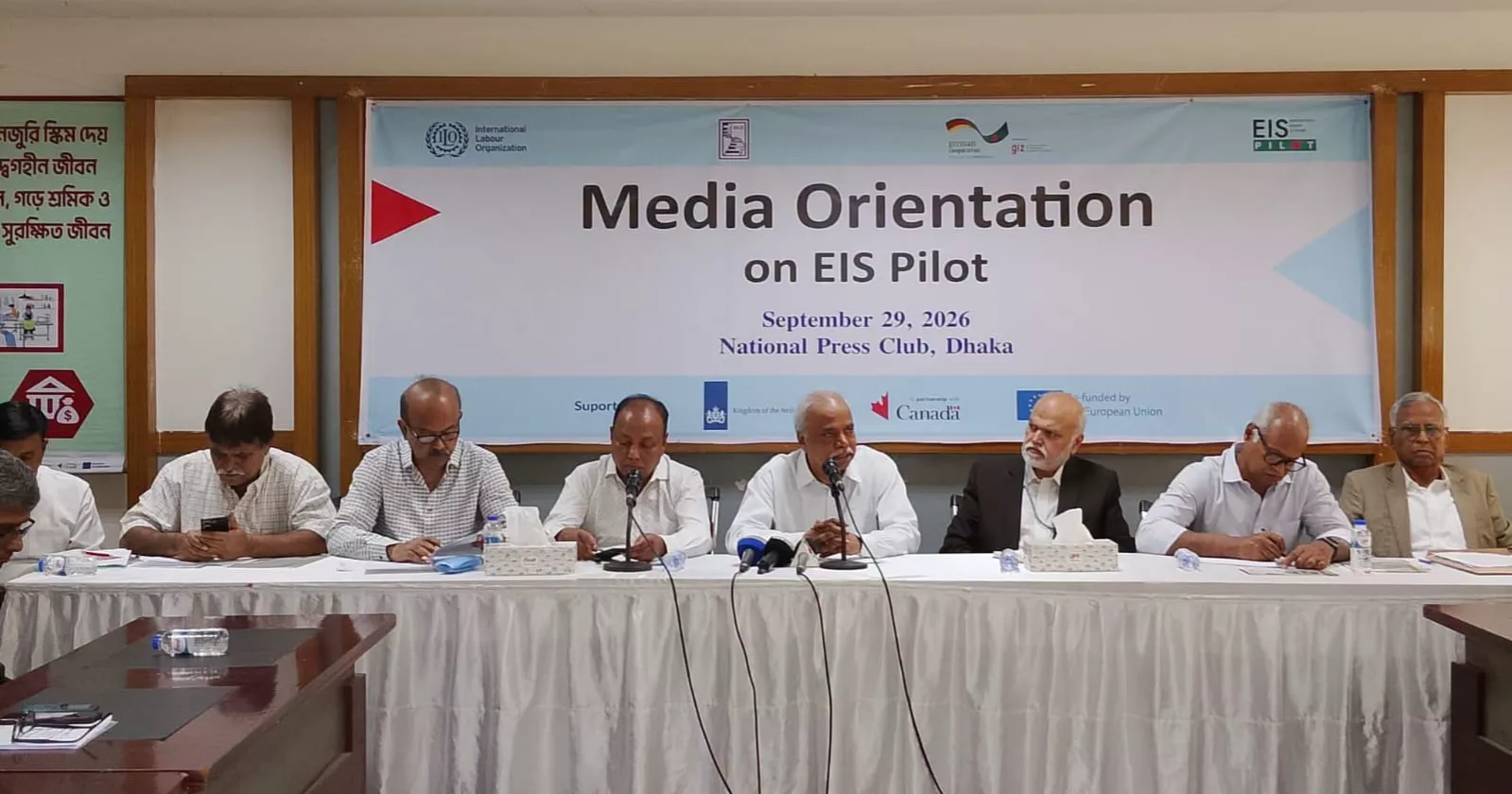
The Bangladesh Institute of Labour Studies (BILS) on Tuesday called for introducing a universal Employment Injury Scheme (EIS) for workers in all sectors, including the informal sector, to ensure long-term financial security for workers and their families in the event of workplace accidents.
The labour rights organisation also urged the government to enact the necessary laws and regulations to extend the scheme nationwide after the completion of its ongoing pilot project in the RMG sector in 2027.
At a press conference held at the Jatiya Press Club, BILS representatives said one-time
compensation was not enough to protect families who lose their breadwinners or whose earning members become disabled in workplace accidents.
They stressed the need for a sustainable compensation system that would provide regular financial support to affected families, helping them avoid poverty and economic hardship.
BILS said the existing EIS model in the garment sector, operated through a tripartite mechanism involving workers, employers and the government, could be extended to other industries after proper evaluation and necessary improvements.
The organisation also called for determining compensation in line with the International Labour Organisation's (ILO) Convention 121, arguing that affected workers and their families needed long-term financial protection rather than a one-time payment.
Presenting its recommendations, BILS urged the government to extend the EIS to workers in all sectors, bring informal-sector workers under its coverage and introduce a legal framework to make the scheme universal after the pilot project ends.
It cited the Rana Plaza Claims Administration, the Accord and the EIS as examples of initiatives involving tripartite participation, saying Bangladesh could share its experience with other countries.
BILS also presented its findings on workplace accidents during the first six months of 2026, based on newspaper reports.
According to the findings, 159 workers were killed and 12 injured in the transport sector, the highest number of casualties among the sectors covered by the survey.
The organisation, however, cautioned that the figures, compiled from available newspaper reports, were not comprehensive and the actual number of casualties could be much higher.
BILS said around 85 percent of Bangladesh's workforce was employed in the informal sector, making universal social protection particularly important for workers outside formal employment.
It also highlighted the need to address gaps in the country's social protection system, including the exclusion of vulnerable people, inadequate benefits and limited coverage of urban poverty.
Referring to the Labour Reform Commission's 2025 report, BILS said workers needed social protection against workplace accidents, death, disability, illness, retirement and maternity-related risks.
The organisation also called for implementing the government's Strategic Framework for National Social Security Strategy 2026–2030 and removing existing barriers to expanding social protection.
BILS urged the media to play a proactive role in raising awareness and building public support for a universal social protection system to ensure workers' rights, safety and dignity.