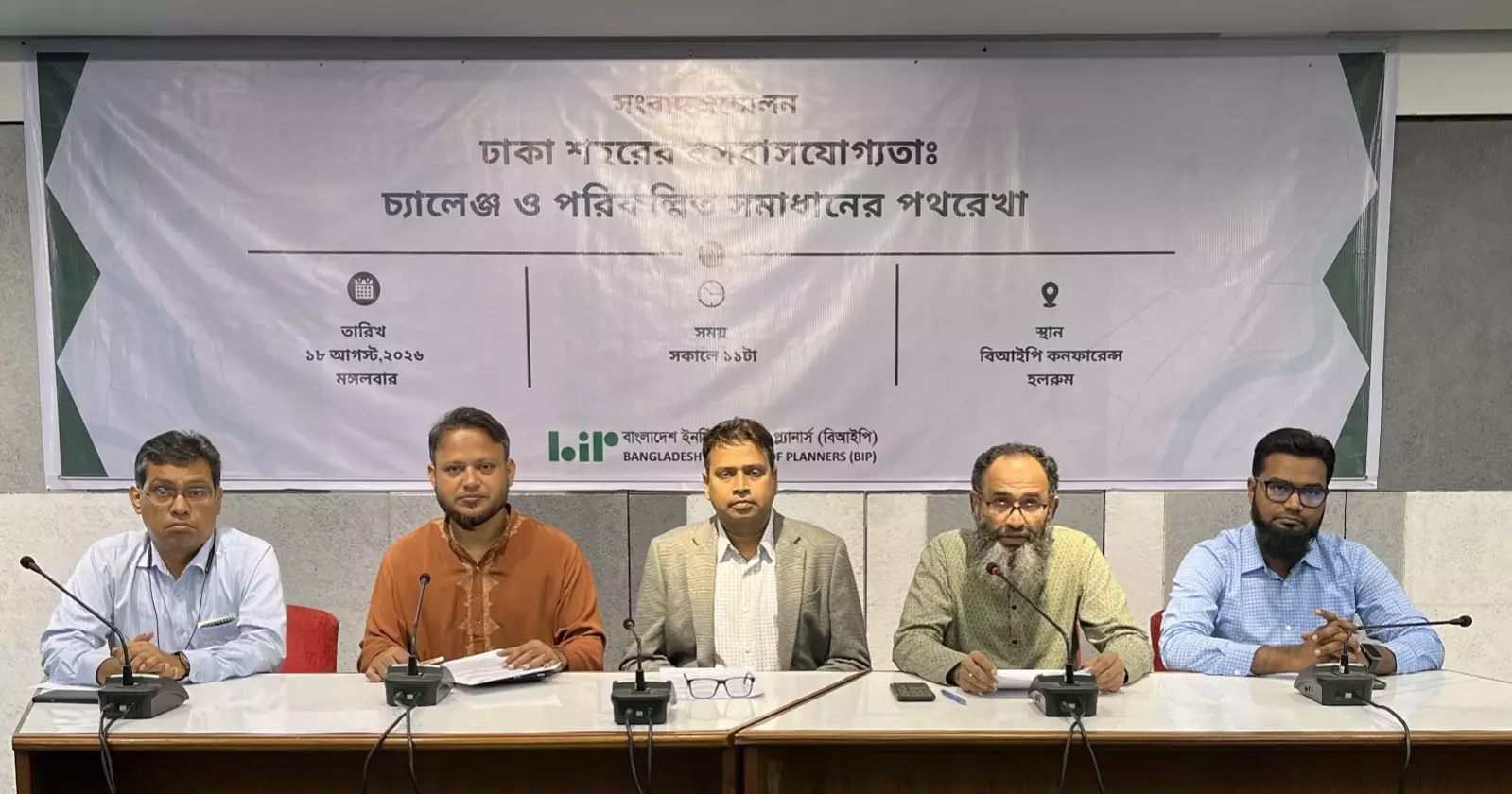
Bangladesh Institute of Planners (BIP) on Tuesday proposed a seven-point roadmap for sustainable urban development, urging the government to make continuity of planning immune to political and administrative changes and to require a mandatory compliance check before approving any development project.
BIP President Muhammad Ariful Islam presented the recommendations at a press conference at BIP's conference hall in Planners Tower.
He said fragmented, short-term and sector-based planning must give way to integrated national and regional spatial planning.
BIP's seven recommendations:
1. Ensuring continuity and full implementation of approved development plans, regardless of political or administrative changes.
2. Preventing any individual, group or institution from altering, undermining or scrapping the basic structure of approved plans for commercial or personal gain.
3. Reviewing planning progress and implementation challenges every five years with planners, experts, government agencies and local stakeholders, while keeping the core objectives of approved plans intact.
4. Replacing fragmented, single-sector and short-term planning with integrated national and regional spatial planning covering land use, transport, environment, housing and the economy.
5. Prohibiting development projects in wetlands, farmland, water bodies and other environmentally sensitive areas where they conflict with approved plans.
6. Making a “Planning Compliance Report” mandatory for every development project before approval.
7. Ensuring that development remains plan-based, integrated and long-term, taking into account future regional needs, environmental balance and the interests of future generations rather than focusing on isolated projects.
BIP General Secretary Mohammad Mosleh Uddin Hasan said the entire country, not just Dhaka, must be brought under a long-term national spatial plan, moving away from short, five-year planning cycles.
Planner AKM Riaz Uddin called for enacting and implementing the Spatial Planning Act to bring all of Bangladesh under integrated planning, along with unified leadership for Greater Dhaka.
Board member Talha Tasnim added that a shared national database would cut duplication in data collection and improve inter-agency coordination in future planning efforts.
The speakers said implementing the recommendations would require sustained political will, institutional accountability and genuine citizen participation.