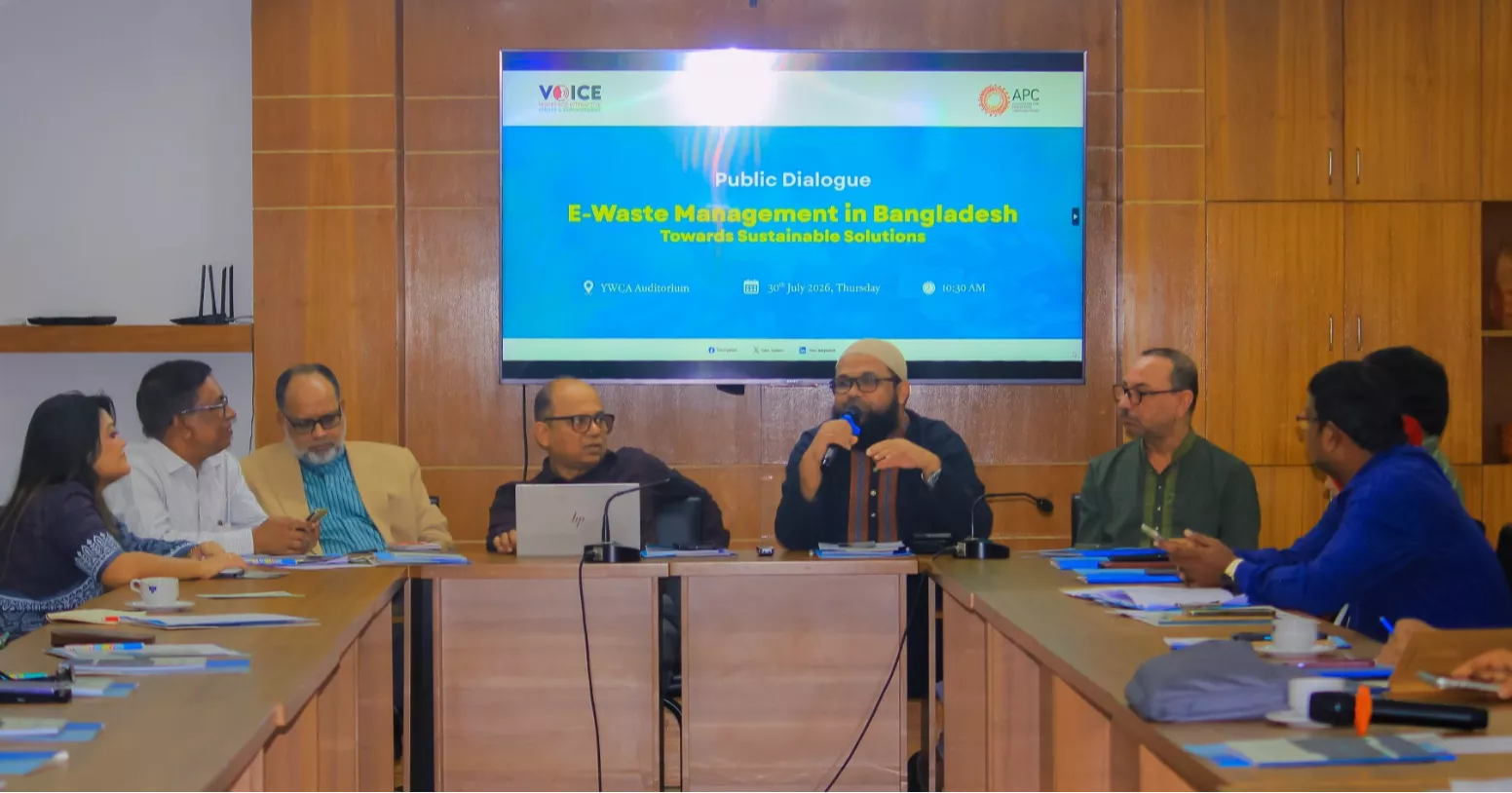
Experts, policymakers and environmental advocates on Thursday called for coordinated national action, stronger implementation and greater public participation to tackle Bangladesh's growing electronic waste (e-waste) challenge, stressing that the country must adopt sustainable and circular economy-based solutions.
The call came at a national public dialogue titled "Electronic Waste Management in Bangladesh: Towards Sustainable Solutions", organised by rights-based advocacy organisation VOICE with support from the Association for Progressive Communications (APC) at the YWCA auditorium in Dhaka.
The discussion focused on strengthening environmental governance, accountability and sustainable e-waste management as Bangladesh's digital economy continues to expand.
According to a recent assessment presented by VOICE, Bangladesh generates around 30 lakh tonnes of e-waste annually, a figure projected to rise to 46.2 lakh tonnes by 2035 if current trends continue.
At present, only about 10 percent of the country's e-waste is processed through 14 formal recycling facilities, while the remainder is handled by the informal sector, raising serious environmental and public health concerns.
Presenting the keynote paper, VOICE Deputy Director Musharrat Mahera highlighted existing policy and implementation gaps and outlined recommendations for improving the country's e-waste management system.
Speaking as the chief guest, Department of Environment Director Mohammed Solaiman Haider said sustainable e-waste management requires collective responsibility beyond government initiatives.
"Every institution must identify its own challenges and take responsibility for addressing them. Alongside government efforts, private investment, decentralised approaches and multi-stakeholder collaboration are essential for sustainable electronic waste management," he said.
Prof Mostafizur Rahman of Jahangirnagar University's Department of Environmental Sciences warned that Bangladesh should prepare for the increasing volume of e-waste generated by renewable energy technologies, particularly solar panels.
He stressed the need for safe recycling systems, stronger research, greater private sector investment and closer collaboration among government agencies, industry and the informal sector.
Consultant (Medical Waste Management) at the Directorate General of Health Services (DGHS) Tarit Kanti Biswas said effective e-waste management requires adequate infrastructure, stronger enforcement and sustainable financing alongside policy reforms and awareness campaigns.
Concluding the event, VOICE Executive Director Ahmed Swapan Mahmud emphasised that public awareness should become a national priority.
He said awareness campaigns, outreach programmes and workshops should be expanded across public and private universities to equip young people with the knowledge needed to adopt responsible e-waste practices and contribute to sustainable management.
Representatives from Citizens' Initiative, Bangladesh Poribesh Andolon (BAPA), Work for a Better Bangladesh (WBB) Trust, recycling companies and media organisations also attended the dialogue.
Participants recommended implementing a coordinated national policy, establishing an effective monitoring mechanism and ensuring active engagement of government, private sector and civil society to build a sustainable e-waste management system.
They also highlighted the importance of promoting environmentally sound recycling practices and advancing circular economy initiatives so that electronic waste can be transformed from an environmental burden into a valuable resource.