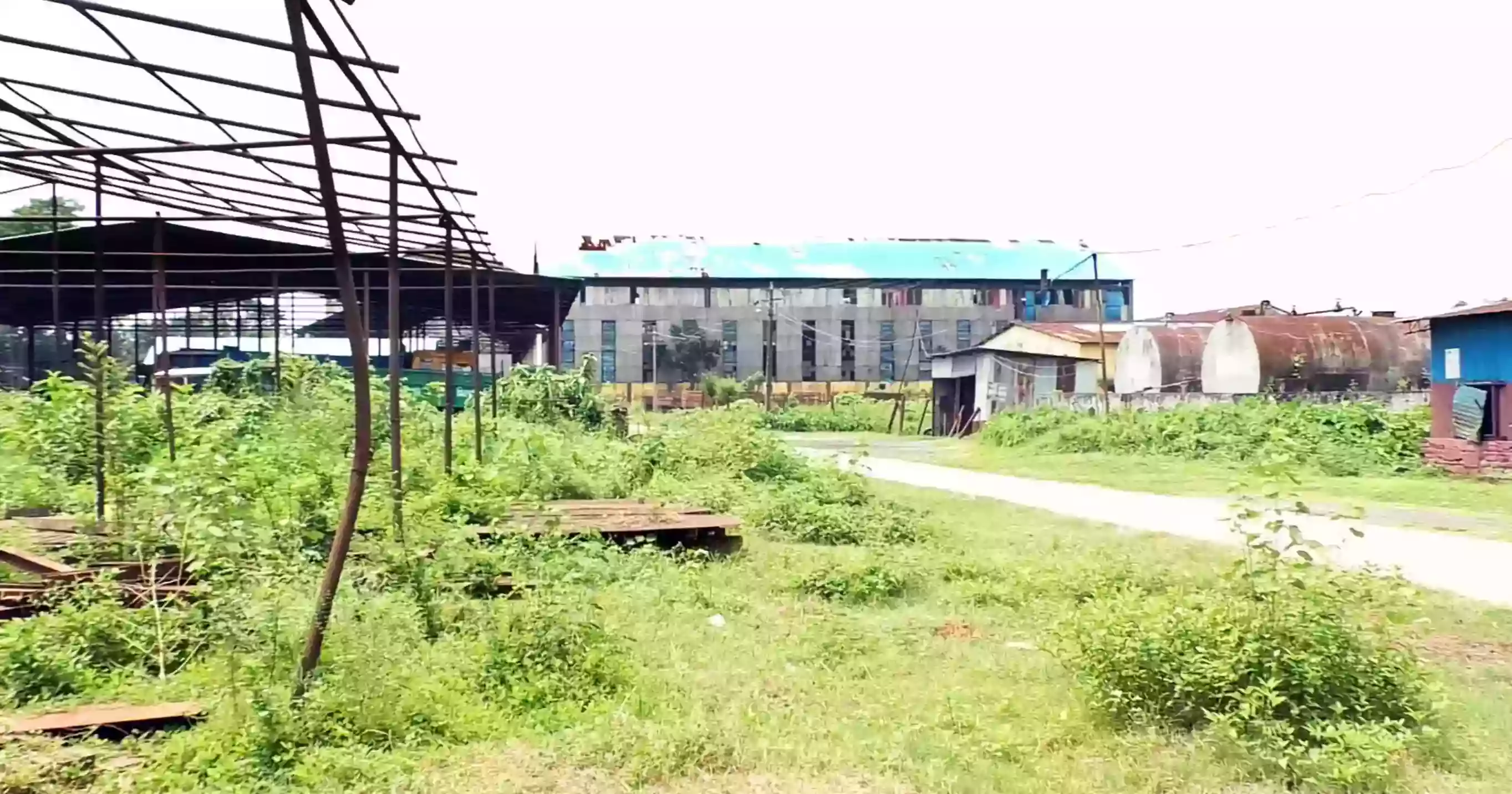
Once a vibrant industrial hub supporting thousands of families in northern Bangladesh, Shyampur Sugar Mills in Rangpur now stands largely silent, its machinery rusting away while the government continues to spend nearly Tk 24 lakh every month despite production remaining suspended since 2020.
The state-owned mill, one of the oldest heavy industries in the region, was shut down during the 2020-21 crushing season following years of mounting losses and declining sugarcane production.
Although the interim government announced plans to revive closed sugar mills and lifted the suspension order in late 2024, local residents, workers and farmers say little visible progress has been made on restarting operations.
Now uncertainty continues to loom over thousands of sugarcane growers, workers and businesses that once depended on the mill for their livelihoods.
Bangladesh Sugar and Food Industries Corporation (BSFIC), a taskforce formed by the interim government, recommended reopening several closed mills including Shyampur Sugar Mills in Rangpur and Setabganj Sugar Mill in Dinajpur.
Based on the taskforce recommendations, BSFIC withdrew the suspension order on December 15, 2024, and proposed phased government financial assistance over three years to resume sugarcane crushing from the 2027-28 season.
However, the revival plan hit a major hurdle when the Finance Division declined a proposal seeking Tk 51.70 crore for Shyampur Sugar Mills during the 2024-25 and 2025-26 fiscal years.
In a response to the Industries Ministry, the Finance Division noted that BSFIC has already received substantial operational loans from the government over the past two decades and described the corporation as a loss-making entity. It also pointed out that the mills had originally been closed to reduce the government’s subsidy burden.
Silent Factory, Continuing Costs
Despite the suspension of production, the mill still employs 63 personnel, including permanent and temporary staff responsible for administration, security and maintenance.
Mill Assistant Manager (Store) Debashish Singha Roy said approximately Tk 24 lakh is spent every month on salaries and allowances.
“Although monthly expenditure is around Tk 24 lakh the mill earns only about Tk 6-7 lakh annually by leasing out some of its land. We still need manpower to protect and maintain the land, machinery, residential quarters and administrative buildings. Otherwise, whatever remains of the mill’s assets may not survive,” he said.
Workers said the closure has transformed what was once a bustling industrial complex into a deserted facility.
“Shyampur Sugar Mill was the economic heartbeat of this area. Thousands of families depended on it,” said Abu Sufian, former general secretary of the Sugar Mill Employees’ Union.
“After the closure, many temporary workers lost their jobs. When the interim government announced plans to restart the mill, people became hopeful. But nearly a year and a half later, no visible initiative has been taken. This is increasing frustration among workers and employees,” he added.
He urged the government to allocate funds in the upcoming budget for modernising and reopening the mill.
Once a Symbol of Industrial Growth
Established in 1964 at Shyampur Bazar in Badarganj upazila, the mill formally began operations in 1967 on 111.45 acres of land.
Designed to crush 1,016 tonnes of sugarcane daily, it had an annual production capacity of 10,161 tonnes of sugar.
Ki For decades, it played a key role in the agricultural economy of Rangpur and surrounding districts.
Although profitable during its early years, the mill started incurring losses after 2000.
Rising bank liabilities, interest payments, employee provident fund obligations and operational inefficiencies reportedly pushed accumulated losses into several hundred crore taka.
A government committee comprising representatives from the industries, commerce, finance and agriculture ministries eventually recommended suspending crushing operations, leading to the mill’s closure in the 2020-21 season.
Management attributed the losses to declining sugarcane cultivation and outdated machinery.
However, workers and farmers disputed that explanation, blaming corruption, mismanagement and inefficient staffing for the deteriorating financial condition.
Impact on Farmers and Local Economy
The closure has significantly affected local sugarcane cultivation.
Fazlul Haque, a farmer from Badarganj, said he stopped growing sugarcane after the mill was shut down.
“While the mill was operating, I cultivated sugarcane regularly. Now I grow paddy, wheat, maize and vegetables instead,” he said.
According to BSFIC officials, around 300 acres of sugarcane have been cultivated this year under the Joypurhat Sugar Mill sub-zone. The harvested cane is being transported to Joypurhat for processing.
BSFIC Assistant Manager (Extension) Zahidul Islam, who oversees Shyampur operations, said reopening the mill would require sustained preparation.
“A sugar mill cannot be run with sugarcane from just one season. Even if funds are allocated this year, it will take at least three crushing seasons to fully restore sugar production operations,” he said.
Local businessman Manik Mia said the closure has weakened the area’s economy.
“Shyampur Sugar Mill was one of the major industrial establishments in this agricultural region. Several thousand families were directly or indirectly connected to it. Many people are now struggling after losing their livelihoods,” he said.
However, the current government has also given assurances over re-opening closed sugar mills.
Industries and Commerce Minister Khandakar Abdul Muktadir has said the current government is determined to reopen the closed state-owned sugar mills.
“But in this (reopening) process, decisions will be made with utmost importance to the factors – the interests of sugarcane farmers and workers, and the long-term profitable operation of the mills,” he said at a view-exchange meeting with sugarcane farmers, arranged by Panchagarh Sugar Mills Limited in Panchagarh recently .