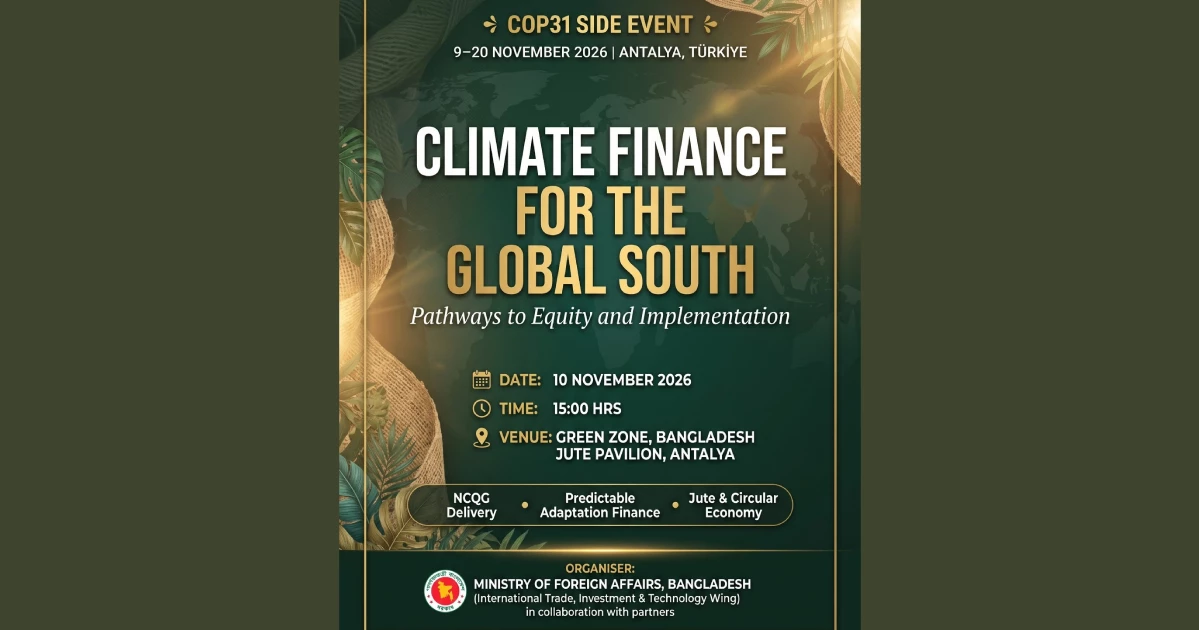
Bangladesh organised a side event at COP31 on Tuesday to call for predictable, grant-based climate finance that matches the scale of the needs in the Global South.
The session, held at the Bangladesh Jute Pavilion in the Green Zone, was organised by the Ministry of Foreign Affairs in collaboration with its partners.
Speakers said the New Collective Quantified Goal agreed at COP29 sets a floor of USD 300 billion a year by 2035 from developed countries, within a wider ambition of USD 1.3 trillion, and that adaptation finance is to be at least tripled. Their concern was delivery. Adaptation needs in developing countries are estimated at around USD 305 billion annually by 2035, while public provision is roughly one-tenth of that.
Public finance still leans toward mitigation and relies heavily on loans rather than grants, and rising debt service is crowding out climate action in many Least Developed Countries and Small Island Developing States. Bangladesh’s own National Adaptation Plan (2023–2050) requires an estimated USD 230 billion, with substantial international support still outstanding.
Bangladesh and fellow Global South voices urged that public finance, led by developed countries, remain central and predominantly grant-based, since private capital has not delivered at the required scale.
They called for finance that is transparent and aligned with national plans rather than donor priorities, a decisive shift away from non-concessional loans with debt relief and SDR channelling in the toolbox, and concrete roadmaps for the USD 300 billion and USD 1.3 trillion goals.
The Fund for Responding to Loss and Damage, they said, also needs credible replenishment.
Speakers stressed that climate finance is not charity but a matter of historical responsibility and equity under the principle of common but differentiated responsibilities and respective capabilities.
The session also showcased Bangladesh’s jute sector as an example of what well-directed finance can support: carbon-negative cultivation, regenerative agriculture and biodegradable plastic alternatives that create jobs and export opportunities. Direct access, South–South cooperation and trade–climate synergies were discussed as practical delivery mechanisms.
Bangladesh said it hopes the exchange will strengthen advocacy for the remaining negotiations, which run until 20 November. Delegates and media are invited to visit the Jute Pavilion throughout the conference.