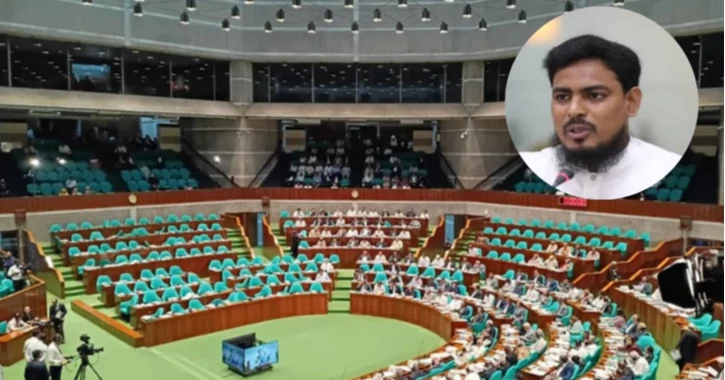
National Citizen Party (NCP) Member Secretary and MP from Rangpur-4 Akhter Hossen on Thursday claimed that the government had increased the country's debt burden by more than Tk 1 lakh crore within four months of assuming office and warned that failure to implement reforms could cost it public support.
Participating in the discussion on the proposed national budget for fiscal year 2026-27 in Parliament, Akhter said the country's total debt stood at around Tk 23 lakh crore when the government took office but had since risen to approximately Tk 24 lakh crore.
NCP’s Akhter demands reform of ‘corroded’ state structure
"Within just four months, the government has trapped the country in an additional Tk 1 lakh crore debt burden," he said.
Questioning the government's commitment to implementing the public mandate delivered through the referendum, the NCP lawmaker said the Finance Minister himself had acknowledged in his budget speech that political reforms were essential to overcome the ongoing economic crisis and repair social damage.
However, Akhter alleged that the ruling party had shown little progress in advancing such reforms.
"The people voted for the formation of a Constitutional Reform Council and for an independent judiciary. Yet the government has not spoken about these issues," he said.
Drawing a parallel with the government's failure to secure expected financial assistance from the International Monetary Fund (IMF), he warned that failure to ensure good governance, democracy and reforms could similarly erode public confidence.
"If reforms cannot be implemented, the ruling party, like the Finance Minister who had to return empty-handed from the IMF, may also have to return to the people," he said.
Akhter urged the government to implement the referendum verdict, establish a Constitutional Reform Council and move forward through proper review and consultation.
He also alleged that the IMF had withheld support because of the absence of meaningful economic reforms.
According to him, the separation of the National Board of Revenue's policy and management wings had been initiated through an ordinance during the interim administration, but the present government allowed it to lapse after taking office.
"Had the government accepted and implemented those reforms, financial management could have improved and perhaps the Finance Minister would not have had to return empty-handed from abroad," he said.
The NCP MP also criticised developments in the banking sector, describing the situation as chaotic.
Referring to the recently enacted Bank Resolution Act, he expressed concern that owners of troubled banks could regain control if they met certain financial conditions.
"Those who drove banks into insolvency, siphoned off money and looted these institutions may again get them back. What benefit can come from returning banks to such owners?" he asked.
Akhter further claimed that Bangladesh's economy had become fragile due to large-scale capital flight and mounting non-performing loans.
Citing a white paper on the Awami League period, he alleged that around $240 billion, equivalent to nearly Tk 30 lakh crore, had been siphoned out of the country.
"Bangladesh's economy is now like a fragile hut. There is little money left inside," he said, adding that default loans had crippled the economy while inflation remained close to 10 per cent.
He also criticised ruling party lawmakers who had claimed that prices of essential commodities had not increased following the budget announcement.
According to Akhter, the government had already raised electricity and fuel prices twice within three months of taking office, triggering broader price increases across the economy.
"When electricity and fuel prices rise, transport costs increase and the prices of all goods go up. The mechanism for increasing prices had already been set in motion before the budget was announced," he said.