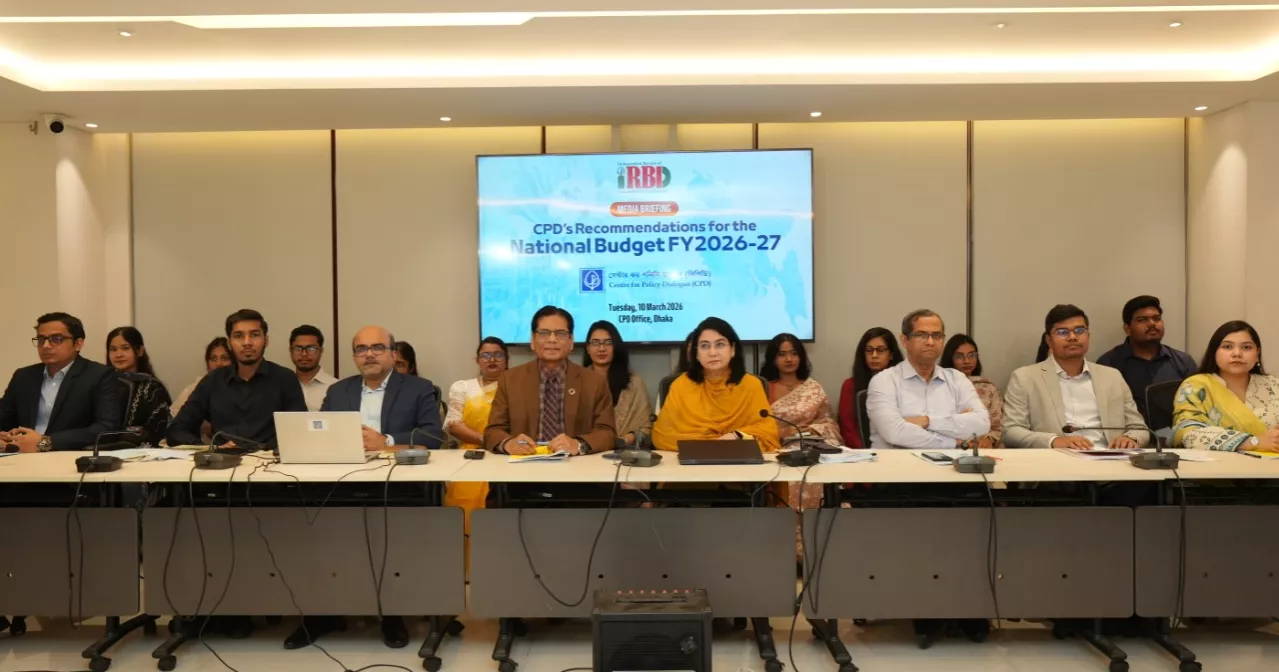
The Centre for Policy Dialogue (CPD) on Tuesday recommended adopting realistic fiscal targets, strengthen revenue mobilisation and prioritise measures to tackle inflation and stimulate investment in the FY2026-27 national budget.
The report, titled “CPD’s Recommendations for the National Budget FY2026-27,” was presented by CPD Executive Director Fahmida Khatun at the organisation’s office in Dhanmondi.
Prepared under CPD’s Independent Review of Bangladesh’s Development (IRBD) programme, the report highlighted the key macroeconomic challenges facing the economy and outlined policy recommendations to guide the fiscal framework of the next national budget.
According to the report, the FY27 budget will be the first for the newly elected government and will be formulated at a time when Bangladesh is facing multiple economic pressures, including high inflation, weak revenue collection, slow budget implementation, rising debt and sluggish investment.
CPD said the upcoming budget should address immediate macroeconomic challenges while also laying the foundation for medium-term structural reforms to stabilise the economy and strengthen resilience.
The think tank pointed out that revenue mobilisation remains a major concern.
Tax collection by the National Board of Revenue (NBR) grew by only 12.9 percent during July-January of FY26 against an annual target of 34.5 percent.
As a result, a significant revenue shortfall of around Tk 60,000 crore was recorded during the period.
CPD warned that such gaps highlight the need for setting more realistic fiscal targets and strengthening domestic resource mobilisation.
The organisation also suggested exploring new sources of revenue, including wealth and property taxation and taxation of the expanding digital economy, while gradually phasing out ad hoc tax incentives.
The report noted that inflation has remained persistently high, with general inflation exceeding 9 percent in early 2026.
CPD said inflation in Bangladesh is largely supply-driven and requires policy responses that address both supply and demand-side factors, including increased food procurement, stronger market monitoring and targeted social protection programmes for low-income households.
The report also raised concerns over declining investment and job creation.
Private investment has fallen to about 22 percent of GDP the lowest in a decade while foreign direct investment remains below 0.5 percent of GDP.
To address this, CPD recommended regulatory simplification, digitalisation of business services, improved access to finance for small and medium enterprises (SMEs), and fiscal incentives for firms creating new formal jobs.
Preparing for external challenges
The think tank also stressed the need for the FY27 budget to take into account several global and structural factors, including Bangladesh’s upcoming graduation from the Least Developed Country (LDC) category, evolving trade agreements and geopolitical tensions affecting global energy markets.
Fiscal planning should also consider possible impacts on trade, tariffs, subsidies and external financing as the country moves toward the post-LDC era, it said.
CPD recommended that the government prioritise spending on agriculture, health, education and social safety net programmes in the upcoming budget to protect vulnerable groups amid rising living costs.
It also suggested reassessing the infrastructure-heavy Annual Development Programme (ADP) and allocating more resources to sectors that support human capital development.
The organisation said a balanced fiscal strategy, combining prudent deficit financing with targeted spending and structural reforms, will be crucial to maintaining economic stability and sustaining growth in the coming years.