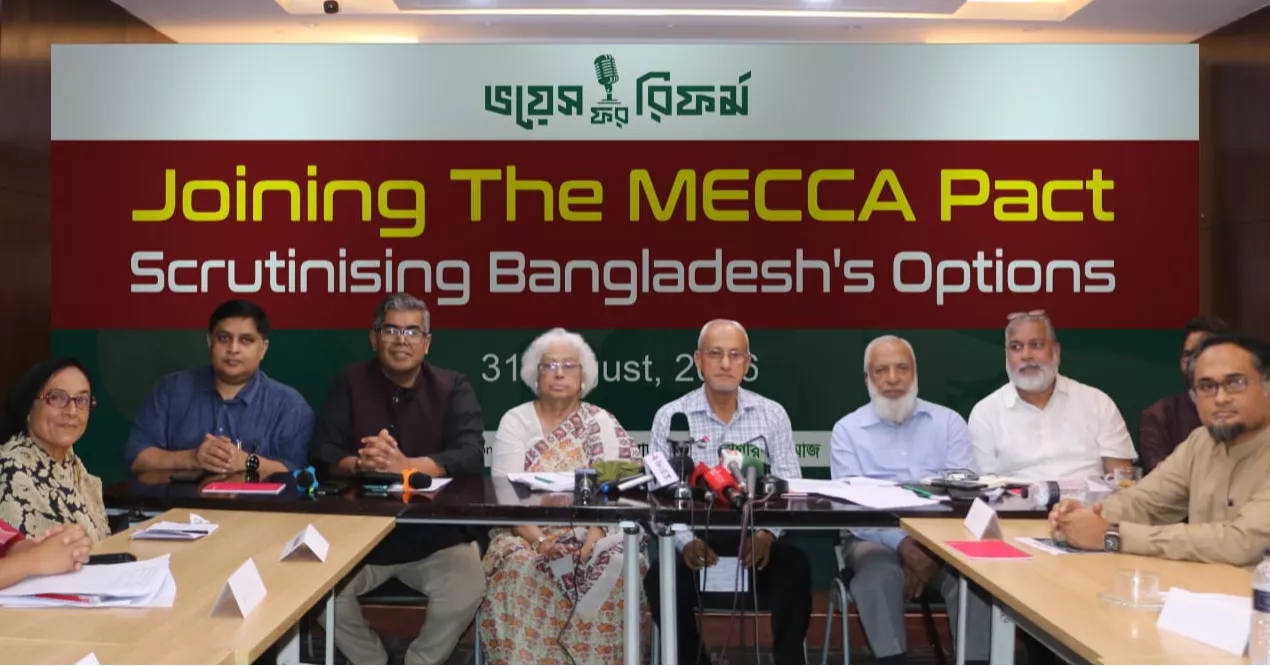
Bangladesh can benefit from joining the “Mecca Pact” if it proceeds with effective diplomatic preparation and political consensus, said international relations expert Prof Shahab Enam Khan, stressing that Bangladesh needs to carefully assess the regional, diplomatic and strategic implications of joining the pact.
“...if we do it with effective diplomatic preparation, with political consensus, it would definitely be good for Bangladesh,” said Prof Khan, Executive Director of the Bangladesh Center for Indo-Pacific Affairs, at a discussion in the city on Monday.
Speaking at a roundtable titled “Joining the Mecca Pact: Sustaining Bangladesh’s Options,” Prof Khan said Bangladesh faces its own security challenges in the Bay of Bengal and the wider region, including instability in neighboring countries and the situation in Myanmar.
“I think it is good that we are having discussions about this and if Bangladesh can join the Mecca Pact, it would be good,” he said.
Foreign Minister Dr Khalilur Rahman on Sunday reiterated that the "Mecca Pact" is an internal matter of the world Muslim family" and that there is no reason for anyone to be upset or worried about this.
“This is not a matter of threatening. This is not a matter of attacking anyone. This is a matter of self-defense of our world Muslim family. So I do not see any reason for anyone to be upset or worried about this,” he said.
Prof Khan of Department of International Relations, Jahangirnagar University, noted that regional organisations such as BIMSTEC and SAARC have so far been unable to provide effective collective security. “So I think Bangladesh can help its neighbouring countries with its own collective security,” he said.
On military interoperability, Prof Khan said Bangladesh should also assess how cooperation among Turkey, Pakistan and Saudi Arabia could evolve.
He said discussions on joint air-defence and avionics capabilities could eventually lead to broader cooperation in military technology, including electronic warfare and common platforms.
Prof Khan said Bangladesh’s diversified defence procurement could put it in a favourable position.
“Bangladesh has diversified its defence system. So there is Turkish diversification, we have Chinese diversification, Russia was once, and now talks are going on with the United States,” he said.
“So Bangladesh actually has nothing to lose here, rather there is an opportunity to benefit here,” he added.
Prof Khan said the biggest challenge for Bangladesh would be its diplomatic capacity to manage relations with different Gulf countries.
He said Dhaka cannot view the issue only through its relationship with Saudi Arabia, given Bangladesh’s broader economic and strategic ties with Qatar, the UAE and other Gulf countries.
“You have LNG relations with Qatar, you have business relations with the UAE, various equations have been created between the Gulf countries,” he said.
The success of Bangladesh’s participation, he said, would largely depend on its ability to negotiate effectively with the different Gulf states.
Prof Khan said the evolving geopolitical equation involving Israel would be another important consideration.
“Many countries have not joined yet. Egypt is thinking about joining, Syria is thinking about joining, and you see a different kind of equation with each of them,” he said.
Fahim Mashrur, co-coordinator of Voice for Reform, moderated the discussion and said discussions on the Mecca Pact have so far been largely confined to political, bureaucratic and diplomatic circles.
“Civil society’s views on an issue as important as national security are also part of the democratic process,” he said.
The roundtable was chaired by political scientist Dr Dilara Chowdhury.
The panelists included former Prime Minister Khaleda Zia’s former security adviser Major General Fazle Elahi Akbar (retd); former US diplomat and former deputy head of the US Embassy in Dhaka John F. Danilowicz; Chairman of the Department of Peace and Conflict Studies at the University of Dhaka Dr Sajjad Siddiqui; Brigadier General Shafayat Ahmed (retd), Principal Research Fellow at FSDS; Brigadier General Hasan Nasir (retd), President of Nexus Defense and Justice (NDJ); former diplomat Shakib Ali; Monira Sharmin, Joint Convener of the National Citizens Party (NCP); Faisal Mahmud, Managing Editor of Daily Waadaa; human rights activist Ruby Ahmadullah; and Syed Hasib Uddin Hossain of Voice for Reform.