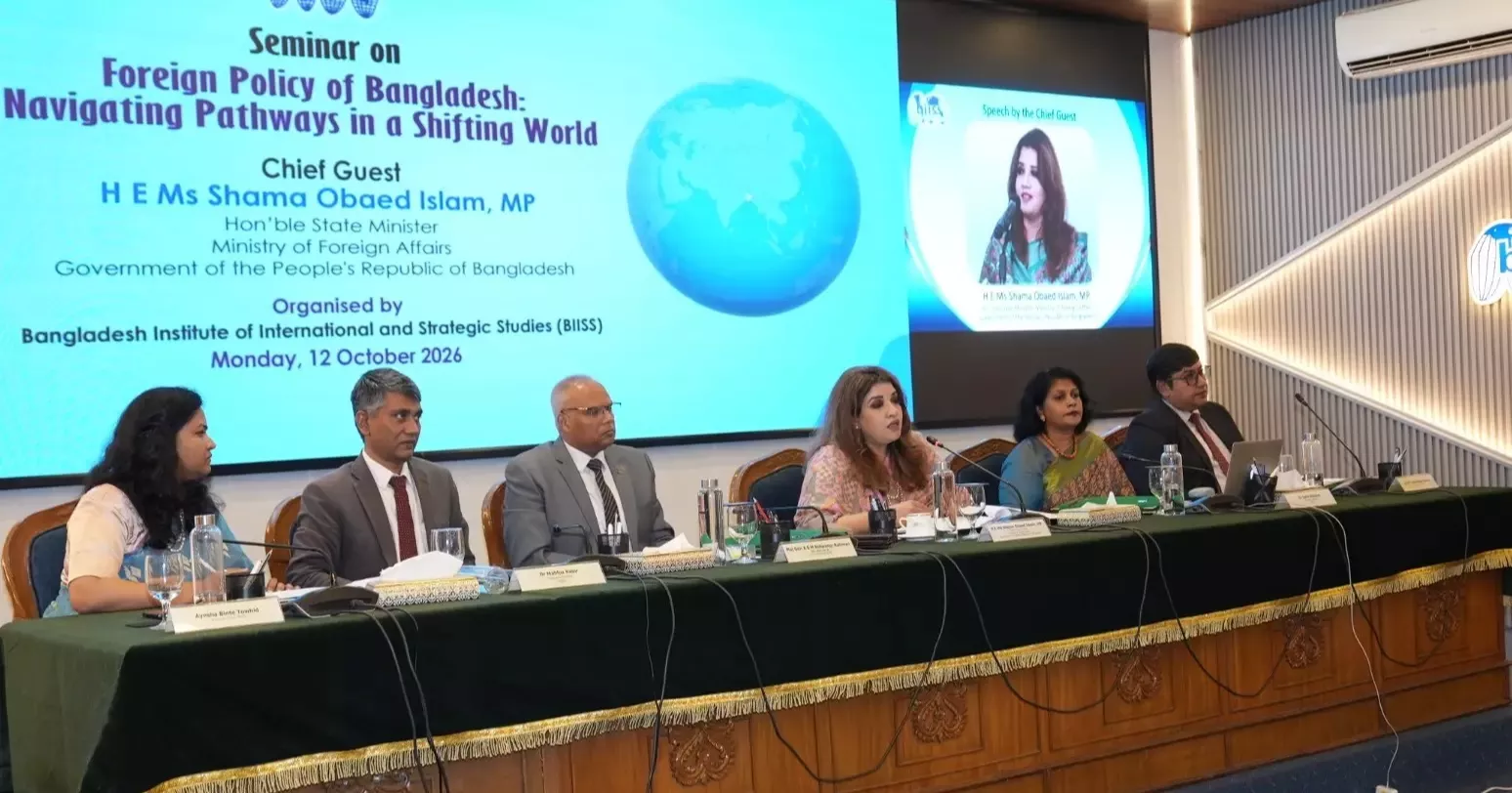
State Minister for Foreign Affairs Shama Obaed Islam on Monday said the regional cooperation remained an important element of Bangladesh's foreign policy, stressing that differences among countries should not prevent them from pursuing areas of common interest.
Bangladesh wants to promote regional peace and stability by expanding trade and economic cooperation, strengthening connectivity, enhancing energy cooperation and addressing transnational challenges through collective action, she said at a seminar in the capital.
Asked about the current situation in India, the State Minister said Bangladesh has no assessment or evaluation to offer at the moment, describing the matter as an internal issue of India.
The State Minister laid particular emphasis on revitalising the South Asian Association for Regional Cooperation (SAARC) and said SAARC could serve as an important platform for dialogue, cooperation and shared development in South Asia.
Alongside SAARC, Bangladesh is working to deepen practical cooperation through the Bay of Bengal Initiative for Multi-Sectoral Technical and Economic Cooperation (BIMSTEC), she added.
The State Minister said their regional diplomacy is guided by clear objective - strengthen mutual trust, and ensure that institutions deliver tangible benefits for the people.
“In this regard, we attach particular importance to revitalising SAARC as a platform for dialogue, cooperation and shared development in South Asia,” she said.
The State Minister said economic diplomacy is the central pillar of Bangladesh’s foreign policy, stressing the need to translate diplomatic engagements into tangible economic opportunities for people.
“Economic diplomacy is the central pillar of our foreign policy. We are determined to ensure that our diplomatic relations translate into tangible economic opportunities for our people through expanded trade, wider investment, access to new markets and stronger international economic partnerships,” she said.
Shama said Bangladesh is pursuing an independent and pragmatic foreign policy guided by national interests, strategic autonomy and the goal of ensuring economic prosperity for its people.
She outlined the government’s foreign policy priorities, including regional cooperation, investment promotion, migration diplomacy, climate justice, multilateralism and the resolution of the protracted Rohingya crisis.
Shama said Bangladesh wants to engage with countries across the world on the basis of mutual respect and shared interests, without compromising its sovereign decision-making.
“This is the essence of strategic autonomy - the ability to engage independently, assess opportunities on their merits and make sovereign decisions in accordance with our national priorities,” she said.
Shama said Bangladesh is seeking to expand partnerships with countries in East Asia, Southeast Asia, the Middle East, Africa, Latin America, Central Asia and Eastern Europe, alongside its traditional partners, including the United States, the European Union, China and Russia.
She said the government wants to explore new avenues of cooperation, particularly in investment, energy, food security, infrastructure, technology, security and skills development.
Migration diplomacy and workers' welfare
Shama said Bangladesh is pursuing proactive migration diplomacy through a whole-of-government approach to ensure safe, orderly and dignified migration.
The government is working to expand legitimate overseas employment opportunities while protecting the rights, welfare and interests of Bangladeshi migrant workers, she said.
Shama stressed that stronger international partnerships were necessary to create more employment opportunities and improve the protection of workers abroad.
Multilateralism and global engagement
The State Minister said multilateralism remained a cornerstone of Bangladesh's foreign policy, describing the United Nations system as an essential platform for countries, large and small, to engage on an equal footing, address shared challenges and advance common interests.
On the Rohingya crisis, Shama said Bangladesh has demonstrated humanitarian responsibility by providing shelter to more than one million displaced Rohingyas who fled Myanmar.
She reiterated that the crisis originated in Myanmar and that a sustainable solution must be found there, with the safe, voluntary and dignified return of the displaced people to their homeland.
Shama said Bangladesh would continue working with the United Nations, regional partners and the wider international community to intensify efforts towards resolving the crisis.
She stressed the need for an effective roadmap for the sustainable repatriation of the Rohingyas, an end to violence against civilians, predictable humanitarian assistance, justice and accountability, and stronger international cooperation to combat transnational crimes.
Shama said the prolonged displacement is placing a significant burden on Bangladesh and host communities, adding that the ultimate objective should be to end the crisis rather than merely manage its consequences.
Shama said Bangladesh's foreign policy would focus on strengthening cooperation through bilateral and multilateral platforms and pursuing balanced, confident and effective diplomacy.
She said the success of the country's foreign policy should be measured not simply by the scale of its international engagements but by their contribution to national prosperity.
“Our government is committed to translating diplomatic engagement into measurable national gains, partnerships into prosperity and our international relations into greater opportunities for our people,” she said.
Bangladesh Institute of International and Strategic Studies (BIISS) organised the seminar titled “Foreign Policy of Bangladesh: Navigating Pathways in a Shifting World” at the BIISS auditorium.
BIISS Director General Major General A S M Ridwanur Rahman began the session with welcome remarks and chaired it.
Four papers were presented by BIISS researchers Dr. Mahfuz Kabir, Research Director, Dr. Sufia Khanom, Research Director, ASM Tarek Hassan Semul, Research Fellow, and Ayesha Binte Towhid, Research Fellow.
The speakers explored the importance of advancing a national interest-driven foreign policy responsive to emerging geopolitical realities while safeguarding national sovereignty and strategic autonomy.
Particular emphasis was placed on aligning foreign policy with contemporary defence and security priorities to address emerging challenges and preserve regional stability.
The programme examined ways to prioritise Bangladesh’s economic interests within an increasingly uncertain multilateral system, notably amidst the rapid growth of AI, with a view to strengthening economic resilience and expanding international cooperation.
Significance of upholding ideological commitments and principled values in shaping a consistent credible foreign policy was underscored.
Discussions stressed on the need of building a balanced, pragmatic, and forward-looking foreign policy framework that would advance Bangladesh’s national interests while reinforcing its role as a responsible actor in the global arena.
Senior officials from different ministries of Bangladesh, foreign diplomatic missions, media, businesspeople, teachers and students from various universities, researchers, representatives from various think tanks were present.