
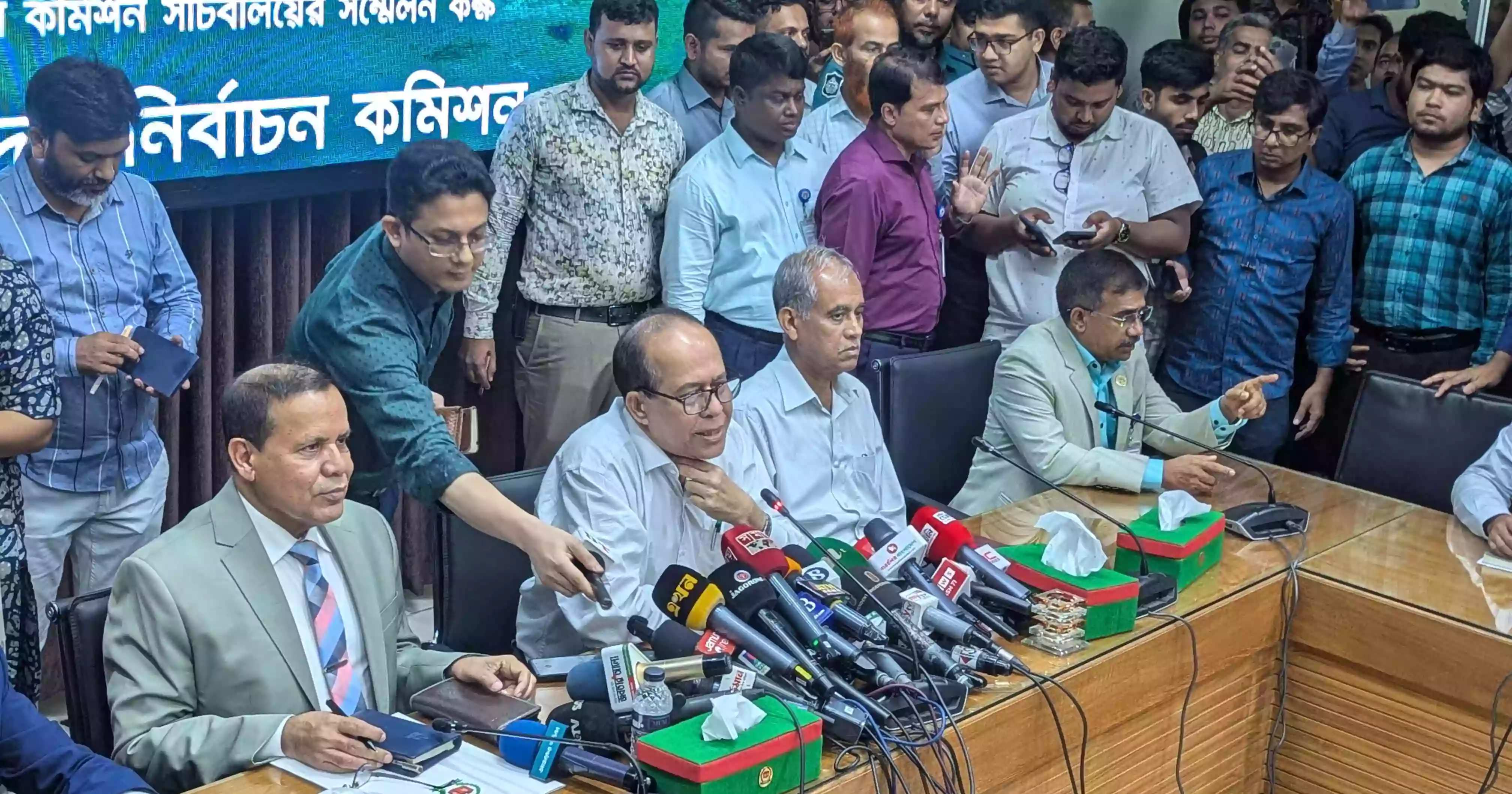
Chief Election Commission Kazi Habibul Awal on Thursday announced the resignation of the five-member commission.
The CEC made the announcement at a press conference in the Nirbachon Bhaban this noon a month after the fall of the Awami League government in the face of a student-led mass upsurge. The EC was formed during the AL regime.
“In this changed situation in the country, I and other commissioners have decided to step down. We’re handing over our resignation letters to the EC Secretary to send these to the President,” said the CEC.
He read out a written statement and left the press conference, not responding to any question from reporters.
Two election commissioners Md Alamgir and Md Ahsan Habib Khan were present, but other two commissioners Rashida Sultana and Anisur Rahman were not present at the press conference.
A group of people were demonstrating against the commission outside the Nirbachan Bhaban during the announcement of their resignation. They were seen chanting different slogans against the outgoing election commission. The army personnel took position inside and outside the Nirbachan Bhaban.
The Kazi Habibul Awal-led election commission started it five-tenure on February 27, 2022 and conducted the 12th parliamentary election and many local body elections.
Election can be held in phases under nonpartisan caretaker government: Outgoing CEC
Kazi Habibul Awal proposed holding the general election in phases under a non-partisan caretaker government to achieve the desired goal.
He also proposed holding the party-wise proportional representation election and ensuring the optimum use of technology in the election.
He said they think it is their duty to place some proposals in light of their experience, knowledge and understanding, gleaned from the present and past, for the consideration of the government in future.
Placing the first proposal, he said, “Bangladesh can be an ideal field for proportional representation (party-based) elections due to the homogeneity of the population of Bangladesh.”
The (national) election can be held in four or eight phases with a 3-5-day gap between the two phases, which will be easy and helpful and for electoral management, the outgoing CEC said in the second proposal.
Raising the third proposal, he said it will be better if the optimized use of technology can be ensured in the electoral process, continuing the online nomination submission system introduced by them.
In the final proposal, Habibul Awal said if each general election is held under a non-partisan caretaker government, the goal will be achieved.
Last general election was controversial since it was not inclusive: Outgoing CEC
The outgoing CEC said the last general election drew controversy logically as it was not an inclusive one.
“Since the election was not inclusive in terms of participation of the political parties, it has been controversial. It is correct and logical,” he said, adding that his commission conducted elections and by-elections in a total of 318 constituencies.
He said since it was actually a one-party election, there was no need for vote-rigging and exercising influence from the government-level.
“The election was held within the party. It was within not between (the parties),” said Kazi Habibul Awal.But in the 53-year history of Bangladesh, there is no instance that any election commission voluntarily resigned, canceling an election by ignoring the constitution, he said.
The CEC said the Commission has conducted elections (including by-polls) in 992 Union Parishads, 496 Upazila Parishads, 71 Zilla Parishads, 90 municipalities, and 16 City Corporations in the last two years.
“There was no widespread controversy or criticism about the integrity, completeness, and impartiality of the elections as in the past,” he claimed.
Habibul Awal said his commission has tried to arrange all the elections with caution, considering the disputed and questionable matters in all past elections since 1973, including the 2008, 2014 and 2018 polls.
“The members of the commission have performed their duties following the constitution,” he said, recalling with gratitude that his commission got the necessary cooperation from media, administration, law enforcement, armed forces and others.
Focusing on the country’s election history, he said his commission members have carried out the responsibility following the constitution.
Citing that conducting elections is a very difficult task, the outgoing CEC said all faults or liabilities for failure to hold credible elections are given solely on the shoulders of the Election Commission.
“A commission may be either dishonest or biased. But all commissions can’t be dishonest or biased all the times. The commission may be unable to make an election flawless and credible for various reasons,” he said.
He said they believe that free and impartial elections freed from black money, muscle power, influence of administration and police won’t be ensure by only reshuffling the election commission.
Habibul Awal said fundamental reforms in the electoral system would be required. “Changes will be required in political culture and behavior and especially in the behavior of candidates,” he said.
With the announcement, the EC led by Habibul Awal broke silence for the first time since former Prime Minister Sheikh Hasina was ousted on August 5. It didn’t take any initiative to conduct any local body election in the last one month.
However, the CEC wrote an article in a Bengali daily on August 24 claiming that the Election Commission is in a crisis amid the successful post-revolution constitutional situation.
The current commission drew strong criticism from various quarters including BNP and other political parties for holding the lopsided general election on January 7, 2024, which created the way for Awami League to go to power for the fourth consecutive term.
Different local body elections held under his commission were also questioned by different political parties.
On February 27, 2022, former secretary Kazi Habibul Awal took the charge of the Chief Election Commissioner, while four others -- former district and sessions judge Rashida Sultana, Brig Gen (retd) Md Ahsan Habib Khan, and former secretaries Md Alamgir and Anisur Rahman, took the charges as election commissioners.
The current commission was constituted through a search committee for the first time under a law mandated by the constitution. The search committee held a series of meetings with eminent citizens and civil society representatives and sought names from the registered political parties for the posts.
A number of political parties including Awami League gave the names, but BNP and some other political parties didn’t send any name to the search committee.